About Berberis empetrifolia Lam.
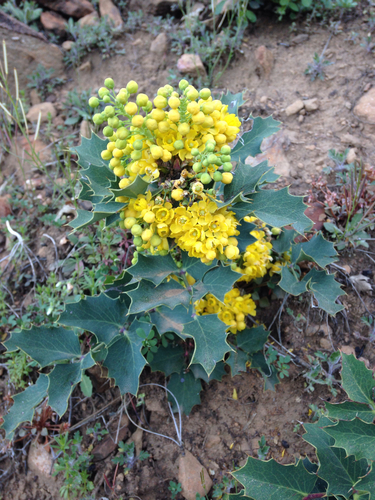
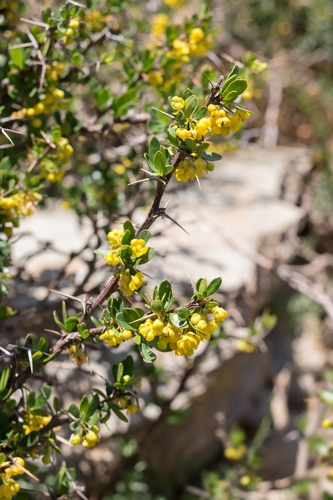
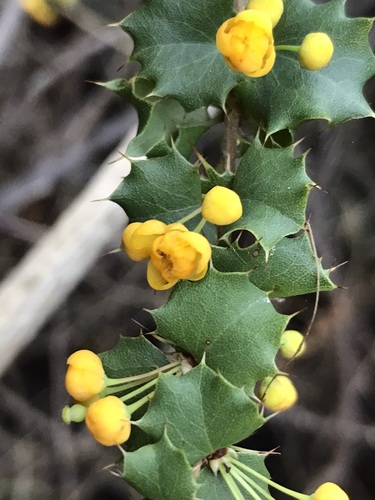
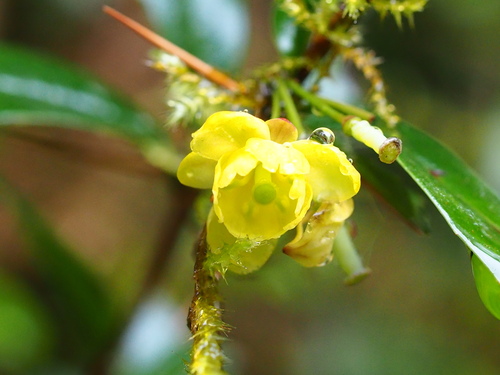
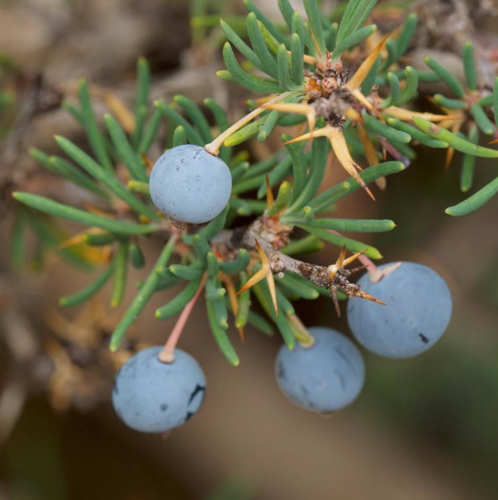
Heath barberry (Berberis empetrifolia Lam.) is a low shrub that reaches up to ½ meter high and over 1 meter wide when growing in the wild. Mature twigs are warm brown, with 3-branched, flattened, light brown spines measuring 1 to 1½ cm long located under each short side shoot. Its thick, narrow leaves are semi-deciduous and linear in shape, 1–2 cm long, with a somewhat bluish-green color. Leaves have entire, rolled-under margins, and pointed, often purplish tips that may later die back to a light brown. Flowers are radially symmetrical, about ½ cm across, and bloom late in spring either individually or in small umbels. They are yolk yellow with a subtle orange tint. Like other Berberis species, the tepals are arranged in four whorls of three to five, and are equal in shape and color, making it difficult to distinguish sepals from petals. Each filament has a tooth on each side near its upper end, where the anther attaches. The fruit is a globose, blue-black berry approximately 7 mm in diameter. This species is native to southern Argentina and Chile, where it grows up to subalpine or alpine elevations in the Andes among rocks, and reaches its largest size in stable scree. Berberis empetrifolia is adapted to harsh microclimates, and typically grows in sites including the stormy beaches of Chile’s southern islands and inlets, the consistently drying winds of Patagonia (such as in Aysen), and rocky Andes slopes. The berries are eaten by wildlife, including the lizard Liolaemus belii. Research shows the seeds are adapted to gut passage: both germination speed and total final germination rate are higher after passing through a lizard’s gut, a change possibly caused by abrasion of the seed’s waxy layer within the gut. This interaction not only allows seed dispersal over a wider area, but also lizards often defecate on bare soil, which improves the chance of seedling survival. Like all barberry species, the rhizomes of Berberis empetrifolia contain berberine, an alkaloid salt with antibacterial effects, antitumour activity, and beneficial impacts on diabetes and cholesterol levels. Because berberine is not easily absorbed by the body, oral treatment against enteric infections such as bacterial dysentery can be effective without causing serious harm to other parts of the body. The berries of heath barberry are edible raw or cooked, and can be used to make jams after seeds are removed. All other parts of the plant are poisonous. It is sometimes planted as an ornamental; when grown in good soil, it can eventually grow larger than its wild size, exceeding 1 m in height and 2 m in width.