About Benstonea monticola (F.Muell.) Callm. & Buerki
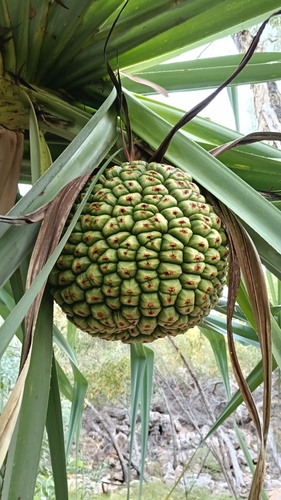
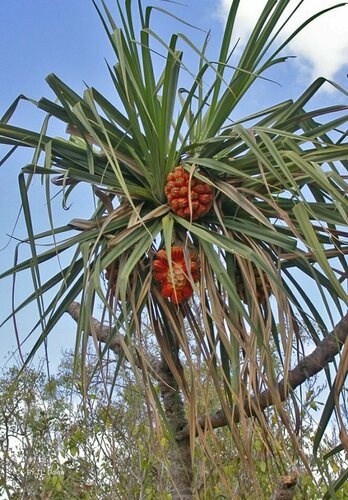
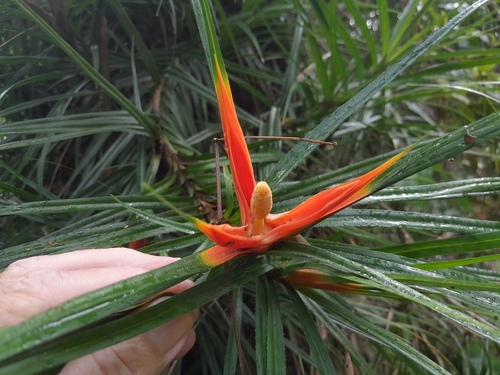
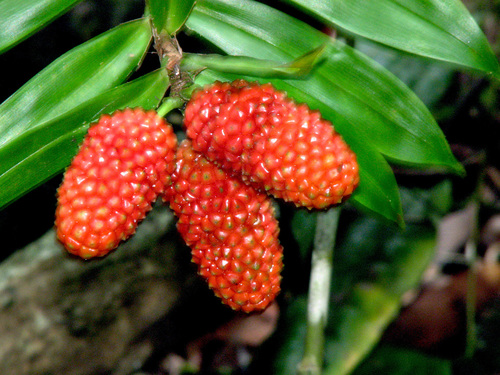
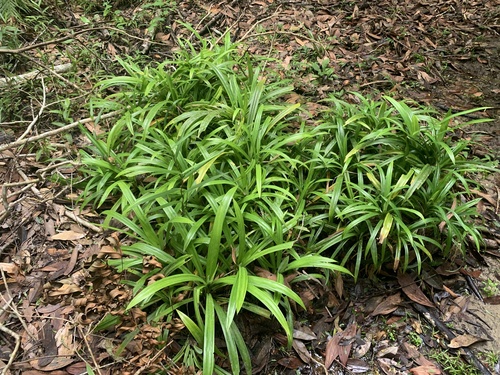
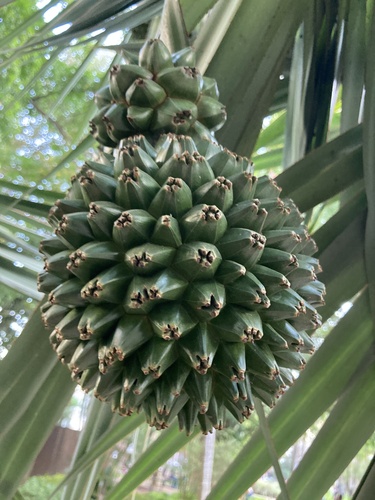
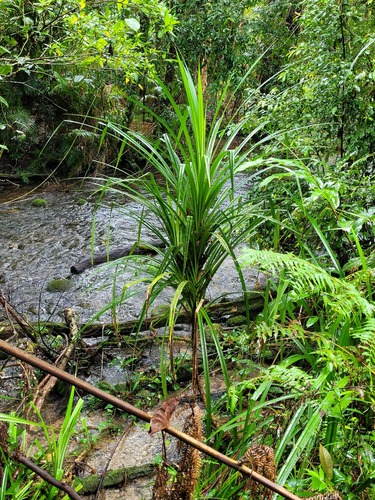
Commonly known as scrub breadfruit, Benstonea monticola is an evergreen shrub or small tree that usually reaches 3 to 6 m (9.8 to 19.7 ft) in height, and may rarely grow as tall as 10 m (33 ft). It produces multiple weak stems that become decumbent as they age: the stems lean to one side, eventually lying on the ground with only their growing tip remaining erect. Stems are approximately 5 cm (2.0 in) in diameter, and this species lacks the prop roots seen in many other members of the Pandanaceae family. Leaves are tightly clustered in a spiral arrangement at the growing tip of the stem. They are very long and narrow, reaching up to 2.5 m (8 ft 2 in) long and 5 cm (2.0 in) wide, and grow from an upward-pointing to an arching orientation. The upper leaf surface is dark green, while the lower surface is a lighter green. Leaves are pleated to form an M-shaped cross-section, with small spines along the leaf margins and on the underside of the leaf midrib. This species is dioecious, meaning functionally male and functionally female flowers grow on separate individual plants. Its inflorescence is a terminal spike, enclosed by large creamy-white bracts. The fruit it produces is a multiple fruit, a single structure formed from the merged maturing ovaries of a flower cluster, distinguishing it from an aggregate fruit. The fruit is orange-red to bright red, roughly spherical to slightly egg-shaped, and measures up to 12 by 12 cm (4.7 by 4.7 in). Each fruit contains more than 300 segments, each around 3 cm (1.2 in) long by 0.4 cm (0.16 in) wide, with a persistent style at the tip of each segment. Scrub breadfruit is naturally distributed from the Cedar Bay area (now part of Ngalba Bulal National Park) south along the coast to Hinchinbrook Island, and inland to the Atherton Tablelands. It grows preferentially in rainforest habitats, at elevations ranging from sea level to around 800 m (2,600 ft). Benstonea monticola is a host plant for the peppermint stick insect (Megacrania batesii), alongside Pandanus tectorius and Pandanus solms-laubachii. The peppermint stick insect shelters in the central hollow of Benstonea monticola leaves and feeds on the leaves. The species' fruits are eaten by cassowaries (Casuarius casuarius) and giant white-tailed rats (Uromys caudimaculatus).