About Bembecia ichneumoniformis (Denis & Schiffermüller), 1775
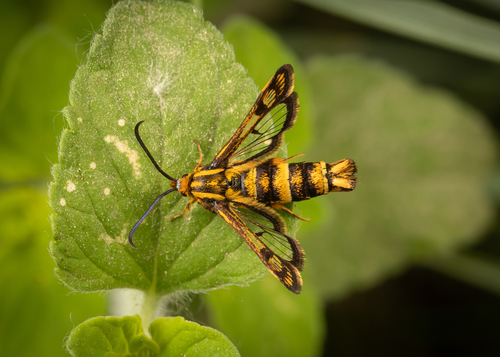
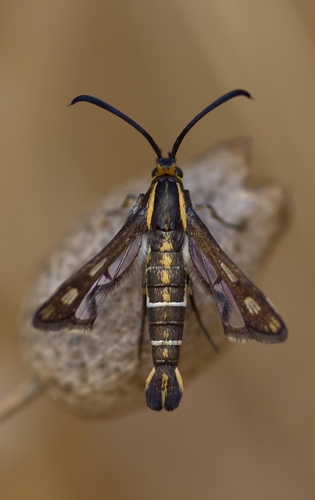
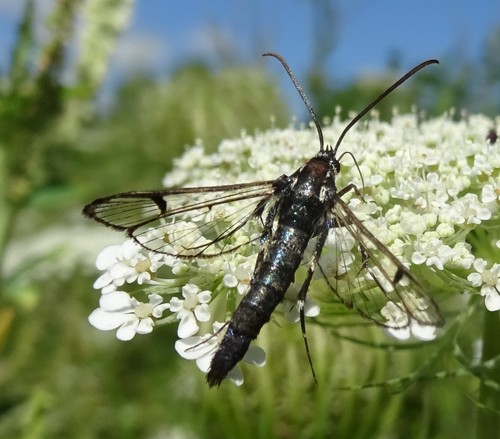
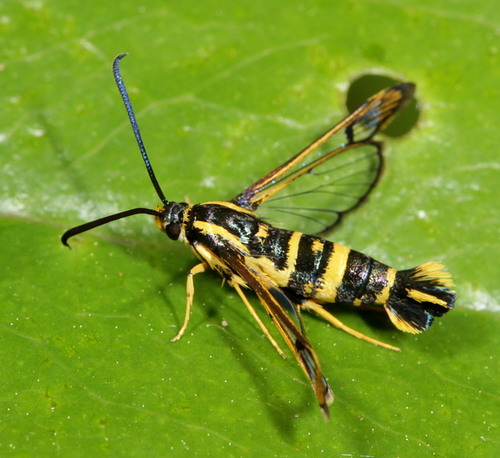
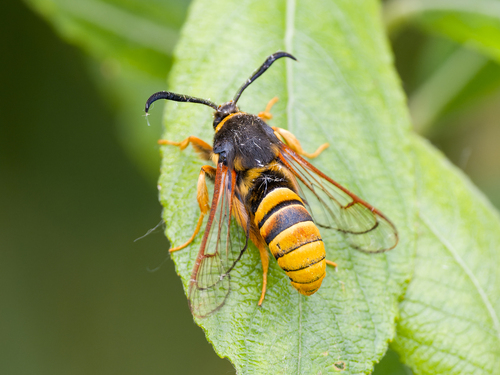
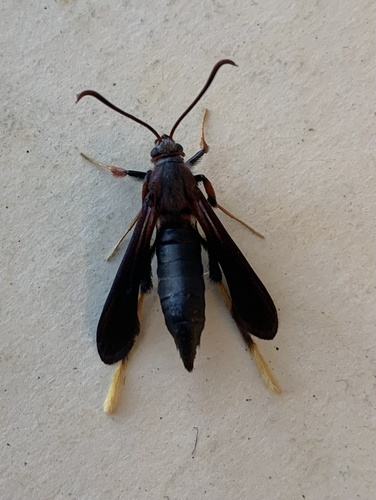
Bembecia ichneumoniformis, also known by the common name referencing its abdominal yellow bands, is a moth in the family Sesiidae. Its wingspan ranges from 15 to 21 millimetres (0.59–0.83 in). The moth's body is black. Males have six narrow, transverse yellow bands on the abdomen, while females may only have five yellow bands. Its antennae are relatively thick: male antennae are typically black, while female antennae are either black with an ocher (yellowish-brown) band, or predominantly ocher with a black tip. The forewings have a distinct pattern: a yellowish or orange apex, a yellow-orange spot that separates two transparent regions, and brownish-orange margins. A key identifying feature is the abdominal brush, which is black with yellow lines. The legs are yellow. This species looks very similar to many other Bembecia species, including Pyropteron muscaeformis, Bembecia scopigera, and Bembecia albanensis. It can be distinguished from similar species by consistent small traits: male Bembecia albanensis lack an inward point on the forewing discal spot, and their hindwing discal spot is yellowish; female Bembecia albanensis always have a solid yellow anal brush. Male Bembecia megillaeformis only have three yellow abdominal rings, while females have four. Bembecia uroceriformis always has a solid yellow abdominal brush. Bembecia illustris has an overall lighter body coloration. Because the external distinguishing traits between Bembecia ichneumoniformis and these similar species are very subtle, reliable identification should be done by specialists, and genital morphological analysis is recommended for a confirmed assignment. Like all sesiid moths, this species resembles a hymenopteran (rather than a lepidopteran) in both appearance and flight. Its wings have large transparent, scale-free areas, and are narrower and more elongated than the wings of moths from most other butterfly and moth families. The specific epithet ichneumoniformis refers to the fact that its shape, coloration, and wing structure resemble ichneumonid wasps rather than a butterfly. Researchers believe the alternating yellow and black body bands protect this species from predators, which associate this color pattern with stinging, venomous insects like wasps and bees. This species occurs across most of Europe, as well as in Asia Minor, the Caucasus, northern Iran, and the Near East. It prefers habitats with calcareous soils, including sea-cliffs and quarries.