About Bellastraea aurea (Jonas, 1844)
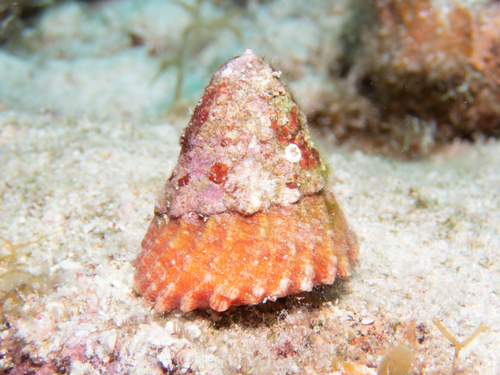
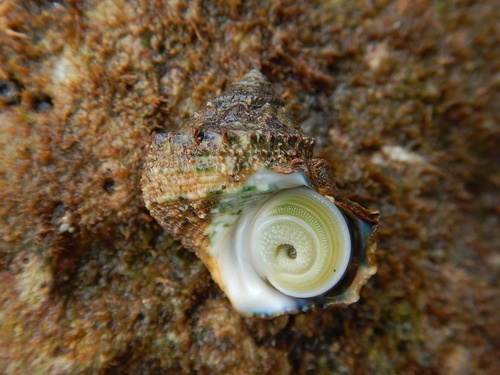
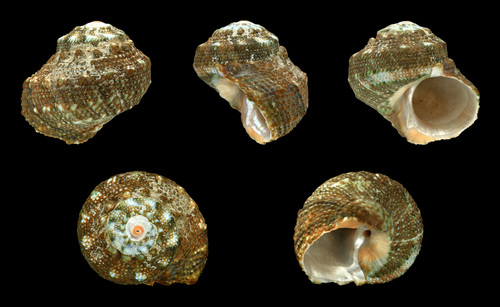
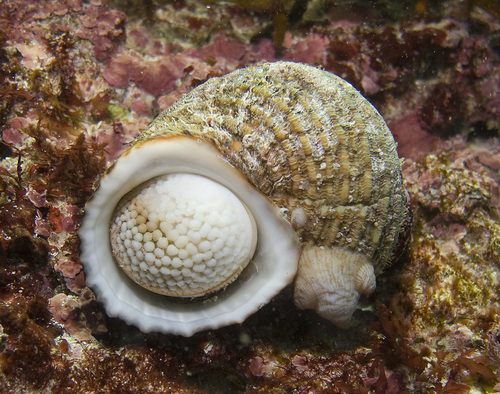
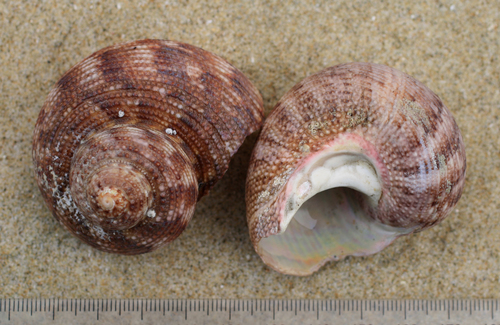
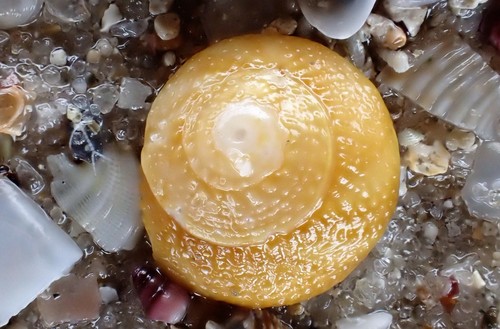
The shell of Bellastraea aurea measures 10 mm to 14 mm in height, and 12 mm to 19 mm in diameter. It is a small, solid, imperforate shell with a depressed-conic shape, and its color ranges from golden yellow to olive. The low-conic spire holds five whorls that are barely convex on the upper portion, and folded at the sutures. These folds grow fainter, and frequently split into two branches as they approach the shell's periphery. The whorls are marked with spiral ridges (called lirae): the lirae on the lower portion of the whorls are rather coarse and beaded, while those on the upper portion are finer, cutting the folds into small granules to varying degrees. The body whorl generally slopes downward toward the aperture, and is compressed toward the periphery, which is subangular except in large adult specimens. The oblique aperture is rather small, and pearly white in color. The columellar callus is expanded over the umbilical region, where it is hollowed out, and has an indistinct small tooth near its base. This is a marine species that is endemic to Australia. It is found in the shallow subtidal zone off the coasts of South Australia, Tasmania, Victoria, and Western Australia.