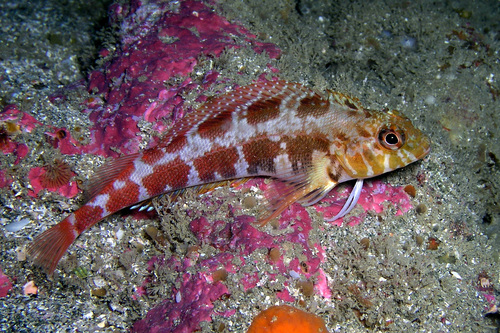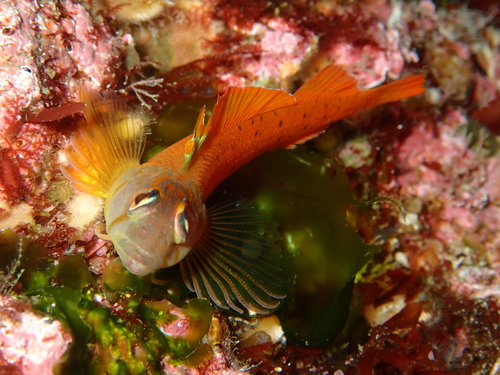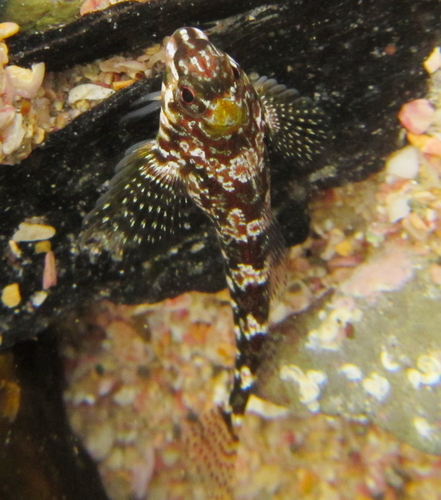
About Bellapiscis lesleyae Hardy, 1987
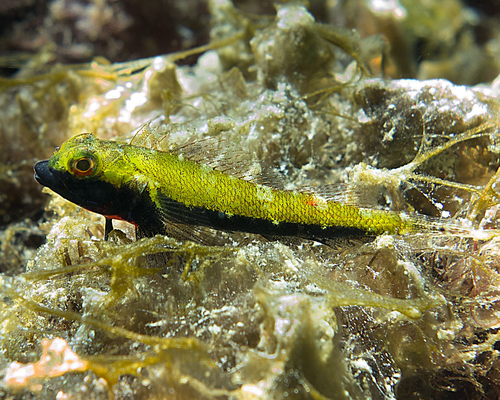
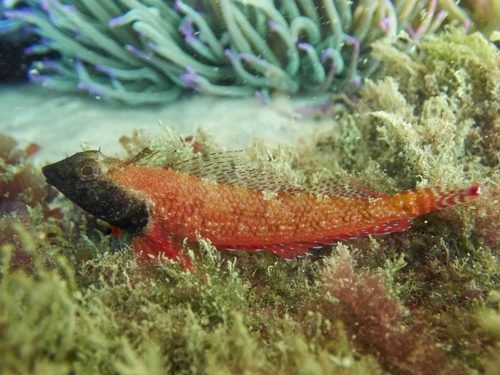
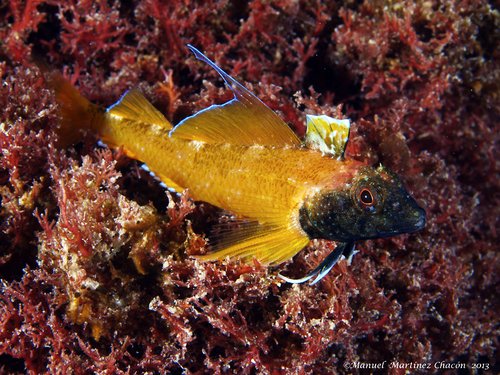
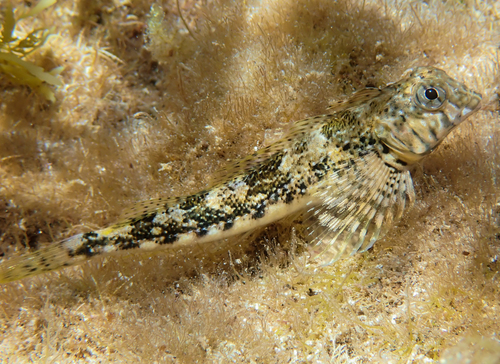
Adults of Bellapiscis lesleyae can reach a maximum total length of 6 cm, and individuals grow to 5 to 5.5 cm by the end of their first year of life. This species has a spindle-shaped body connected to a head with a concave dorsal profile. B. lesleyae has three dorsal fins, with a total of 18–22 spines and 10–15 soft rays. It has a single anal fin that has 2 spines and 17–22 soft rays. The pelvic fins each contain 1 spine and 3 soft rays, while the pectoral fins each have 15–18 soft rays. B. lesleyae has mottled body colouration: its head and body range from whitish to brown, and are patterned with dark spots and saddle-shaped markings. The pectoral, dorsal, and caudal fins are translucent, the sides of the body bear dark oblique bands paired with matching white streaks, and the fin rays carry dark brown or black spots. The entire body of B. lesleyae is covered in numerous overlapping ctenoid scales, which have comb-like edges; these scales provide greater body movement flexibility than other scale types. Sexual dimorphism is not prominent in this species. However, when spawning, females of the same body size as males have a wider and deeper body than males, and males develop intense red colouration during courtship to attract females. No other consistent distinct differences exist between male and female B. lesleyae. Several morphological and colour traits distinguish Bellapiscis lesleyae from its sister species B. medius. B. lesleyae has larger pectoral fins and a lower caudal peduncle than B. medius. B. lesleyae has an irregular checkerboard body pattern that extends onto its belly, while B. medius has a more cryptic, uniform body pattern that does not extend to the belly. During spawning and mating, male B. lesleyae develop bright red colouration on the first dorsal fin and the upper portion of the pectoral fins, a trait that has not been recorded in male B. medius. Individuals of B. medius also have more prominent gills than B. lesleyae, as B. medius is adapted to lower oxygen environments and relies more heavily on gill respiration. Ecologically, B. medius occupies the upper intertidal zone, while B. lesleyae occurs in the lower tidal zone. Bellapiscis lesleyae is endemic to New Zealand. Its recorded distribution extends from the far northern Three Kings Islands, south to include the Chatham Islands and Stewart Island, and it is found on both the east and west coasts of New Zealand as well as south of Fiordland. This species prefers shallow, highly sheltered habitats, most commonly tidal rock pools between 0 and 5 m deep, in surge zones with mixed algae and shallow encrusting algae. B. lesleyae lives in the lower tide zone and is capable of facultative breathing by gulping atmospheric oxygen. The annual breeding season for B. lesleyae runs from May to September. This species does not form monogamous mating pairs, and females take no part in brood care. Males court females through aggressive territory defence displays and visual colour displays, which occur at the start of the breeding season; males lure one or more females into their established territory, and females prefer larger males that give more attractive displays. B. lesleyae reproduces via external fertilization. Males provide a suitable substrate for females to deposit their eggs, which must offer shelter and protection from disturbance and predation. After a female deposits her eggs on the selected substrate, the male releases sperm to fertilize the eggs. Females lay egg batches containing from hundreds to thousands of eggs, and a single nesting site may hold eggs from multiple females. Documented observations of nesting habitat use in triplefins including B. lesleyae show this species selects fine-scale microhabitats for nesting, such as the sides of rocks or boulders, the undersides of overhang roofs, and empty barnacle shells. Overhangs reduce exposure to predators, while rocks and boulders provide gentle currents that oxygenate eggs without dislodging them. B. lesleyae eggs have external filaments that allow them to adhere to a wide range of structures. Territorial males guard the nesting site after fertilization. B. lesleyae can live up to 3 to 4 years, and up to 3 to 4 generations can occur within a single year. B. lesleyae eggs hatch into planktonic larvae, which float in the water column during their pelagic phase before drifting to the seabed to settle into their adult habitat. In their late growth stage, larvae have highly developed sensory systems, and are competent to settle: they can respond to reef sounds, chemical cues, and floating objects. Larval settlement timing varies between individuals, and a lack of suitable habitat can delay settlement, meaning some larvae remain in the pelagic phase longer than others. The average pelagic larval duration for B. lesleyae is 55.6 days, and can range from 41 to 114 days depending on environmental conditions. Juvenile B. lesleyae settle in intertidal rocky reefs, tidepools, and seagrass beds between August and December. They are solitary and do not migrate. Juveniles reach sexual maturity in the same year they grow to roughly 40–45 mm in length. As juveniles grow, they develop consistent adult behaviours and establish fixed home ranges. Juvenile B. lesleyae feed on smaller crustaceans, other invertebrates, and zooplankton; as they grow, juveniles switch to larger prey items to meet their increasing energy demands for growth.