About Bejaria racemosa Vent.
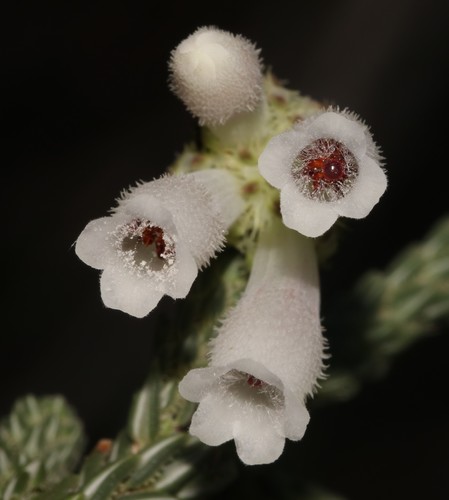
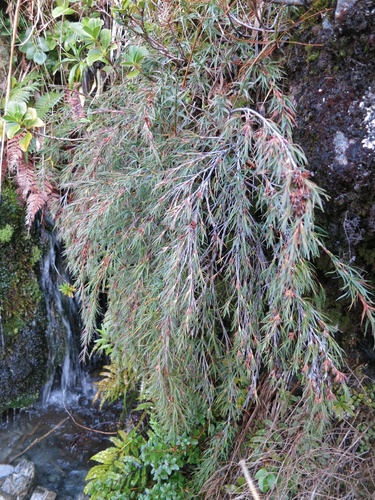
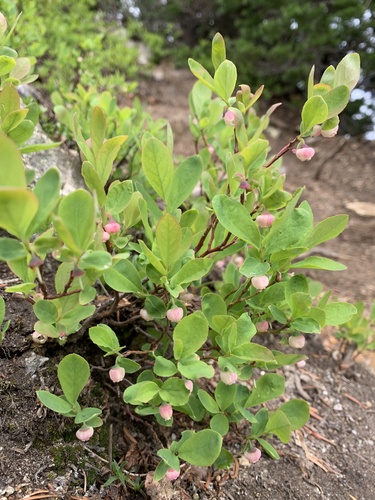
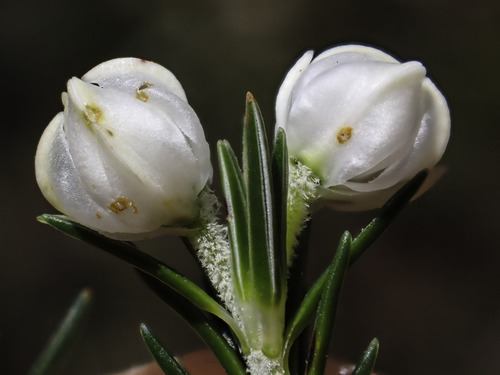
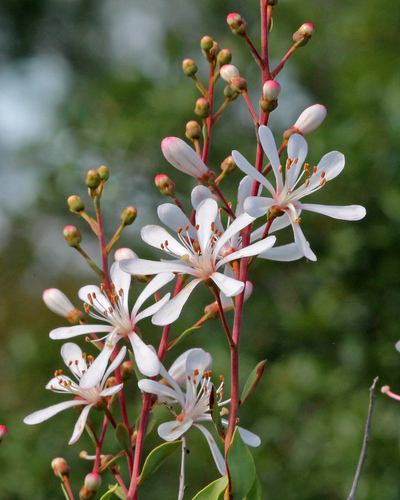
Bejaria racemosa Vent., commonly called tarflower, is an evergreen shrub that grows up to 2.5 meters tall. It has a small number of erect branches that support stems covered in powdery pubescence. It bears simple, alternate, sessile leaves that are elliptic to ovate in shape, measuring 2–6 cm long and up to 2 cm wide. Its leaves have entire margins, with leaf tips ranging from rounded to acute, and cuneate leaf bases. The upper (adaxial) leaf surface is covered in powdery pubescence, while the lower (abaxial) surface is whitish and has long hairs along the midrib. The flowers of Bejaria racemosa are fragrant and sticky, with seven distinctly separated petals that range from white to pinkish, and are 2–3 cm long. Flowers are bisexual, bearing rust-colored anthers and a persistent pistil that remains on the capsule as it develops and matures. The glandular inner surface of the calyx produces large amounts of nectar, which gives both flowers and fruits their sticky texture. The fruit is a capsule 6 to 8 millimeters in diameter. Tarflower grows in scrub ecosystems, mesic flatwoods, and coastal pinelands. Scrub ecosystems have well-drained, nutrient-poor sandy soils, and plants living here are adapted to harsh conditions of full sun exposure and rapid drainage of water and nutrients into sandy soil. It has been suggested that B. racemosa acts as a facultative insectivore: it traps and kills insects in its sticky resin, and later gains supplemental nitrogen from the decaying insect bodies. Bees and flies are attracted to the blooms, and often become trapped in the sticky resin. Documented native bee visitors include sweat bees, resin bees, leaf cutter bees, and bumblebees. These bee species were documented at Archbold Biological Station: Agapostemon splendens, Augochlorella aurata, A. gratiosa, Augochloropsis sumptuosa, Anthidiellum perplexum, Anthidium maculifrons, Megachile brevis pseudobrevis, M. mendica, M. petulans, Bombus impatiens and B. pennsylvanicus. B. racemosa is also a host plant for the Southern Emerald moth. Larvae that feed on tarflower have coloration that matches the rust-colored anthers and stems, while larvae that feed on other host plants display different coloration. One study found that Southern Emerald moth larvae develop more slowly on B. racemosa than on other host plants, possibly due to the sticky resin produced by the plant's flowers. The natural range of Bejaria racemosa extends from the southern Florida counties of Dade, Lee, and Highlands north to Camden, Worth, and Glynn counties in Georgia. B. racemosa is used in Florida native landscaping. It is valued for its drought tolerance and fragrant, showy flowers that bloom in spring and summer. It can be propagated by seed or cutting. It can be grown in areas with full sun to part shade, and prefers sandy, well-drained soils. Tarflower does not tolerate salty wind or direct salt spray. The Orange County chapter of the Florida Native Plant Society is named after the tarflower.