About Beilschmiedia tarairi (A.Cunn.) Kirk
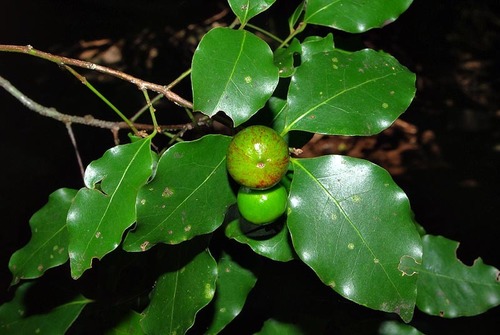
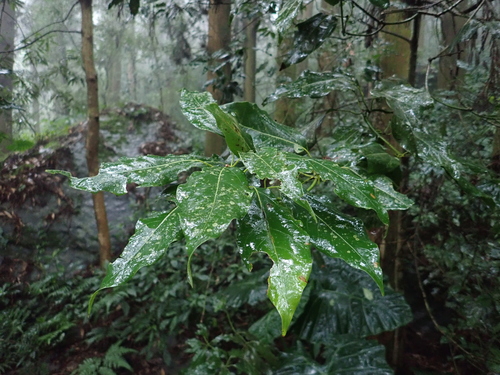
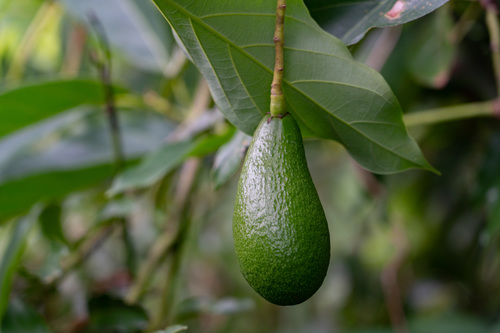
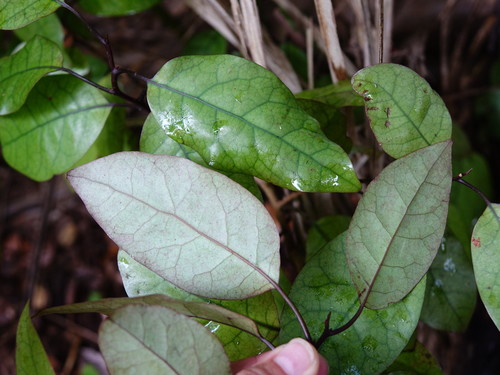
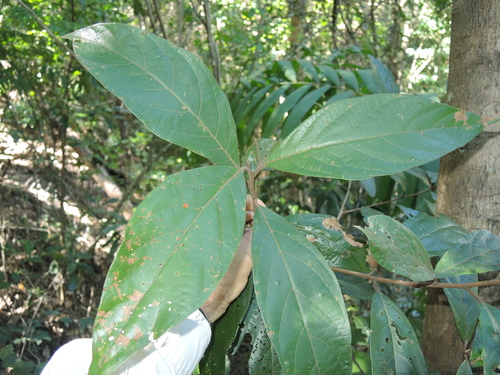
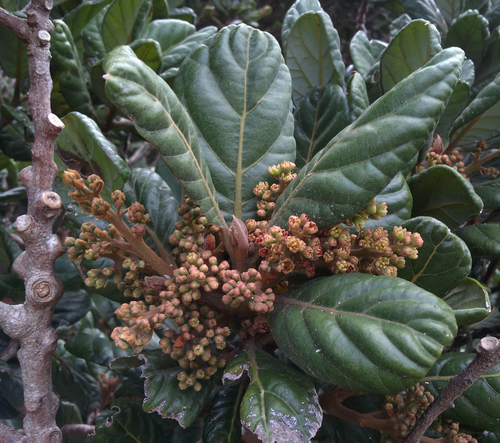
Beilschmiedia tarairi, commonly called taraire, grows up to 22 meters tall, with a very wide crown and a trunk that can reach up to 1 meter in diameter. Its bark is dark brown and smooth, and its stout branches typically spread widely. Fine dense reddish-brown hairs cover its branchlets, young leaves, leaf stems, and young flower buds. Its dark green leaves are alternate, leathery, simple, and marked with depressed veins; they are generally 50 to 72 mm long and 34 to 48 mm wide, attached to leaf stems 8 to 12 mm long. Its inflorescence is an erect panicle up to 100 mm long that grows from leaf axils. Flowering takes place between September and December, peaking in November. The greenish flowers are 3–5 mm in diameter and often covered in dense reddish-brown hairs. The fruit is an erect, elliptical to ovoid drupe around 30 by 16 mm, which turns dark purple when ripe, is covered in a waxy bloom, and contains a single seed. Fruits ripen between March and November, and are a favourite food of the kererū, also known as the New Zealand pigeon. Taraire is a very distinct species with a tropical appearance. It can be distinguished from all other indigenous New Zealand trees and shrubs by its broad dark-green leaves with distinctive depressed veins, and its large, erect, plum-like dark purple fruits. It is one of three endemic Beilschmiedia species native to New Zealand. The other two are the common canopy tree tawa (B. tawa), which has thin willow-like leaves, and tawaroa (B. tawaroa), which is similar to tawa but has broader leaves. Taraire occurs only in the North Island of New Zealand, north of 38°S latitude. It is most common north of Auckland and Thames, at approximately 37°S. Scattered populations are found on the west coast between Port Waikato and Kawhia Harbour, and inland at Pukemokemoke. On the east coast of the North Island, scattered populations occur as far as East Cape. The wood of taraire is straight-grained, but brittle, prone to splitting, and not durable when exposed to the elements. It has been used for flooring, light carts, furniture, picture frames, ship's blocks, and firewood.