About Beilschmiedia obtusifolia (F.Muell. ex Meisn.) F.Muell.
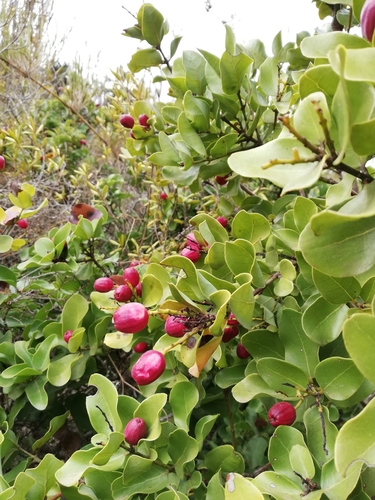
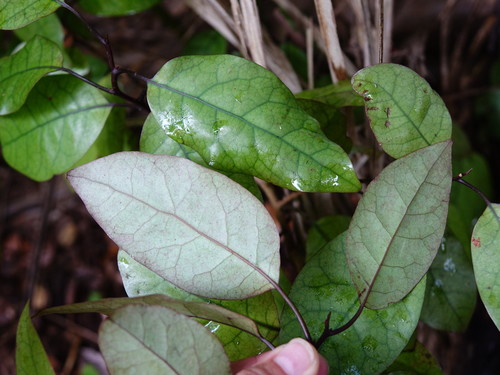
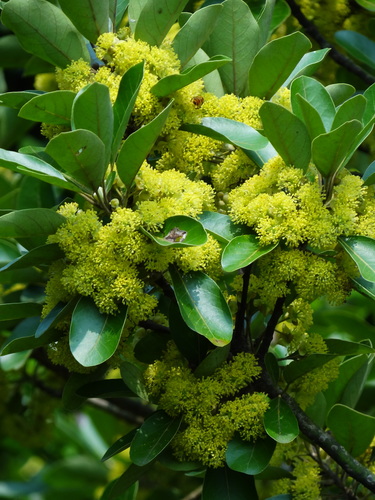
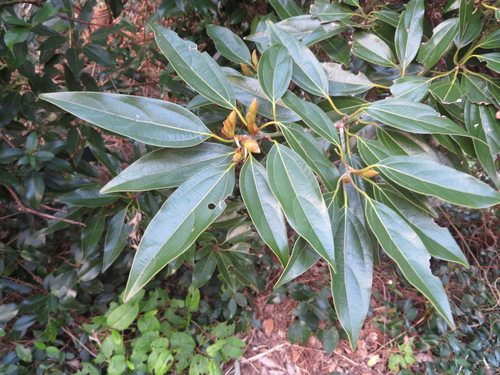
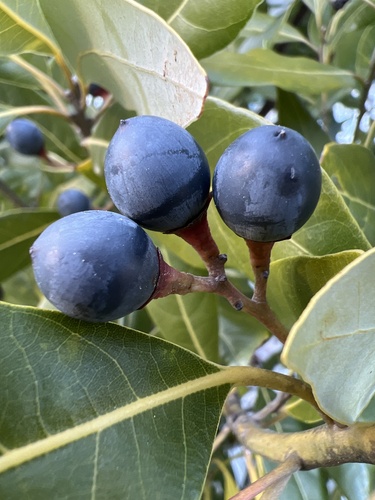
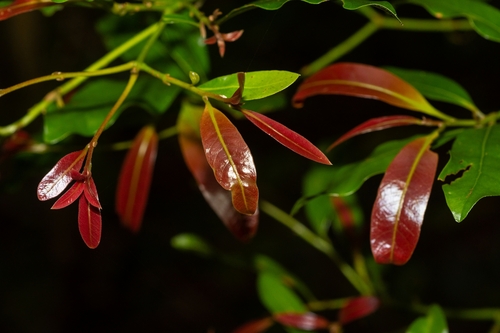
Beilschmiedia obtusifolia is a medium to large tree. Its cylindrical trunk is brown or creamy in color, marked with vertical lines of raised pustules. The trunk has scales with round depressions, a feature that is colloquially called "bollies", and this is similar to the closely related bollygum, Litsea reticulata. Larger specimens develop a flanged base at the base of the tree. Shoots and stems are covered in hairs. The leaves are elliptic or reverse lanceolate, arranged alternately, and have smooth, untoothed edges. They measure 8 to 10 cm long and 2 to 4 cm wide. Leaves are bluntly pointed at the tip, and sometimes have a small notch at the tip. Leaf stalks are 5 mm long. Leaf venation is prominent on both sides of the leaf, with a raised midrib. Cream-colored flowers grow in panicles, and bloom from October to November. The flowers have an unpleasant scent. Fruit ripens from December to July; it is a black, egg-shaped drupe with a scented, green, oily aril. The fruit is 20 to 30 mm long and contains a single seed. Like most Australian laurels, removing the fleshy aril is recommended to help seed germination. Germination of Beilschmiedia obtusifolia is slow, but fairly reliable. A variety of birds eat the fruit of this tree, including the pied imperial pigeon, rose-crowned fruit dove, topknot pigeon, wompoo fruit dove, metallic starling, Australasian figbird, magnificent riflebird, bowerbird, and spotted catbird.