About Bebearia cocalia Fabricius, 1793
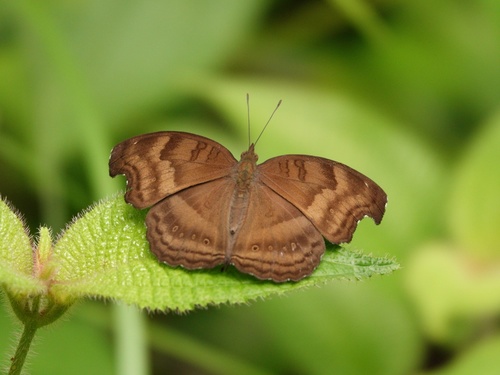
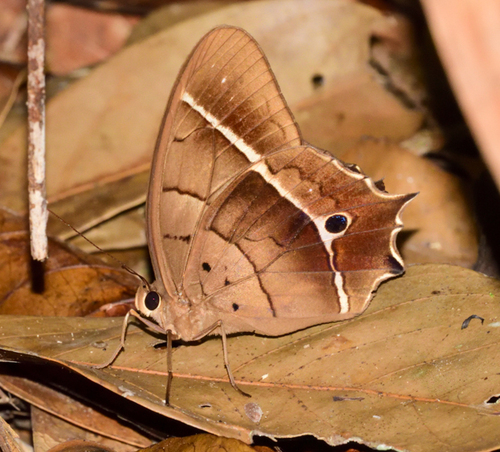
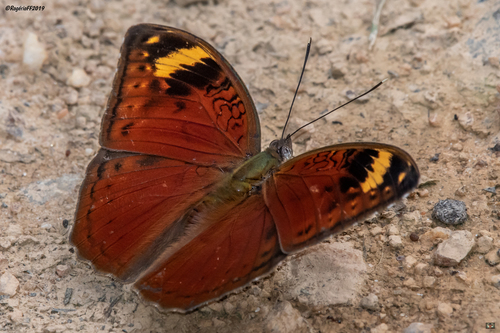
Bebearia cocalia, commonly known as the common palm forester, is a butterfly species belonging to the family Nymphalidae. It can be found in Guinea, Guinea-Bissau, Sierra Leone, Liberia, Ivory Coast, Ghana, Togo, Nigeria, Cameroon, Gabon, the Republic of the Congo, Angola, the Democratic Republic of the Congo, Uganda, Kenya, Tanzania and Zambia. Its natural habitat is forests, especially riparian forests. Both males and females of this species can be distinguished by the long, sharp teeth of the second transverse line of the forewing on veins 4 and 5. For males, the upper side of the wings are dark red-brown or chestnut-brown, with clear black markings. Only the third transverse band is barely darker than the base wing color, so it is only visible at the costal margin of the forewing, where it has a light border. The yellow subapical band of the forewing is very narrow, approximately 1 mm wide, and only appears as yellow bordering on the distal side of the second band in cellules 3 to 6. The postdiscal spots are large and rounded, and are margined with orange at least on the forewing. Females differ from other related species in their light-colored upper wing surface. The basal part of the wings is light brown-yellow, and gradually shades into the whitish base color of the distal half of the wing. Their dark markings match those of males, and both wings are darkened along the distal margin. This distribution range extends from Cameroon to the Congo. Adult Bebearia cocalia are attracted to fermented bananas, and their larvae feed on palm trees.