About Beauveria bassiana (Bals.-Criv.) Vuill.
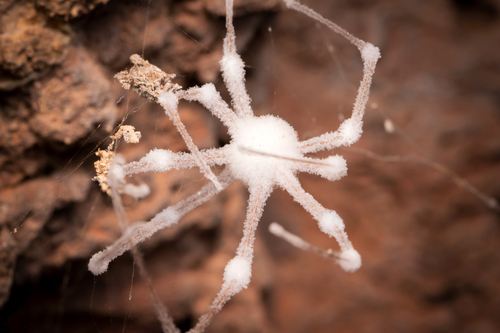
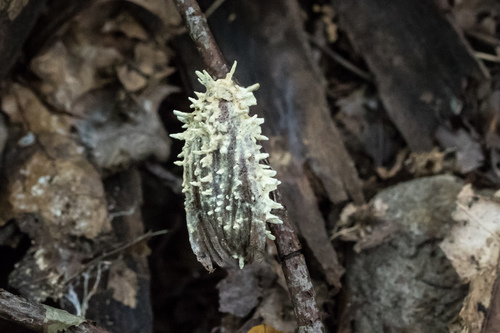
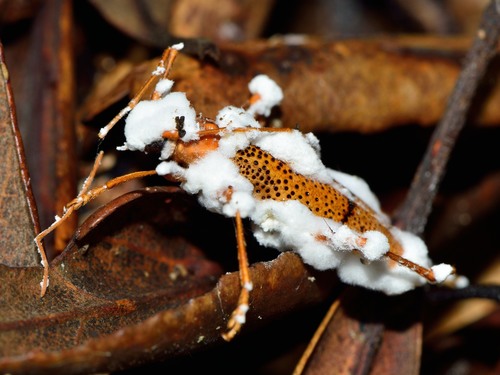
When grown in culture, Beauveria bassiana is a white mold that forms white spore balls composed of many conidia. These conidia are single-celled, haploid, and hydrophobic. The short, ovoid conidiogenous cells that produce conidia have a narrow apical extension called a rachis, which elongates into a long zig-zag shaped extension. The insect disease caused by this fungus is a type of muscardine called white muscardine disease. When the fungus's microscopic spores contact an insect host's body, they germinate, penetrate the insect's cuticle, and grow inside the host, killing the insect within a few days. After the insect dies, a white mold emerges from the cadaver and produces new spores. A typical isolate of B. bassiana can attack a broad range of insects, and different isolates vary in their host ranges. B. bassiana parasitizing Colorado potato beetles has been recorded to in turn act as a host for the mycoparasitic fungus Syspastospora parasitica. This mycoparasite also attacks related insect-pathogenic species in the Clavicipitaceae family. A fungus identified as B. bassiana was observed causing infections in a captive American alligator, and B. bassiana was linked to pulmonary disease in captive tortoises. The affected reptiles were held in captivity and experiencing temperature stress, which may explain their susceptibility to the fungus. In an experimental test, when a tortoise was kept at 22 °C and injected with 0.5 mL of 10⁶ B. bassiana spores into the lung, no mortality occurred. A second infected tortoise that was kept only at 16 °C died. A 2013 microevolutionary experiment found that the Greater wax moth (Galleria mellonella) was able to adapt its defense mechanisms over 25 generations of constant selective pressure from B. bassiana. The moth developed resistance to the fungus, but this resistance apparently came at a fitness cost. Wagner and Lewis have reported that B. bassiana is able to grow as an endophyte in corn. The fungus rarely infects humans or other animals, so it is generally considered safe for use as an insecticide. However, at least one case of human infection by B. bassiana has been reported in a person with a suppressed immune system. Additionally, the fungus's spores may make breathing difficulties worse. Beauveria bassiana can be used as a biological insecticide to control a number of insect pests including termites, whiteflies, and many other insect species. Its use for controlling malaria-transmitting mosquitoes is currently under investigation. When used as an insecticide, the spores are sprayed onto affected crops as an emulsified suspension or wettable powder, or applied to mosquito nets as a mosquito control agent. As a species, B. bassiana parasitizes a very wide range of arthropod hosts. However, different strains vary in their host ranges; some strains have rather narrow host ranges, for example strain Bba 5653, which is very virulent to diamondback moth larvae and kills only a few other types of caterpillars. Some strains do have a wide host range, and these should therefore be considered nonselective biological insecticides. Nonselective strains should not be applied to flowers that pollinating insects visit. Preliminary research shows the fungus is 100% effective at eliminating bed bugs exposed to cotton fabric sprayed with the fungus's spores. It is also effective against bed bug colonies because infected bed bugs carry B. bassiana back to their harborages. The tested B. bassiana strain caused rapid mortality within 3 to 5 days after short-term exposure. In a 2017 follow-up study, pyrethroid-resistant bed bugs had more than 94% mortality after treatment with a commercial preparation of B. bassiana.