About Bauhinia acuminata L.
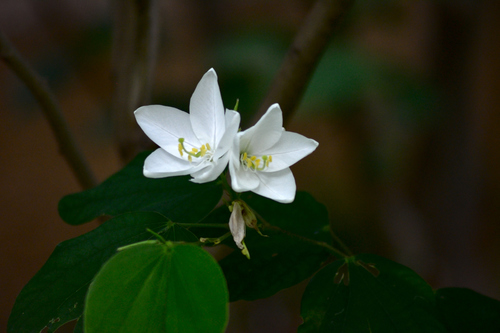
Bauhinia acuminata L. is a species of flowering shrub native to tropical southeastern Asia. Its common names are dwarf white bauhinia, white orchid-tree, and snowy orchid-tree. Because the species has been extensively cultivated, its exact native range is not certain, but it is most likely native to Malaysia, Indonesia (including Java, Borneo, Kalimantan, and the Lesser Sunda Islands), and the Philippines. This shrub grows to between two and three meters tall. Like other species in the Bauhinia genus, its leaves are bilobed and shaped like an ox hoof. The leaves are 6 to 15 centimetres (2 1/4 to 6 inches) long and wide, with an apical cleft that can reach up to 5 centimetres (2 inches) deep, and a petiole that is 1.5 to 4 centimetres (1/2 to 1 1/2 inches) long. Its flowers are fragrant, with a diameter of 8 to 12 centimetres (3 1/4 to 4 3/4 inches). Each flower has five white petals, ten stamens tipped with yellow, and a green stigma. The fruit is a pod that measures 7.5 to 15 centimetres (3 to 6 inches) long and 1.5 to 1.8 centimetres (1/2 to 3/4 inches) wide. In the wild, the species grows in deciduous forests and scrub. It is widely cultivated across tropical regions as an ornamental plant. It can escape from cultivation in some areas, and has become naturalised on Cape York Peninsula, Australia. This plant has several ethnobotanical uses in different regions. People in Java use its roots to treat coughs and colds, while people in India use its leaves and bark to treat asthma. It is also used as an ingredient in many culinary dishes from Odisha.