About Battus philenor (Linnaeus, 1771)
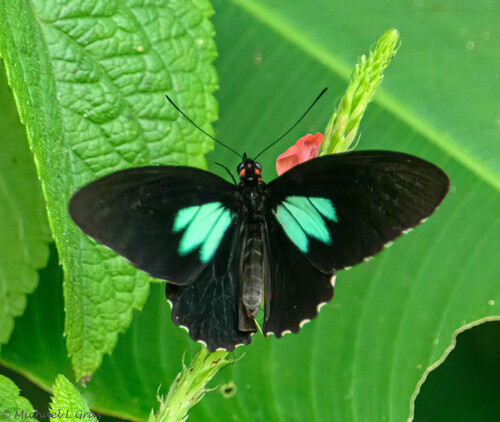
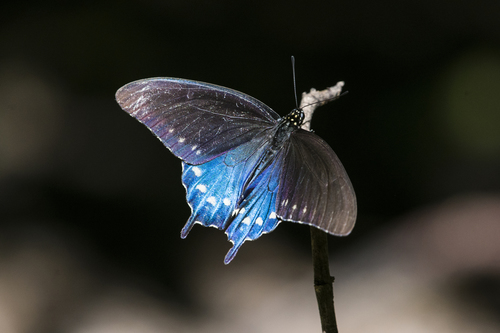
Battus philenor, commonly known as the pipevine swallowtail or blue swallowtail, is a species of swallowtail butterfly native to North America and Central America. Adults have black wings with iridescent-blue hindwings. While they occupy many different habitats, they are most common in forested areas. Caterpillars of this species are most often black or red, and feed exclusively on compatible plants from the genus Aristolochia. Pipevine swallowtails are known to sequester acids from their host food plants, making them poisonous to predators that eat them. Adult pipevine swallowtails feed on nectar from a wide range of flowering plants. Some Aristolochia species, typically tropical varieties, are toxic to this species' larvae. Though citizen conservation efforts led by enthusiasts have worked to protect pipevine swallowtails in West Coast neighborhoods, the species has not been the focus of any formal conservation program, nor is it protected by legislation. It is classified as of Special Concern in Michigan, which lies at the northern limit of the species' range. The pipevine swallowtail has a broad distribution across North America. In the United States, it occurs from New England south to Florida, and west to Nebraska, Texas, New Mexico, Arizona, California, and Oregon. An isolated population of the species lives in central California. Individual sightings have been recorded as far south as Mexico and as far north as Ontario, though these sightings are not consistent. The species favors warm, temperate environments, and is most often found in open grasslands, woodlands, meadows, and residential backyard gardens. It occurs in any area where pipevine (Aristolochia) can grow in large numbers.