About Battus ingenuus (Dyar, 1907)
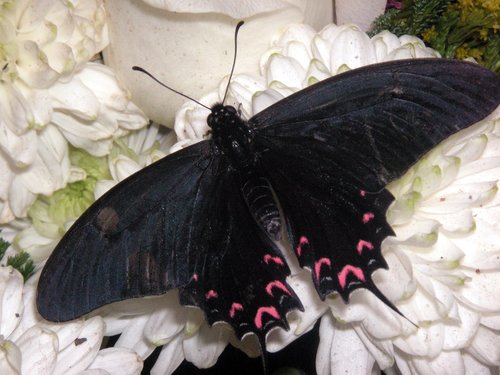
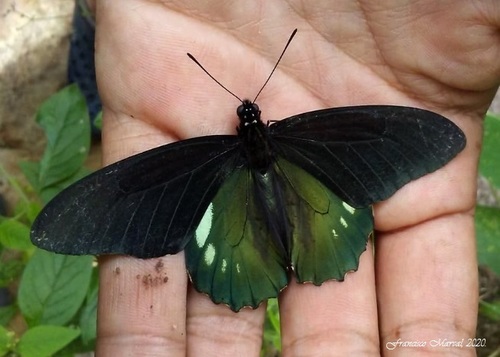
Battus ingenuus (Dyar, 1907) has a wingspan ranging from approximately 82 to 95 millimeters, which equals 3.2 to 3.7 inches. The upper surface of its wings is primarily black, with greenish reflections and pale green patches on the hindwings. The underside of the wings is mainly brownish, with red and white spots along the edges of the hindwings. Its body is blackish, with yellow spots on the sides of the thorax and abdomen, and a small number of white spots on the underside of the abdomen. Male individuals have a pale yellowish-green upper abdomen. This species is distributed from southeastern Mexico to eastern Venezuela, and can also be found in Belize, Colombia, Costa Rica, Ecuador, El Salvador, Honduras, Nicaragua, Panama, Peru, and Trinidad. Battus ingenuus occurs from low elevations up to moderate elevations in the Andes, reaching around 900 meters, or 3,000 feet, above sea level. In monsoonal regions of Costa Rica, it inhabits tropical deciduous forest, a habitat where most trees drop their leaves at the end of the dry season. For its life cycle, the larvae feed on Aristolochia constricta. When caterpillars feed on these poisonous pipevines, they become poisonous themselves, and have a very unpleasant taste for birds.