About Batrachoseps gregarius Jockusch, Wake & Yanev, 1998
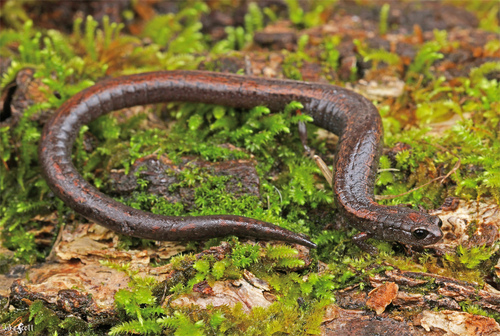
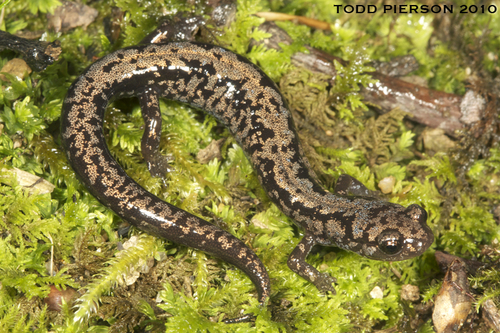
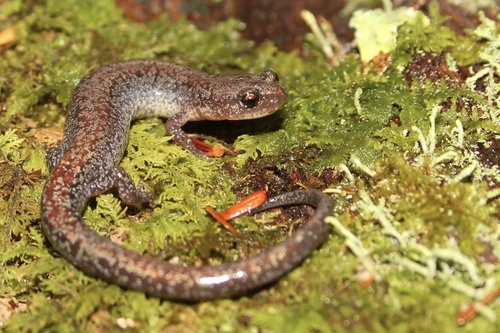
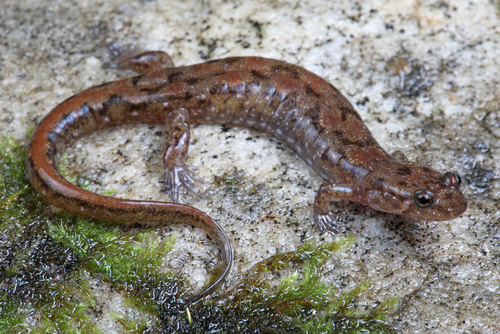
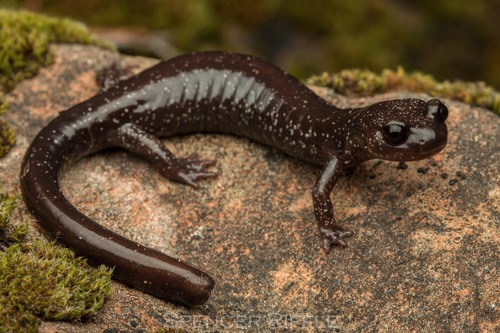
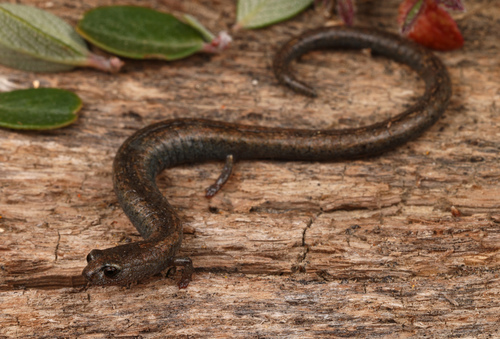
The gregarious slender salamander (Batrachoseps gregarius) is a small, slender species. It has a narrow head, short limbs, small hands and feet, and a long tail that tapers near its tip. Its colouration includes a brown dorsal colour band, a blackish back and sides dotted with white specks, which transitions to a pale grey belly. The dorsal band starts at a golden-brown to tan area on the neck and extends along the spine all the way to the tail. Colouration varies between individual salamanders, ranging from light brown marked with dark flecks and bright highlights to a much darker shade. The maximum snout-to-vent length of an adult individual is under 50 mm (2.0 in). This salamander is endemic to the western slopes of the southern and central Sierra Nevada in California, United States. It can be found at altitudes up to 1,800 m (6,000 ft), but in the southern section of its range, it rarely occurs above 900 m (3,000 ft). Its distribution covers riparian zones in the Central Valley, and it is common in southern Tulare County and northern Kern County, within the drainages of the White River and its tributary Arrastre Creek. Its habitat varies across different parts of its range. It mainly occurs in relatively open oak woodland dominated by interior live oak (Quercus wislizeni), blue oak (Quercus douglasii) and foothill pine (Pinus sabiniana). It can sometimes also be found in mixed coniferous forest containing ponderosa pine (Pinus ponderosa), incense cedar (Calocedrus), white fir (Abies concolor) and California black oak (Quercus kelloggii). In the northern part of its range, it is abundant in coniferous forest with sugar pine (Pinus lambertiana) and giant sequoias (Sequoiadendron giganteum). In the southern part of its range near the Kern River, it occurs in dry grassland with scattered boulders. Reproduction in this species is seasonal. In the southern part of its range and at lower elevations, egg-laying typically happens shortly after the rainy season begins, while it occurs later at higher elevations. Females deposit clutches of eggs in well-hidden, moist locations: under bark, fallen logs, or rocks, or in leaf-litter, often close to a seep or stream. Eggs are usually laid in communal nests. These nests have been found holding over 300 eggs, estimated to have been laid by more than 18 different females. Larger females generally produce larger clutches. The mean clutch size is 15.3 for females from the northern part of the range, and 7.3 for females from the southern part. After being laid, the eggs are not guarded by the mother, though adult males and young salamanders may continue to shelter near the nest. Eggs develop directly into miniature adult salamanders, with no aquatic larval stage. In laboratory conditions, the eggs take between 65 and 73 days to hatch, and a similar incubation period is likely in the wild.