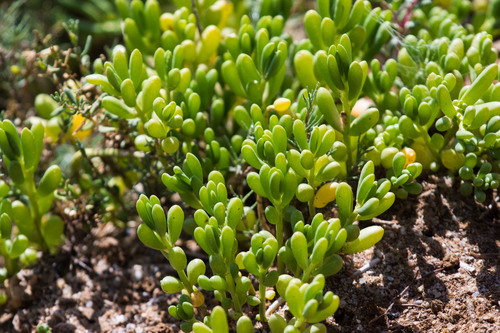
About Batis maritima L.
Batis maritima L. is a dioecious, perennial subshrub that grows 0.1 to 1.5 meters tall and forms dense colonies. It produces opposite, sessile, succulent leaves. Its small white flowers are self-incompatible, and pollen morphology confirms this species is wind-pollinated. The seeds measure 1.1 mm long and 0.8 mm wide, with an extremely low mass of 0.5 mg per seed. They have a smooth, very dark, hard outer coating, and an elongated lenticular shape. Seeds have been recorded germinating after floating for several months in seawater. The plant’s primary root branches early in development, and remains unbranched until the associated shoot reaches 10 cm or more in height. This species grows naturally on both Atlantic and Pacific tropical coasts of North, Central, and South America, as well as on Caribbean Islands. Its northern range extends up to 33º N latitude, and this boundary appears to be shaped by frost events. Most of its natural habitats are regularly impacted by severe tropical storms. It typically grows at elevations less than 1.0 m above mean sea level, in locations with salinity between 18 and 50 ppt, including habitats such as muddy tidal banks, mangrove swamps, salt marshes, and mud and salt flats. It can also grow in soils with no salt, but it is vulnerable to competition from non-halophytic species. It usually grows in sites that experience very little sand coverage, and wrack deposits appear to stimulate its growth. Batis maritima is classified as an invasive species in Hawaii, where it displaces native plant species. Its ability to produce sufficient biomass across a wide range of environmental conditions is well documented. It is not seriously impacted by insects, disease, or grazing, but its shoots cannot tolerate being covered by sand. The leaves of Batis maritima are occasionally added to salads in Puerto Rico, and the species has also been used as a pot herb, puree, and pickle. Its seeds can be added to salads, toasted, or “popped” similar to corn. The Comcáac people traditionally used its roots to sweeten coffee before they gained access to sugar. A yellow to golden meal made from the plant is used as food. Due to its high oil content, Batis maritima has potential use as an oil crop. In Puerto Rican folk herbal medicine, it has been used to treat gout, eczema, psoriasis, rheumatism, blood disorders, and thyroid disorders.

