About Batia lunaris Haworth, 1829
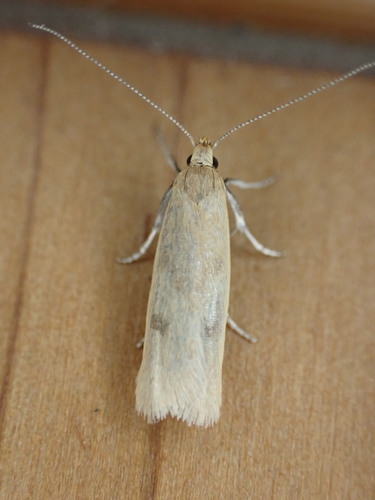
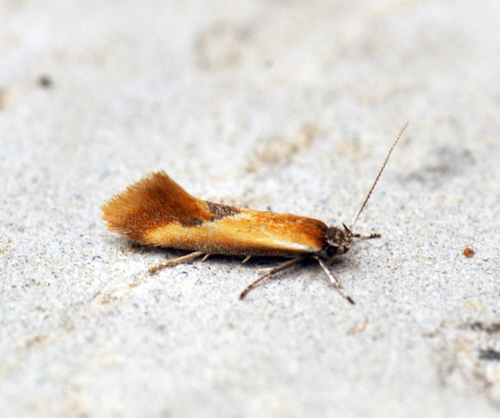
Description and ecology: This moth has a wingspan of 7–10 mm. Adult individuals generally resemble the closely related species Batia lambdella, but are only two-thirds the size of B. lambdella. Its forewings are dark ochre, slightly darker at the tips and along the surrounding hairy fringe. A dark blotch sits on the dorsal margin at the border between the lighter and darker sections of the forewing; when the moth rests with its wings held back, this blotch forms a continuous pointed patch. Per Meyrick’s description: the head is whitish, mixed with dark fuscous. The forewings are yellow, turning orange towards the dorsum; the costa from the base to two-thirds of the wing length, and the termen broadly, are ferruginous. A narrow fuscous costal streak runs from the base to two-thirds of the wing length, and a large triangular blackish spot is located before the tornus, with its apex extending irregularly toward the apex of the wing. The hindwings are ovate-lanceolate and a rather dark grey. This species occurs in Europe, where it is not rare in many woodland habitats. It remains widespread even at the outer edge of its range; for example, it is commonly seen across most of England. Adults fly during July and August, with flight timing varying by location. This moth is generally nocturnal, but can be lured by bright lights. The habits of its caterpillars are not well understood. There is no evidence to suggest that their habits differ from those of their close relatives, which typically live under bark and feed on rotting wood, and occasionally fungi.