About Bathytoshia lata (Garman, 1880)
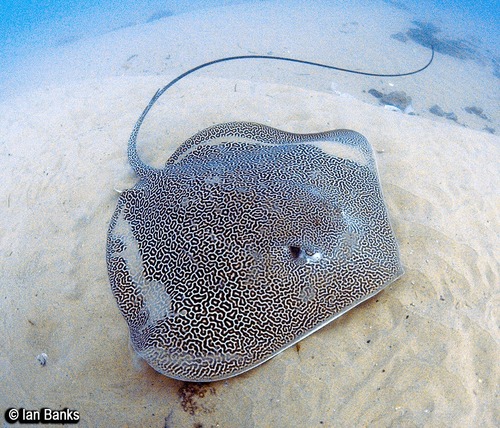
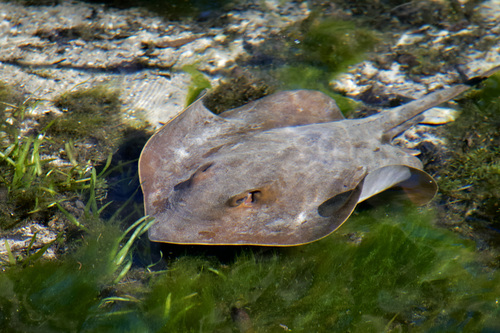
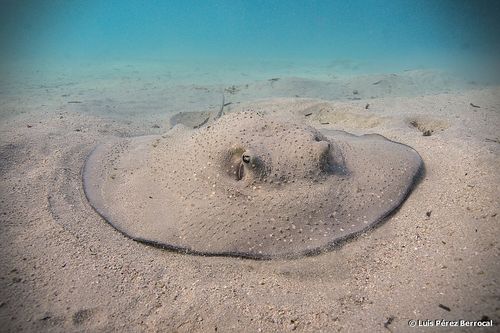
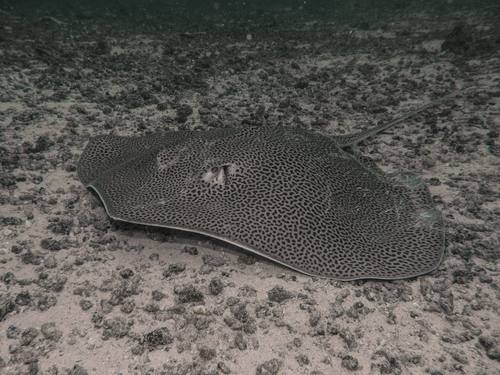
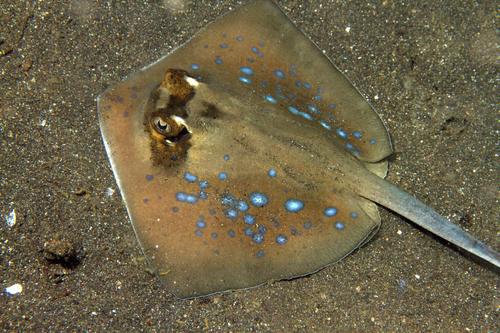
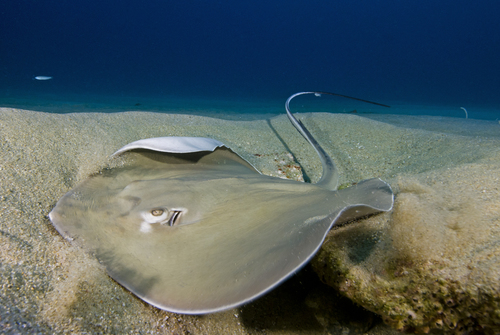
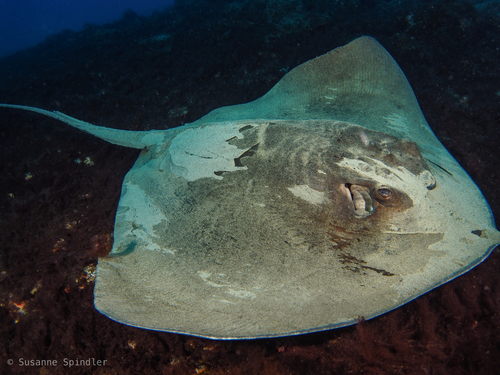
Bathytoshia lata (Garman, 1880), commonly called the broad stingray, has a diamond-shaped pectoral fin disc that is one fourth wider than it is long. Its nearly straight leading fin margins converge at an obtuse angle, while its trailing margins are curved. The tip of its snout is rounded and protrudes past the edge of the disc. Its mouth is arched, with five or six papillae on the mouth floor, two of which sit in front of the others. Its pelvic fins are short and rounded. Its whip-like tail is at least twice the length of the disc, and it bears a serrated stinging spine on the upper tail surface near the tail base. A long, narrow fin fold runs underneath the tail, which eventually becomes a keel that extends all the way to the tail tip. Larger individuals have three large, elongated tubercles in the middle of the back. The tail is roughened by small dermal denticles, plus an irregular row of conical tubercles on each side and several large, flattened tubercles in front of the stinging spine. This species is plain olive to brown on its upper side and white on its underside. The diamond stingray (Hypanus dipterurus), a similar-looking species, is the only other nearshore stingray found off Hawaii, though it rarely occurs this far west. It can be told apart from the broad stingray by its shorter tail, which has both upper and lower fin folds. The broad stingray can grow to 1.5 m (5 ft) across and reach 56 kg (123 lb) in weight, though few individuals exceed 1 m (3 ft) across. This species occurs in the eastern Atlantic and Indo-Pacific, ranging from southern Africa to the Hawaiian Islands. It is also found in the Mediterranean Sea, with occasional records from Spain to Turkey. It is common in coastal bays with mud or silt bottoms, and can also be found in sandy areas or near coral reefs. It is most common at depths between 40 and 200 m (130 to 660 ft), but has been found as deep as 800 m (2,600 ft). During the day, the broad stingray is relatively inactive, and spends most of its time lying half-buried on the seabed. A tracking study conducted in Kaneohe Bay found that individual rays roamed an average area of 0.83 km² (0.32 mi²) at night, compared to an average diurnal activity space of 0.12 km² (0.046 mi²), and did not consistently rest in any particular spot. Rays are most active two hours after sunset and before sunrise, and are more active in the higher water temperatures of summer than in winter. Tides do not significantly influence this species' behavior, likely because it inhabits deeper water. The broad stingray feeds mainly on bottom-dwelling crustaceans, and also preys on polychaete worms and small bony fishes. It excavates large pits to uncover buried prey, and is often followed by opportunistic species such as jacks. Foraging broad stingrays favor areas close to reef boundaries, where many parrotfish, wrasses, gobies, and other reef fishes shelter at night. Known parasites of this species include the tapeworms Acanthobothrium chengi, Rhinebothrium hawaiiensis, Pterobothrium hawaiiensis, Prochristianella micracantha, and Parachristianella monomegacantha. Like other stingrays, the broad stingray is aplacental viviparous. Kaneohe Bay appears to be a nursery area for this species, where the broad stingray and juvenile scalloped hammerheads (Sphyrna lewini) are the dominant predators. Off North Africa, birthing occurs in June and December, which indicates either that females produce two litters per year with a four-month gestation period, or that there are two cohorts of females producing one litter per year with a ten-month gestation period.