About Bathytoshia brevicaudata (Hutton, 1875)
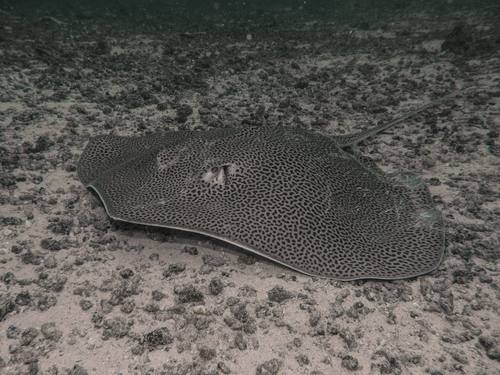
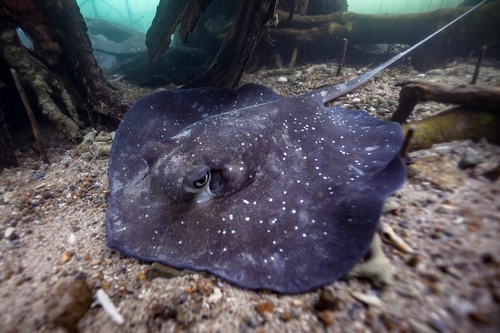
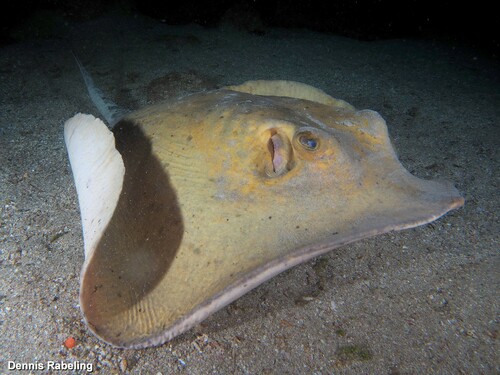
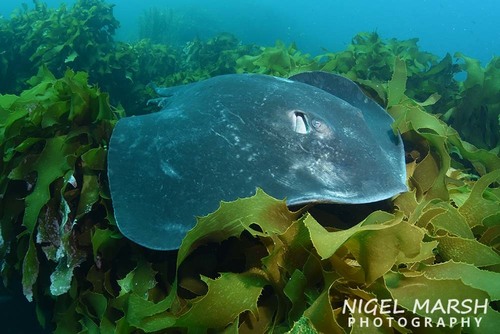
The short-tail stingray, scientifically named Bathytoshia brevicaudata (Hutton, 1875), is heavily built with characteristically smooth skin. Its pectoral fin disc has a rather angular rhomboid shape, and is slightly wider than it is long. The leading margins of the disc are very gently convex, and converge at a blunt, broadly triangular snout. Its eyes are small, and are immediately followed by much larger spiracles. The widely spaced nostrils are long and narrow; between the nostrils sits a short, skirt-shaped curtain of skin with a fringed posterior margin. Its modestly sized mouth has an evenly arched lower jaw, prominent grooves at the corners, and five to seven nipple-like papillae on the mouth floor. Additional tiny papillae are scattered across the nasal curtain and outside the lower jaw. Short-tail stingrays have 45 to 55 densely arranged teeth, which are small, blunt, and conical. The teeth are arranged in a gridded quincunx pattern, giving them a flat, planar appearance. The pelvic fins are somewhat large, with rounded tips. The tail is usually shorter than the disc, and bears one, sometimes two, serrated stinging spines on its upper surface, positioned about halfway along the tail’s length. The tail is broad and flattened up to the base of the sting; after this point, it tapers rapidly. A prominent ventral fin fold runs almost to the sting tip, and a low dorsal ridge is also present. Dermal denticles are only found on the tail; by the time an individual reaches 45 cm (18 in) in disc width, at least one thorn appears on the tail base. Adults have a midline row of large, backward-pointing, spear-like thorns or flattened tubercles in front of the sting, as well as much smaller, conical thorns behind the sting that cover the tail all the way to the tip. The dorsal coloration is grayish brown, darkening toward the tip of the tail and above the eyes, with a line of white pores flanking the head on either side. The underside is whitish, darkening toward the fin margins and beneath the tail. Albino individuals of this species have been reported. The short-tail stingray is the largest stingray species, confirmed to reach at least 2.1 m (6.9 ft) in width, 4.3 m (14 ft) in length, and 350 kg (770 lb) in weight. Reliable observers off New Zealand have reported sighting individuals almost 3 m (10 ft) across. Mature females are around one third larger than mature males. This species is common and widely distributed in the temperate waters of the Southern Hemisphere. Off southern Africa, it has been recorded from Cape Town, South Africa to the mouth of the Zambezi River, Mozambique. Along Australia’s southern coast, it ranges from Shark Bay, Western Australia to Maroochydore, Queensland, and also occurs in Tasmania. In New Zealand waters, it occurs off the North Island and Chatham Islands, and is rarely found off the South Island and Kermadec Islands. Records from northern Australia and Thailand likely represent misidentifications: those from northern Australia are likely pink whiprays, and those from Thailand are likely pitted stingrays. Over the past few decades, both its range and population size off southeastern Tasmania have grown, possibly as a result of climate change. Off southern Africa, the short-tail stingray is rare in shallow water, and is most often found over offshore banks at depths of 180 to 480 m (590 to 1,570 ft). However, off Australia and New Zealand, it occurs from the intertidal zone down to a maximum depth of 156 m (512 ft). In Australian and New Zealand populations, this ray is most abundant in shallow waters during the summer. A tracking study of two New Zealand individuals suggests that they shift to deeper waters during the winter, but do not undertake long-distance migrations. The short-tail stingray is mainly a bottom-dwelling species, and inhabits a variety of environments including brackish estuaries, sheltered bays and inlets, sandy flats, rocky reefs, and the outer continental shelf. It also makes regular forays upward into the middle of the water column. The short-tail stingray is usually slow-moving, but can produce sudden bursts of speed, flapping its pectoral fins with enough force to cause water cavitation and create an audible “bang” — cavitation occurs when a liquid is pushed faster than it can react, causing a drop in pressure. This species is known to form large seasonal aggregations; a well-known example occurs every summer from January to April at the Poor Knights Islands off New Zealand, particularly under rocky archways. In some areas, it moves into very shallow water with the rising tide. Individual rays tend to remain within a relatively small home range with a radius under 25 km (16 mi). Captive experiments have shown this species can detect magnetic fields via its electroreceptive ampullae of Lorenzini, which it may use for navigation in its natural habitat. The short-tail stingray forages for food both during the day and at night. It feeds primarily on benthic bony fishes and invertebrates such as molluscs and crustaceans. The lateral line system on its underside lets it detect the minute water jets produced by buried bivalves and spoon worms, which it then extracts by suction; excess water is expelled through the spiracles. It also eats significant quantities of open-water fishes and invertebrates, including salps and hyperiid amphipods. Off South Africa, this ray has been observed patrolling the egg beds of chokka squid (Loligo vulgaris reynaudii) during mass spawnings, capturing squid that descend to the bottom to spawn. Due to its large size, the short-tail stingray has few predators; known predators include the copper shark, smooth hammerhead, great white shark, and killer whale. When threatened, it raises its tail warningly over its back like a scorpion. Smaller fishes have been observed using swimming short-tail stingrays for cover while they hunt their own prey. Known parasites of this species include the nematode Echinocephalus overstreeti, and the monogeneans Heterocotyle tokoloshei and Dendromonocotyle sp.