About Batara cinerea (Vieillot, 1819)
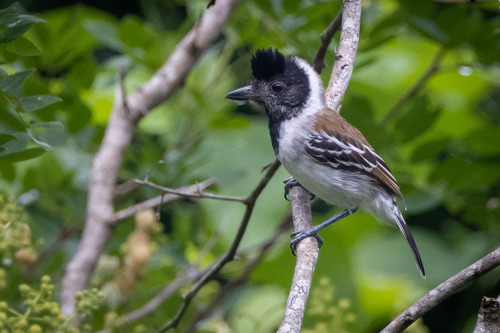
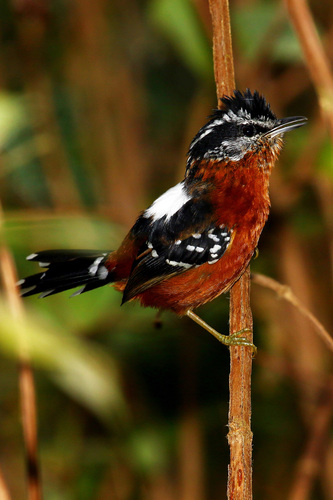
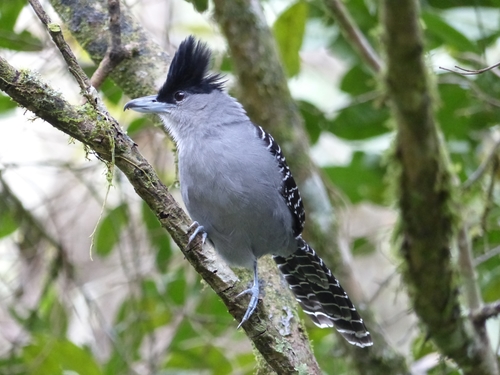
The giant antshrike, scientifically named Batara cinerea (Vieillot, 1819), is the largest species in the antbird family. It measures 27 to 35 cm (11 to 14 in) in length and weighs 100 to 155 g (3.5 to 5.5 oz). The species shows significant sexual dimorphism, but both males and females share a crest, a very long and wide tail, and a long gray bill that ends in a hook similar to that of true shrikes. Adult males of the nominate subspecies have a black forehead, crown, and crest. Their back, wings, and tail are barred with black and white, while their face, nape, throat, and underparts are neutral gray. Adult females have a rufous crest with some black feather tips. Their back, wings, and tail are barred with cinnamon-buff and dark brown, and their face, nape, throat, and underparts are mostly olive that becomes yellowish toward the crissum. Subspecies B. c. argentina is smaller than the nominate subspecies. Males of this subspecies have fewer bars on their wings and tail than nominate males; females have less black on their crest, slightly paler upperparts, and warmer underparts than nominate females. Subspecies B. c. excubitor is paler overall than B. c. argentina, and this difference may follow a clinal pattern. The giant antshrike has a disjunct distribution, with the nominate subspecies geographically separated from the other two subspecies. The nominate subspecies occurs from southern Espírito Santo and southwestern São Paulo states in southeastern Brazil, south to central Rio Grande do Sul, and extends into Misiones Province in northeastern Argentina. B. c. excubitor is found only in western Santa Cruz Department in central Bolivia. B. c. argentina occurs in southern Bolivia's Santa Cruz, Chuquisaca, and Tarija departments, in northwestern Argentina's Jujuy, Salta, and Tucumán provinces, and in western Paraguay's Boquerón and Presidente Hayes departments. Across its geographic range, the giant antshrike occupies different landscape types, but it always favors vegetation from the understorey to the mid-storey. In the Atlantic Forest, it is found from humid evergreen forest near sea level up to elfin forest at around 2,200 m (7,200 ft), and it almost always occurs in or near large stands of bamboo. Further west in the Andes, it lives in montane forest up to 2,600 m (8,500 ft), mostly in dense vegetation along ravines and streams. At lower elevations in Argentina, Bolivia, and Paraguay, it occurs in the stunted woodlands of the semi-arid Gran Chaco, where it favors dense thorny thickets.