About Bassariscus sumichrasti (Saussure, 1860)
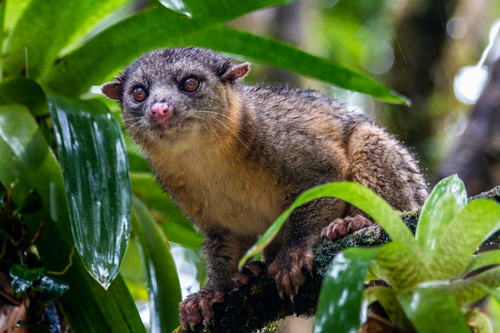
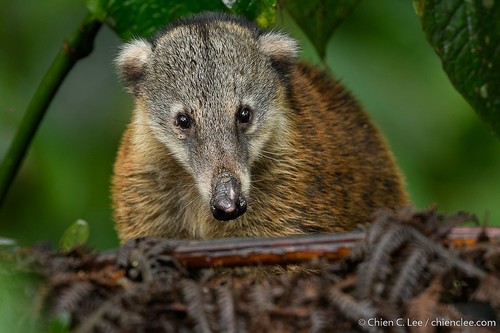
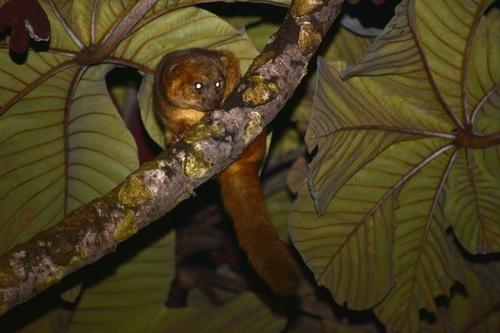
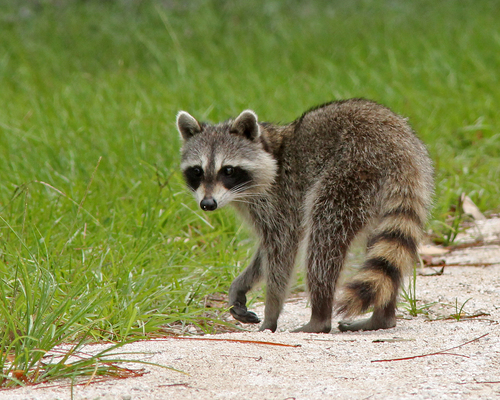
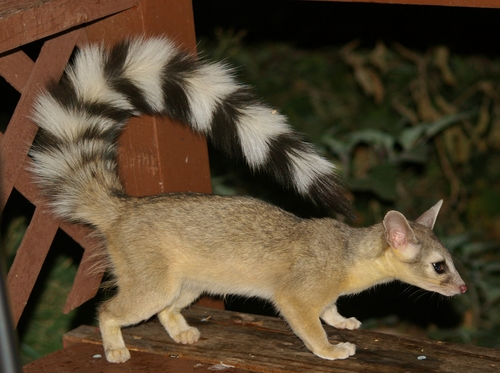
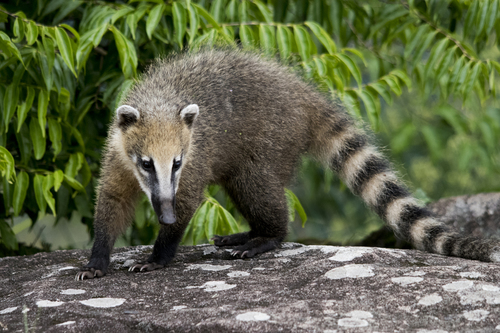
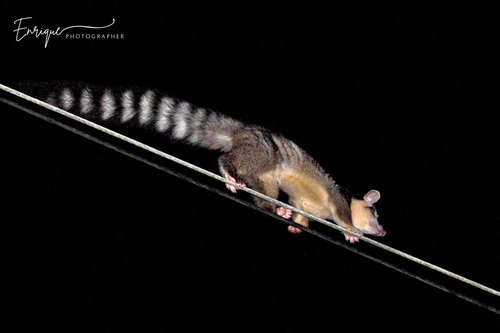
Bassariscus sumichrasti, commonly called the cacomistle, has a body length of 38 to 47 centimeters, with a tail that is roughly the same length or longer, adding 39 to 53 centimeters to its total length. Male cacomistles usually have slightly longer bodies than females, but both sexes have a similar average weight, falling between 1 and 1.5 kilograms. Their bodies are covered in gray or light brownish fur, which contrasts sharply with their black-and-white striped tails. Tail striping is clearest closest to the body, and gradually fades to solid black at the tail tip. Untrained observers often confuse this species with its close relative Bassariscus astutus, the ringtail. Unlike the cacomistle, the ringtail has a more northerly distribution and does not have retractable claws. Cacomistles can also be distinguished by their faded tail markings and distinctly pointed ear tips. The cacomistle inhabits tropical and subtropical forests from Mexico in North America south through Central America, all the way to Panama. This species is solitary, with individuals spacing themselves out across the landscape. Each cacomistle has a home range of at least 20 hectares, which equals the area of around 20 sports fields. Cacomistles are typically found in the middle and upper levels of forest canopies, and they occupy a wide variety of forest ecosystems across their range. In Mexico, cacomistles tend to avoid oak forests, secondary forest, and overgrown pastures; in Costa Rica, the species is known to favor exactly these habitats. Mating season is the only time cacomistles interact with one another, and these interactions are brief: females are only receptive to male advances for one day. After mating, females undergo a gestation period of approximately two months, then give birth to a single offspring. The cub is weaned at three months old, after which the mother teaches it hunting and survival skills before the young cacomistle leaves to establish its own territory.