About Bassariscus astutus (Lichtenstein, 1830)
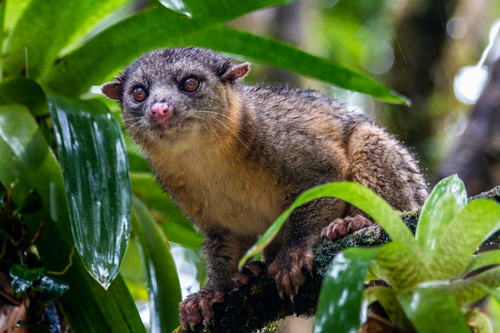
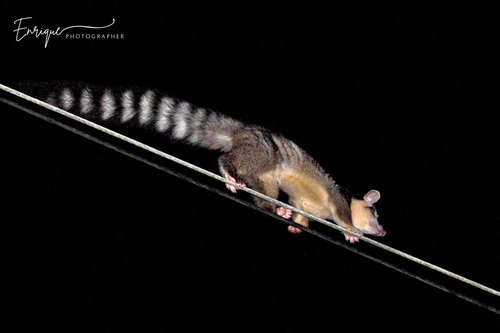
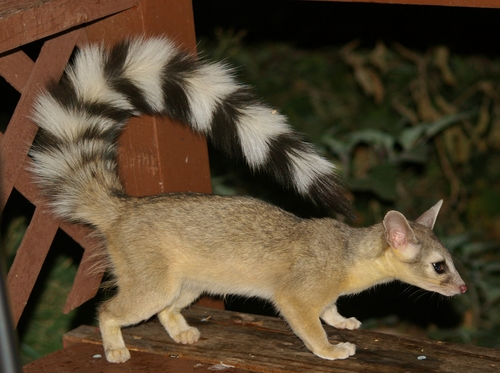
Description: The ringtail (Bassariscus astutus) is black to dark brown with pale underparts. It has a pointed muzzle with long whiskers, which looks similar to a fox's muzzle, and its Latin name means 'clever little fox'; its body shape resembles that of a cat. Dark brown and black hair surrounding the ringtail's eyes gives its face a masked appearance. This species is characterized by a long black and white ringed tail marked with 14–16 stripes, and the tail is approximately the same length as the ringtail's body. Ringtails are primarily nocturnal, with large eyes and upright ears that help them navigate and forage in the dark. They are adept climbers that use their long tail for balance. The alternating rings on the tail can act as a distraction for predators: the white rings draw predator attention to the tail, so if the tail rather than the body is caught, the ringtail has a higher chance of escaping. Ringtails have short, straight, semi-retractable claws that are well-suited for climbing. They are smaller than house cats, and are one of the smallest living procyonids; only members of the olingo species group average smaller in size. The body alone measures 30–42 cm (12–17 in), while the tail averages 31–44 cm (12–17 in) from its base. Ringtails typically weigh around 0.7 to 1.5 kg (1.5 to 3.3 lb). Their dental formula is 3.1.4.2 / 3.1.4.2 = 40 teeth. The ringtail's ankle joint is flexible and can rotate over 180 degrees, contributing to its agility as a climber. Its long tail provides balance for moving across narrow ledges and limbs, and even allows individual ringtails to reverse direction by doing a cartwheel. Ringtails can ascend narrow passages by stemming (pressing all feet on one wall and their back against the opposite wall, or pressing both right feet on one wall and both left feet on the opposite wall), and can move up wider cracks or openings by ricocheting between walls. Adult ringtails lead solitary lives, and generally only come together to mate. Their typical call is a very loud, plaintive bark. They produce a variety of other sounds, including clicks and chatters that are similar to those made by raccoons. Ringtails have been reported to use fecal marking as a form of intraspecific communication, to define territory boundaries or attract potential mates. It has been proposed that ringtails use feces to mark territory; a 2003 study in Mexico City found that ringtails tended to defecate in consistent areas in a seemingly nonrandom pattern, matching the behavior of other carnivores that use excretions for territory marking. Though they prefer a solitary existence, ringtails may share a den or engage in mutual grooming with one another. They have limited interaction outside of the breeding season, which takes place in early spring. Ringtails can survive for long periods using only water obtained from their food, and they produce more concentrated urine than any other mammal studied to date, an adaptation that allows maximum water retention.
Range and habitat: The ringtail is commonly found in rocky desert habitats, where it nests in tree hollows or abandoned wooden structures. It occurs throughout the Great Basin Desert, which spans parts of Nevada, Utah, California, Idaho, and Oregon, as well as the Sonoran Desert in Arizona, and the Chihuahuan Desert in New Mexico, Texas, and northern Mexico. The species also prefers rocky habitats associated with water, such as riparian canyons, caves, or mine shafts. In areas with abundant water, populations can reach as many as 50 ringtails per square mile (20 per km²). Male ringtails have territories ranging from 50 to 100 acres (20 to 40 ha), and these territories occasionally overlap with the territories of several females. The ringtail is found in the Southwestern United States, including southern Oregon, California, eastern Kansas, Oklahoma, Arizona, New Mexico, Colorado, southern Nevada, Utah, Louisiana and Texas. In Mexico, its range extends from the northern desert state of Baja California to Oaxaca. Its distribution overlaps with that of Bassariscus sumichrasti in the Mexican states of Guerrero, Oaxaca, and Veracruz. Fossils identified as Bassariscus astutus dating to the early Pliocene epoch have been found as far north as Washington.
Reproduction: Ringtails mate in the spring. Their gestation period is 45–50 days, and during this time the male gathers food for the female. A single litter contains 2–4 kits. The cubs open their eyes after one month, and begin hunting on their own after four months. They reach sexual maturity at 10 months old. In the wild, the ringtail's lifespan is about seven years.
Ecology: Foxes, coyotes, raccoons, bobcats, hawks, and owls opportunistically hunt ringtails of all ages, though they predominantly prey on younger, more vulnerable individuals. Ringtails are also occasional prey for coatis, lynxes, and mountain lions, but the species is rather adept at avoiding predators. The ringtail's ability to deter potential predators is largely due to its habit of excreting musk when startled or threatened. The main predators of the ringtail are the great horned owl and the red-tailed hawk. Ringtails have occasionally been hunted for their pelts, but their fur is not especially valuable. Fur trapping has slowed down considerably, but current population sizes and growth rates remain unclear.