About Basiliscus basiliscus (Linnaeus, 1758)
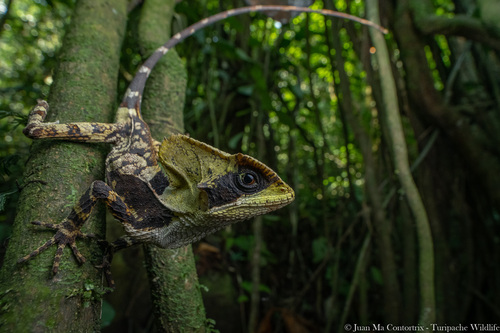
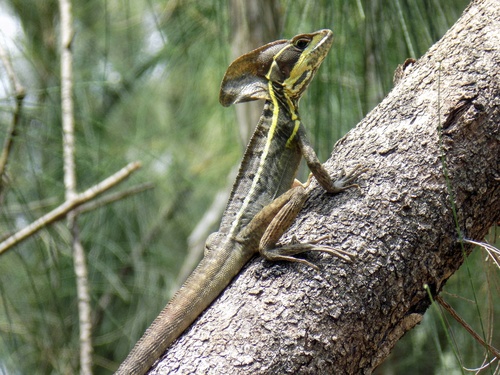
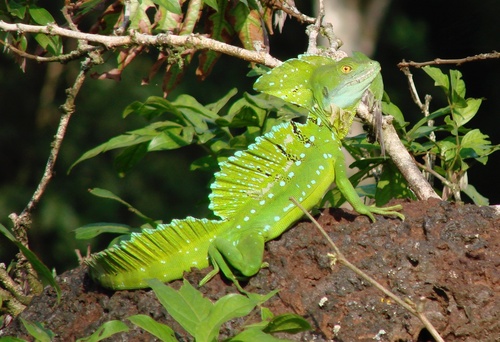
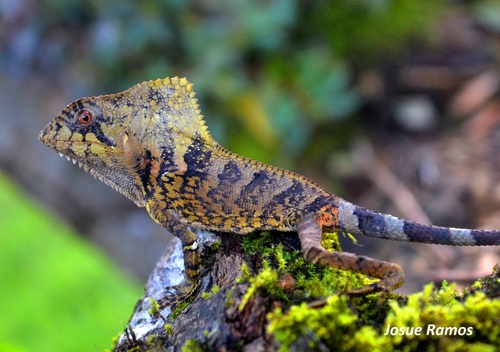
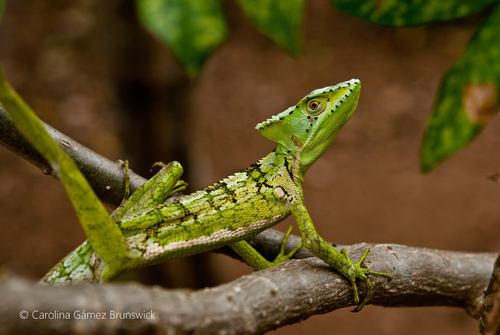
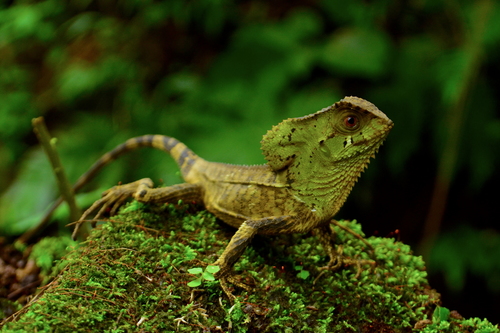
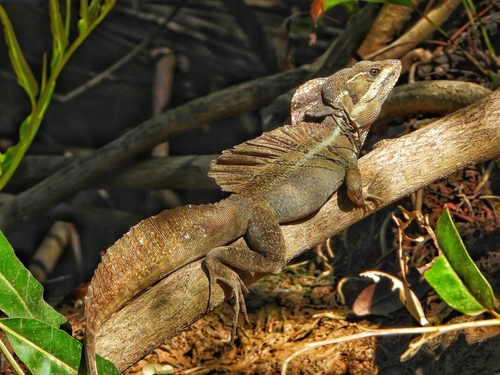
The common basilisk, Basiliscus basiliscus, can be told apart from similar species in its range by its large size and the tall fin-like crest that runs along its back. Most common basilisks are brown and cream in color. Males also have tall crests on the head and tail. Both sexes range in color from brown to olive, and have a white, cream, or yellow stripe on the upper lip, plus a second stripe running along each side of the body. These stripes have higher contrast in young juveniles, and fade as the lizards grow older. Newly hatched common basilisks weigh only 2 grams (0.071 oz), and measure 38 to 43 mm (1.5 to 1.7 in) in length. Full adults can reach a total length, including the tail, of 76 cm (2.5 feet). Females generally weigh between 135 and 194 g (4.8 to 6.8 oz), which is half the weight of males. The tail makes up 70 to 75% of the lizard's total length: for example, a 70-cm-long (27.5-inch-long) common basilisk would have a tail that is 50 cm (19.5 inches) long. The common basilisk has a large mouth with saw-like teeth on the inner sides of its jaw. While the common basilisk is most famous for its ability to run on water, it is also an excellent climber and swimmer, and has been recorded staying underwater for up to half an hour. In captivity, the common basilisk has an average lifespan of seven years; in the wild, lifespans tend to be shorter due to predators. When startled, the common basilisk escapes by speeding to the nearest edge of water, then continues sprinting across the water surface. The lizard runs only on its hind legs in an upright position, holding its forelegs close to its sides. The common basilisk is able to move skillfully across water because its feet are large and have flaps of skin along the toes that help it catch onto small air bubbles. When moving quickly, the lizard can cross a stretch of water surface before sinking. On water, it runs at an average speed of 24.1 km/h (15 mph), which is just slightly slower than its speed on land. Younger basilisks can run 10 to 20 m (33 to 66 ft) across water, while adults only cross a few meters before sinking. Adults do not move slowly, but they weigh more and cannot keep sprinting for as long a distance. Once a basilisk submerges, it continues swimming until it is far enough from its pursuer, if the predator followed it past the bank. Although the common basilisk stays near water to escape terrestrial predators, it only swims when necessary, because some aquatic animals will prey on it if given the chance. The common basilisk lives in tropical rainforests across Central America and northwestern South America. It usually inhabits low elevations, ranging from sea level up to 600 m (2,000 ft); in Costa Rica, it can be found as high as 1,200 m (3,900 ft) in some locations. The species' range extends from southwestern Nicaragua to northwestern Colombia on the Pacific side, and from central Panama to northwestern Venezuela on the Atlantic side. In Costa Rica, it is mostly found on the Pacific side of the country. The equivalent species occupying similar habitats and sharing similar biology on the Atlantic side is the green basilisk, Basiliscus plumifrons. The common basilisk has also been recently discovered in South Florida. Female common basilisks lay three to four clutches of 10 to 20 eggs each per year. The eggs hatch after around three months, and newly hatched young weigh about two grams and can be up to three inches long. Their effective camouflage lets them stay hidden when they remain motionless.