About Basileuterus culicivorus (Deppe, 1830)
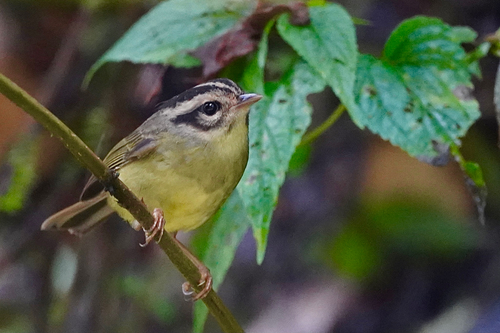
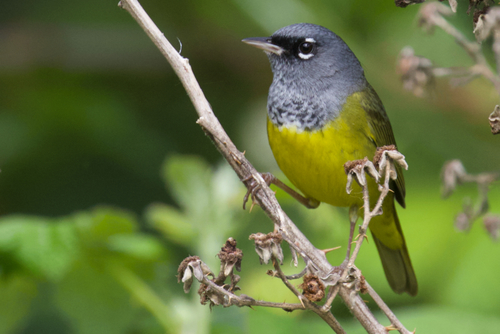
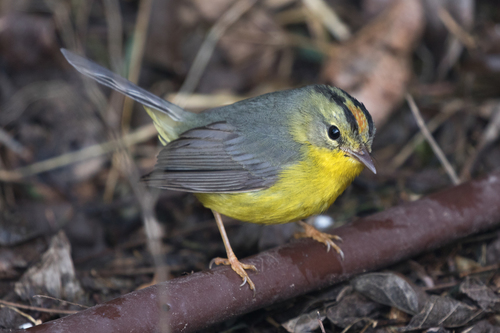
The golden-crowned warbler, scientifically named Basileuterus culicivorus (Deppe, 1830), measures 12.0–13.5 cm (4.7–5.3 in) in total length. It has grey-green upperparts and bright yellow underparts. Its head is grey, marked with a yellow crown stripe bordered by black, a yellow or white supercilium, and a black eyestripe. The sexes are similar in appearance, but immature golden-crowned warblers are duller and browner, and lack all the adult head patterning except the eyestripe. This species' subspecies are divided into four groups. The Central American culicivorus group, commonly called the stripe-crowned warbler, matches the general description of the nominate subspecies given above. The southwestern cabanisi group, known as Cabanis's warbler, has grey upperparts and a white supercilium. The aureocapillus group, called the golden-crowned warbler and found in the southeast, has a white supercilium and an orange-rufous crown stripe. The hypoleucus group contains only one subspecies, known as the white-bellied warbler, which has white underparts instead of yellow and occurs in south central Brazil. This warbler breeds from Mexico south through Central America to northeastern Argentina and Uruguay, and also on Trinidad. It mainly inhabits lowland forests.