About Barytelphusa cunicularis (Westwood, 1836)
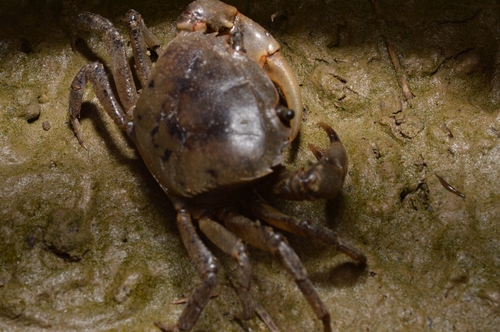
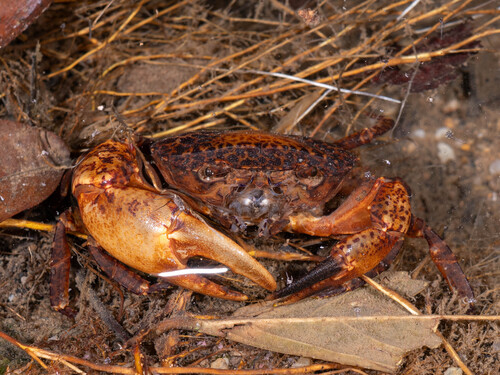
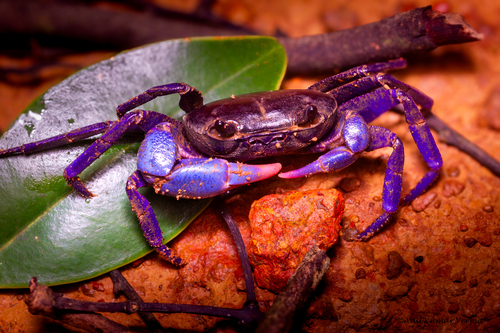
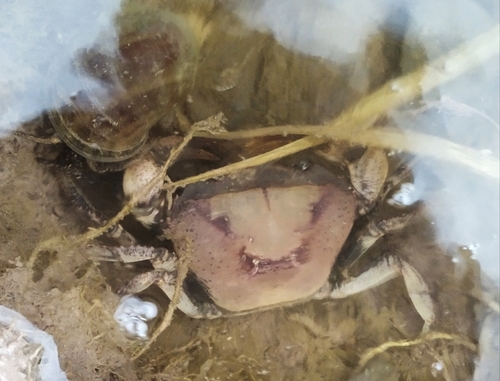
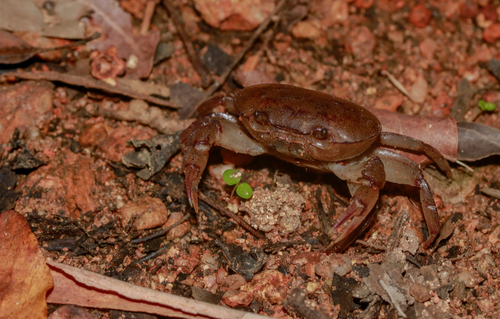
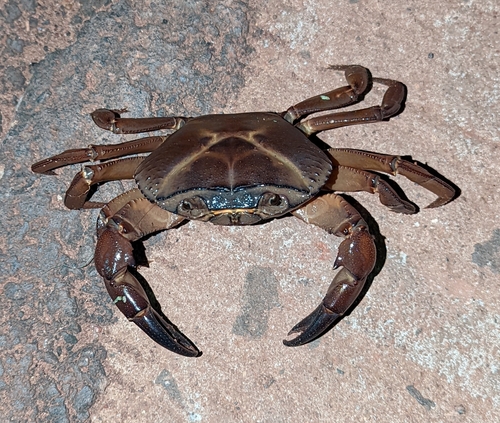
Barytelphusa cunicularis (Westwood, 1836) has a dark chestnut black, nearly smooth carapace. Its claws match the shell color, but the basal joint of the first legs and the entire surface of the other legs are much paler, taking on a dirty testaceous brown shade covered in numerous small transverse black marks. This species of freshwater crab is nocturnal. It has been observed in small pits along the banks of rivers, lakes, and reservoirs, and is most commonly found inhabiting rocky crevices adjacent to paddy fields, streams, and rivulets. It builds rectangular burrows. It has been observed in tributaries of the Godavari River in Nanded, where individuals mostly build their burrows in river beds that hold small pools with boulders and rocks. This species has been recorded between late winter and summer, from December to May. Gut analysis of wild-caught B. cunicularis shows that the species is mostly carnivorous, but will sometimes feed on decaying plant matter. A laboratory experiment that held individual crabs in air pump-aerated water and fed them dried prawns, dead trash fish, and rice flakes found the crab to be omnivorous. Wild specimens collected from the Godavari River have been observed eating the gastropods Melanoid tuberculata, Bellamya bengalensis, Bellamya dissimilis, and Taberia lineate. When feeding, the crab breaks the shells of these small, slow gastropods into 3–4 pieces, then drags out the mollusc's soft body using its chelate legs to feed. This is partial feeding: parts of the gastropod body remain inside the shell because the crab cannot remove the entire body completely, which means gastropods are a supplementary food source for this species. At the edge of a pool on a seasonal streambed in Agumbe, Karnataka, one crab was observed feeding on Pterocryptis wynaadensis, a species of catfish. It remains unclear how the crab caught this relatively large prey. At Rangana Fort, a crab was observed feeding on tadpoles of the Amboli leaping frog in a rocky crevice. Another Indian freshwater crab, Ghatiana atropurpurea, was also found in a pond full of tadpoles and has been recorded feeding on them. This co-occurrence of observations suggests that B. cunicularis may share a tendency to hunt tadpoles with other Indian freshwater crabs. Barytelphusa cunicularis is dioecious. Its spawning season runs from June to September, and females outnumber males during this June to September breeding period. Male B. cunicularis reach sexual maturity when their carapace reaches approximately 40mm in width, while females reach maturity at a carapace width of 44mm. The species' reproductive activity depends on rainfall. Gonad ripening begins in March and continues through May; by June, most gonads are fully mature and spawning begins. After spawning ends in September, the gonads enter a quiescent period. Intersexuality occurs in B. cunicularis: intersexual individuals have a male-like abdomen alongside female gonopods and gonopores. The cause of intersexuality in this species is still unknown, and further detailed study is required to identify potential factors driving this phenomenon. Barytelphusa cunicularis and Barusa guerini are consumed by humans, primarily in the state of Maharashtra. B. cunicularis is the preferred species for consumption, because Barusa guerini is smaller, has less body mass, and is considered unsuitable for cooking. Crabs are collected by specialized crab-catching communities or experts from specific castes and tribes, then sold in weekly fish markets; they are not sold in dedicated crab markets. This species is hardy: it can survive out of water in moist conditions, breathes air, and stays alive without food for several days. This makes the crabs easy to maintain, so they are in high demand in local markets. To prepare the crab for consumption, the carapace is removed, and the body is crushed with a grinder or mixer. The resulting body extract is used to make a special 'crab curry' prepared with local condiments, and the leftover carapace residue is discarded. Some consumers report that eating this species helps prevent and treat joint pain and sexual dysfunctions including erectile deficiency. An experiment to test captive growth and survival of the species found that in captivity, crabs prefer a mixed diet of clams and fish. Oil extracted from the dried meat of Barytelphusa cunicularis contains cholesterol, glycerol, and Vitamin A. It is a good source of Vitamin A, but excessive consumption should be avoided because it contains a measurable amount of cholesterol. The oil has a good saponification value, with free fatty acids measured at 34.78 mg and a low peroxide value of 4.3 mEq/Kg. The oil is insoluble in polar solvents such as methanol and ethanol, which rules out hydrogen bonding or polar interactions. It is soluble in non-polar solvents including hexane and carbon tetrachloride, indicating the compounds it contains are mostly covalent. The oil provides fat but contains no protein, and tests have confirmed it cannot act as an antimicrobial agent.