About Baryphthengus martii (Spix, 1824)
This species, commonly called the rufous motmot, is the second-largest member of its motmot family. For the nominate subspecies, males measure 42 to 47 cm (17 to 19 in) in length and weigh 146 to 160 g (5.1 to 5.6 oz), while females weigh 153 to 173 g (5.4 to 6.1 oz). For the B. m. semirufus subspecies, males weigh 185 to 193 g (6.5 to 6.8 oz) and females weigh 170 to 208 g (6.0 to 7.3 oz).
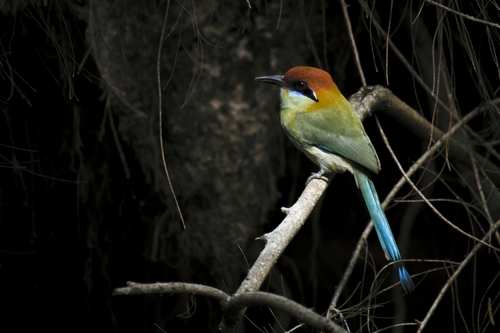
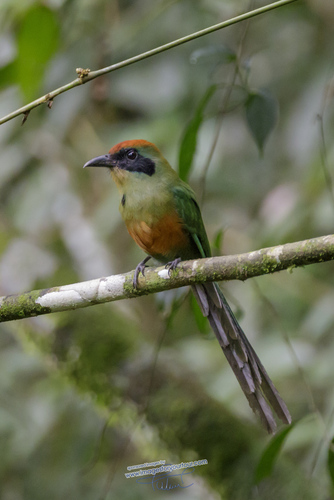
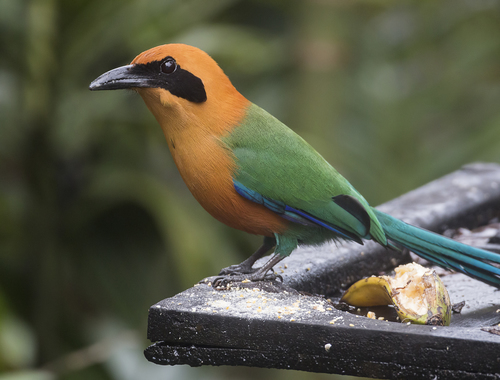
Adult rufous motmots are primarily cinnamon-rufous in color. They have a black face mask, a black central breast spot, green wings and green body sides, a greenish-blue lower belly, and dark blue tail and flight feathers. Their tails are very long; B. m. semirufus tails have bare-shafted racket tips, while nominate subspecies tails do not. The species' bill and legs are black. Juvenile rufous motmots are paler and duller than adults, and they lack the adult's tail rackets and black breast spot.
The nominate subspecies is distributed across the western Amazon Basin, ranging from southeastern Colombia through eastern Ecuador and eastern Peru to northern Bolivia, and extending east into western Brazil. The B. m. semirufus subspecies has a range completely separate from the nominate. It occurs from eastern Honduras, along the Caribbean slopes of Nicaragua, Costa Rica, and Panama, then continues along the Pacific slope of Panama into northwestern Colombia and western Ecuador.
In terms of elevation, the rufous motmot occurs from near sea level up to 1,250 m (4,100 ft) in Costa Rica, and up to 1,400 m (4,600 ft) in Panama and Ecuador. In Peru, it can be found locally up to 1,600 m (5,200 ft), though it generally occurs no higher than 1,300 m (4,300 ft). The rufous motmot lives in humid lowland evergreen primary forest, and also occurs in secondary forest. It prefers tall forest, especially areas along rivers and streams, and avoids dense foliage.