About Bartramiopsis lescurii (James) Kindb.
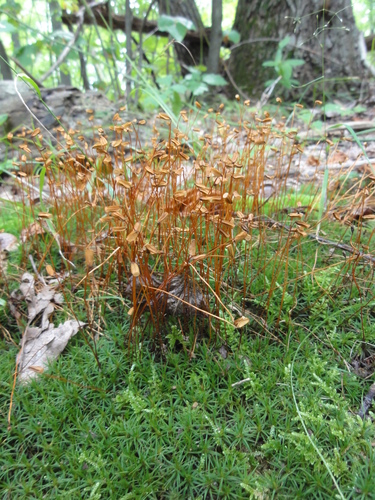
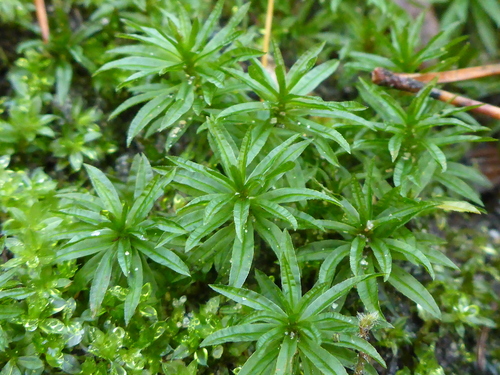
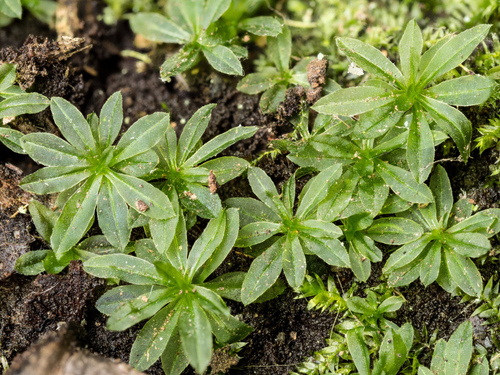
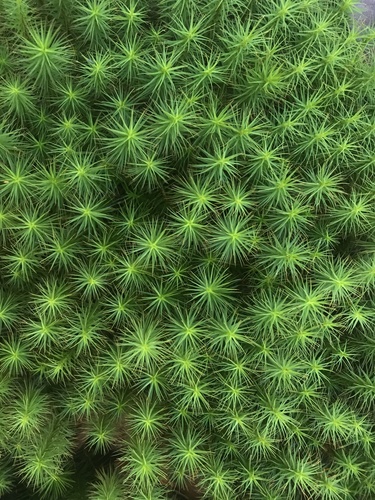
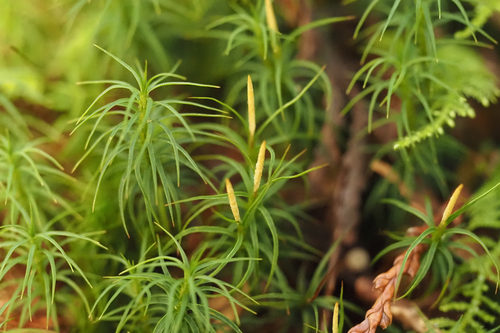
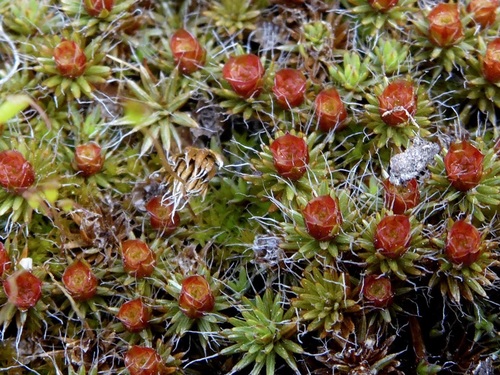
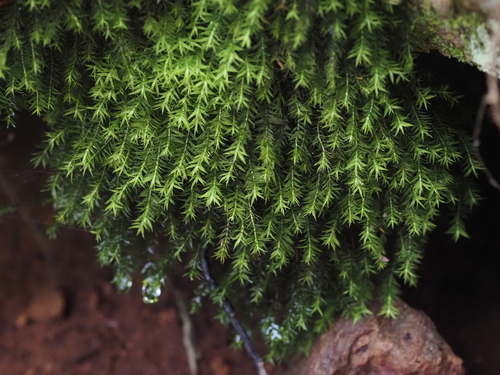
Bartramiopsis lescurii (James) Kindb. is an acrocarpous moss that grows in tufts. Its color ranges from dull olive green to dark green when young, and matures to dark reddish brown or black with age. Stems are erect and simple; they may reach up to 10 cm (3.9 in) tall, but most often grow between 2–5 cm (0.8–2.0 in) tall. The lower portion of stems bears sheathing scales and bears no leaves. When moist, its leaves spread outward; when dry, the leaves become crisp and contorted. Mature leaves measure 4–6 mm (0.16–0.24 in) long, and are linear-lanceolate shaped starting from a sheathing base. Above the sheathing base, leaves have serrated, plane margins. The costa is broad, percurrent, and smooth at the base. On the ventral surface of the costa, there are 4–9 serrate lamellae that stand 3–9 cells high. Ventral surface cells are mammillose, quadrate to irregular in shape, and have thick cell walls. The leaf sheath is unistratose and contains hyaline cells. At the shoulder between the sheathing base and the leaf blade, there are 3–5 cilia (hairs) 0.4–0.7 mm (0.016–0.028 in) long, which shorten into teeth toward the leaf blade. The lamina above the sheath is bistratose, while leaf margins are either unistratose or bistratose with an outer layer of unistratose cells. This species is dioecious. The seta is thick and measures 7–12 mm (0.28–0.47 in) long. The attached capsule is erect and yellowish-brown. After the operculum sheds, a membrane called an epiphragm sits above the capsule rim. This species lacks peristome teeth. Spores are ovate to spherical, measure 0.12–0.16 mm (0.0047–0.0063 in), and have a papillose texture. Its gametophyte persists year-round, and sporophytes generally emerge in early spring and remain attached through the plant’s life. The native range of Bartramiopsis lescurii extends from Alaska to Washington state in western North America, including British Columbia in Canada. It is also found in far eastern Russia and Japan. Documented localities include Virgin Bay, Oracle, Douglas Island, and Wrangell in Alaska, and Primorsky Krai, Sakhalin, and the Kamchatka Peninsula in Russia. It grows on soil embankments, as well as on soil overlying rock or roots. In British Columbia, it occurs in cool, shady, humid canyons, and at low elevations in wet coniferous forests near stream terraces. It is most commonly found on vertical substrates, growing in mineral soil or soil associated with upturned root systems. In eastern Russia, it has been recorded growing alongside the species Calypogeia lunulifolia and Diplophyllum taxifolium. Other associated species include Aruncus sylvester, Amelanchier alnifolia, Alnus viridis, Erythranthe lewisii, Festuca occidentalis, Saxifragaceae spp., Oligotrichum aligerum, Bucklandiella sudetica, and Diplophyllum sp. Documented nearby species include Pohlia drummondii sp, Blindia acuta, Codriophorus acicularis, Dicranum howellii, Pogonatum urnigerum, Polytrichastrum alpinum, Scapania americana, Plagiothecium piliferum, Philonotis capillaris, Pellia epiphylla, and Marsupella profunda. Bartramiopsis lescurii is a pioneer species that can be outcompeted by other bryophytes.