About Barringtonia edulis Seem.
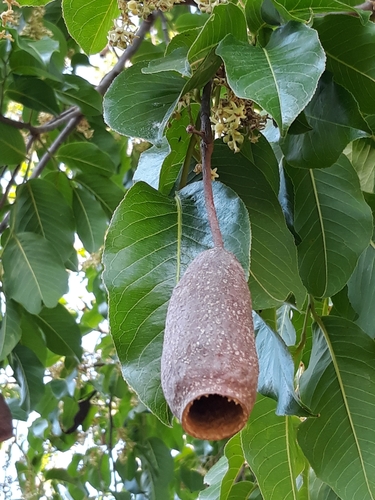
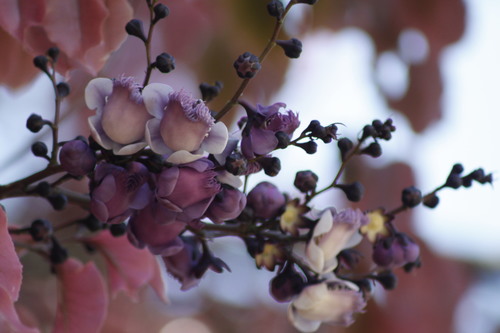
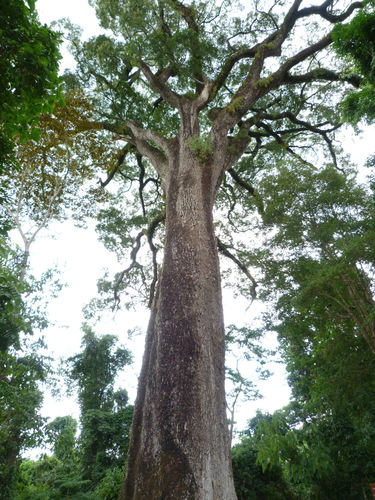
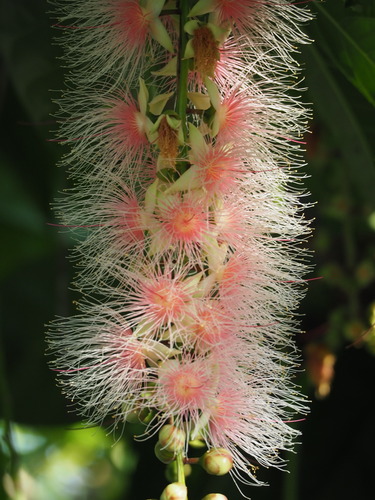
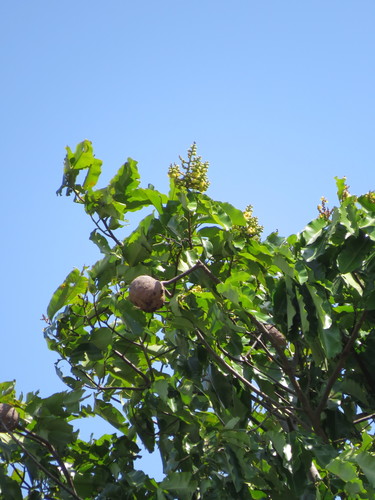
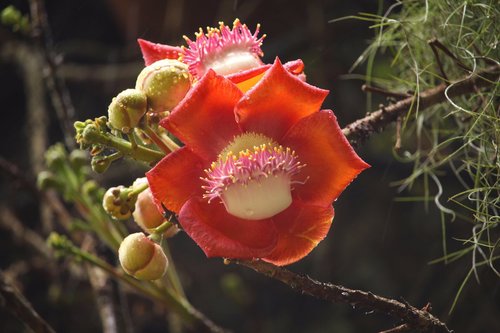
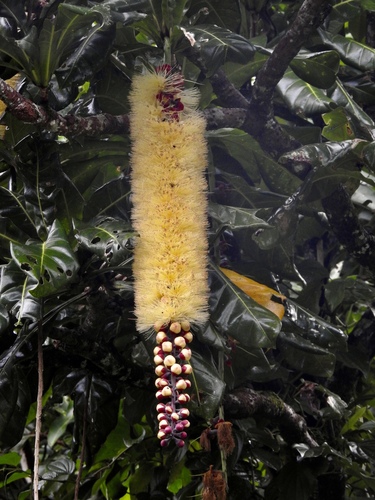
Barringtonia edulis Seem. is a little-branched evergreen tree that reaches about 18 meters (60 feet) in height. Its trunk can grow up to 40 centimeters (16 inches) in diameter, and bears smooth, greyish-brown bark. Large, glossy green leaves grow in clusters at the ends of the branches. These leaves have short petioles, and can grow up to 45 centimeters (18 inches) long and 18 centimeters (7 inches) wide. The leaf blades are simple, oblong-elliptical and entire, with slightly undulating margins, prominent veins, and acute apexes. The inflorescence is a terminal, dangling raceme that can grow up to 80 centimeters (30 inches) long. The central rachis holds a spiral arrangement of small, closely-packed tubular flowers. Each flower has a globose, reddish-brown calyx tipped by two to four red lobes, four squarish white petals, a projecting dense cluster of stamens, and a single long style. The fruits are oblong berries with persistent calyces, growing up to 10 centimeters (4 inches) long. They are covered in densely matted short hairs, are greyish-green, and turn reddish or purplish when ripe. Barringtonia edulis is endemic to Fiji and Vanuatu. It grows in humid coastal forests at altitudes below 400 meters (1,300 feet). It also grows beside roads, footpaths, and near human habitations, and is cultivated in gardens for its attractive glossy foliage and edible fruits. The flowers of Barringtonia edulis are pollinated by moths and bats. The tree is a host to several fruit fly species, including the oriental fruit fly (Bactrocera dorsalis), the Pacific fruit fly (Bactrocera xanthodes), and the Fijian fruit fly (Bactrocera passiflorae). The fruits can be eaten raw or cooked, though they are described as insipid. The seeds are also edible, with a flavor similar to peanuts. The bark is used in traditional medicine to treat stomach problems and gonorrhoea, and to induce abortion. The light wood burns quickly and is used for firewood. The timber is used for light construction, crating, and making canoe paddles.