About Barringtonia asiatica (L.) Kurz
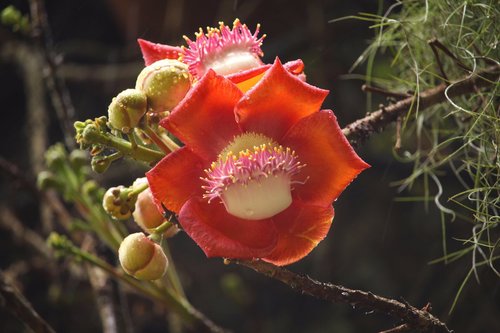
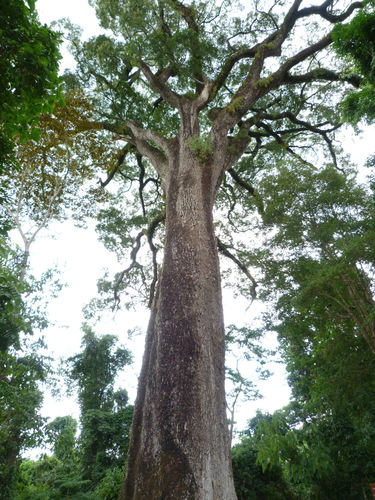
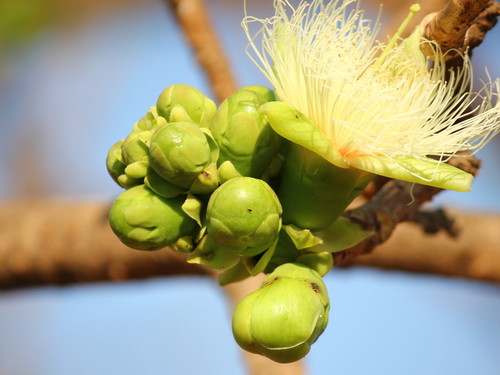
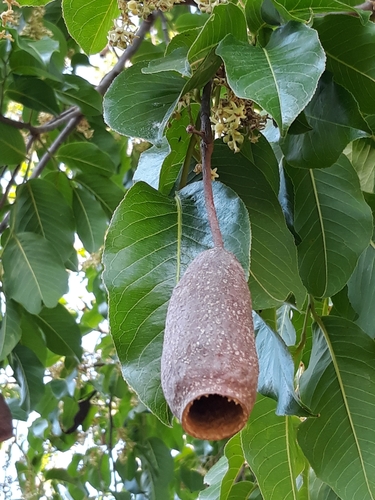
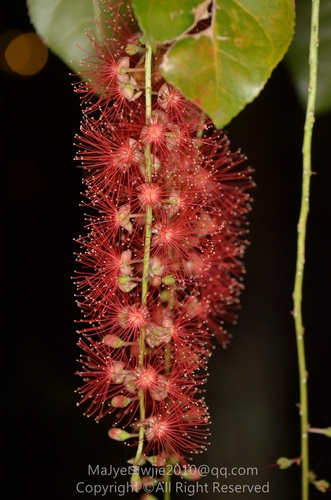
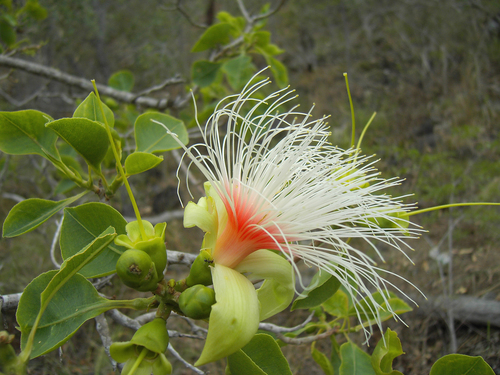
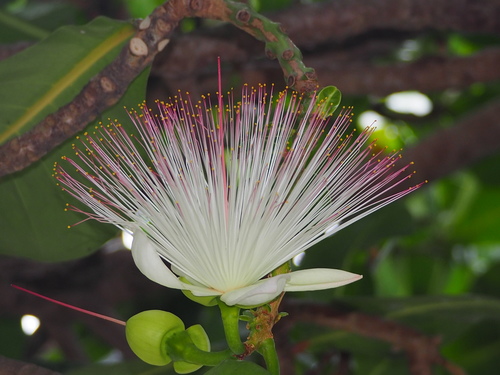
Barringtonia asiatica (L.) Kurz is a tree that usually reaches about 20 m (66 ft) in height, occasionally growing up to 30 m (98 ft), with a trunk diameter of up to 30 cm (12 in). Its trunk is irregularly shaped and often leaning, with dark, coarse bark. Its leaves are obovate (pear-shaped, widest at the tip and narrowest at the base), glossy green, somewhat waxy, and can grow up to about 40 cm (16 in) long and 20 cm (7.9 in) wide. Leaf margins are unlobed, and the petiole (leaf stalk) is very short or absent entirely. Flowers grow in erect racemes at the ends of branches, with each raceme holding up to 20 flowers. The calyx is completely fused during bud development, splits into two uneven parts when the flower opens, and remains attached even after the fruit matures. The flowers are large, showy, and fragrant, with numerous long stamens that are white at the base and pink or purple at the tip. There are four white petals, and the entire flower reaches about 15 cm (5.9 in) in diameter. The fruit is large and somewhat pyramid-shaped. Its cross section is roughly square, while its longitudinal section is roughly ovate or triangular, with the widest part at the base that attaches to the stalk. Fruit measure about 11 cm (4.3 in) long and 9 cm (3.5 in) wide, and contain one seed, or rarely two seeds. Barringtonia asiatica is native to tropical coastlines ranging from Tanzania and Madagascar to India, Southeast Asia, Australia, the Solomon Islands, New Caledonia, Fiji, and many other islands of the western Pacific Ocean. It has been introduced to the Cayman Islands, Cuba, the Dominican Republic, Haiti, the Leeward Islands, Puerto Rico, Trinidad-Tobago, and the Windward Islands. It grows on beaches and in coastal forests at altitudes up to 100 m (330 ft). This tree's flowers open at night and are pollinated by bats and moths. The fruit has a thick spongy layer around the seed that makes it very buoyant, allowing dispersal by ocean currents. Testing has shown fruit can remain afloat for up to fifteen years, though most only survive for up to two years in the ocean. Dispersed fruit have been found on beaches as far away as Ireland and the Netherlands, and Barringtonia asiatica was one of the first plants to colonize the island of Anak Krakatau after the massive 1883 eruption. The plant is highly toxic to humans. Many traditional cultures use its bark and seeds as a fish poison. The bark and seeds are crushed or pounded to release contained saponins, then placed in slow-moving freshwater streams or coral lagoons. This kills or stuns fish quickly, though the mechanism behind this effect is not fully understood. Fruit have been used as floats for fishing nets. The timber is not very hardy, so it has limited use. Bark, leaves, and fruit have been used to treat medical complaints including headaches, backaches, sores, and bad dreams. This tree has ornamental flowers and foliage, provides good shade, and is widely planted in tropical parks and gardens. In Cairns, Australia, nearly 100 individuals have been planted in local streets and parks.