About Barnardius zonarius (Shaw, 1805)
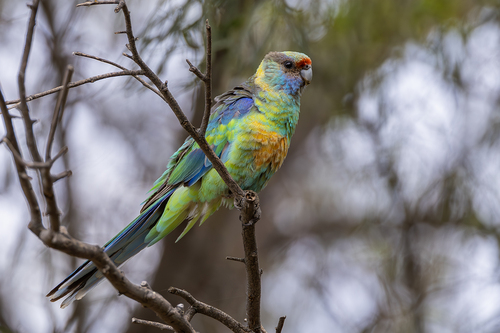
This species, commonly known as the Australian ringneck, has four subspecies that differ considerably in colouration. It is a medium-sized species around 33 cm (13 in) long. Its basic body colour is green, and all four subspecies share the characteristic yellow ring around the hindneck; wings and tail are a mixture of green and blue. Subspecies B. z. zonarius and B. z. semitorquatus both have a dull black head, with brilliant green back, rump and wings, and bluish-green throat and breast. The difference between these two subspecies is that B. z. zonarius has a yellow abdomen while B. z. semitorquatus has a green abdomen; B. z. semitorquatus also has a prominent crimson frontal band that B. z. zonarius lacks. Intermediate individuals between these two subspecies show characteristics of both. The remaining two subspecies differ from B. z. zonarius and B. z. semitorquatus by having bright green crown and nape, and flushed cheek-patches. The underparts of B. z. barnardi are turquoise-green with an irregular orange-yellow band across the abdomen; the back and mantle are deep blackish-blue, and this subspecies has a prominent red frontal band. B. z. macgillivrayi is generally pale green, with no red frontal band, and a wide uniform pale yellow band across the abdomen. The calls of the Mallee ringneck (B. z. barnardi) and Cloncurry parrot (B. z. macgillivrayi) have been described as "ringing", while the calls of the Port Lincoln ringneck (B. z. zonarius) and Twenty-eight parrot (B. z. semitorquatus) have been described as "strident". The common name Twenty-eight is an onomatopoeia derived from the species' distinctive call, which sounds like "twenty-eight" — or the French equivalent, vingt-huit, according to one early description.