About Barleria prionitis L.
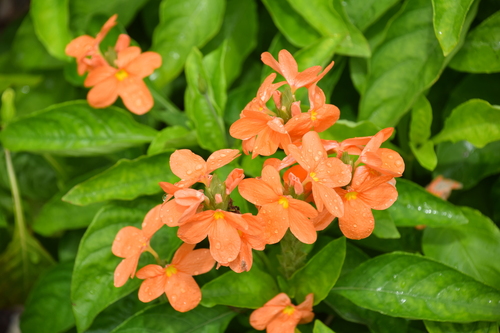
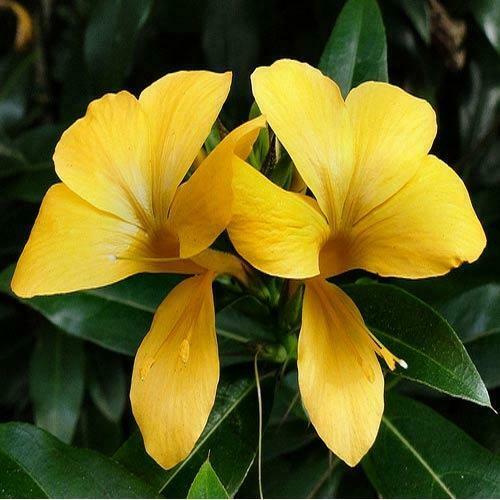
Barleria prionitis L. is a much-branched shrub that grows up to 1.8 meters tall. A defining characteristic of this species is the 1–2 cm long spines found in its lower leaf axils. Its stems and branches are terete, smooth, lenticellate, and glabrous. The leaves range from elliptic to ovate, measuring 4–10.5 cm long by 1.8–5.5 cm wide. When young, both leaf surfaces are pubescent, but they quickly become glabrescent as they mature. Its large golden-yellow flowers cluster in the axils of upper leaves and/or on bracts. This species can be distinguished from other Barleria by its apically spinose calyx lobes and yellowish to orange corolla. Flowering occurs from October to December and fruiting from December to February in China; it flowers year-round in Pakistan. In Australia, flowering and fruiting occur in three distinct periods: March to June, August to October, and December. The subspecies pubiflora differs from the nominate subspecies by having longer anthers (5 mm or more), a longer corolla (4.5–7 cm), and larger leaves that grow up to 17 cm long by 5.5 cm wide. The nominate subspecies is native to Island and Mainland Southeast Asia, China, and the Indian subcontinent as far west as Pakistan. It is recorded in Indonesia (Maluku, Nusa Tenggara, Bali, Sulawesi, Jawa), Philippines, Peninsular Malaysia, China (Yunnan), Vietnam, Thailand, Laos, Myanmar (Kachin, Magway, Mandalay, Sagaing, and Yangon), Bangladesh, India (Nicobar Islands, Assam, Laccadive Islands), the West Himalaya region, Sri Lanka, Maldives, and Pakistan. It has become naturalised in Nauru, Australia (Top End of the Northern Territory, northern Western Australia), Andaman Islands, Rodrigues, Mauritius, Réunion, Seychelles, Leeward Islands, Windward Islands, Puerto Rico, and Jamaica. There is uncertainty whether it is native, naturalised, or cultivated in Sudan, Kenya, Tanzania, Angola, Mozambique, Malawi, Botswana, Namibia, South Africa (KwaZulu-Natal, Transvaal), and Madagascar. Barleria prionitis subsp. pubiflora has a much smaller native range, restricted to coastal and subcoastal western India, Himalayan foothills, eastern Punjab, and southeast Pakistan. Barleria prionitis subsp. appressa is native to Saudi Arabia and Yemen. Barleria prionitis subsp. induta is native to northern Ethiopia and Eritrea. This shrub grows in habitats including roadsides, thickets, and dry areas within evergreen broad-leaved forests, occurring at elevations up to 600 m. In Myanmar, it prefers fields and pastures. It is a fast-growing perennial that is widely cultivated as an ornamental plant, and has frequently escaped to grow as a weed in disturbed areas, forest edges, rocky outcrops, near streams, along roads, and in overgrazed pastures across many tropical regions. It can grow in a wide range of climates and soil types, and is adapted to open, full sun areas, highly disturbed sites, and the understory of secondary forests. It has strong dispersal ability, reproducing sexually via seeds and vegetatively via stem fragments. It has the potential to cause economic and environmental harm: it forms dense thickets that displace native vegetation and prevent native plants from re-establishing, can impede livestock movement, restrict access to waterways, and reduce aesthetic values. It is listed on Australia’s alert list for environmental weeds due to its potential to cause serious ecosystem degradation. Barleria prionitis commonly acts as a host for the larvae of the butterflies Phalanta phalantha and Junonia lemonias. In Pakistan, it is grown as a hedge, and its bitter quinine-like extract is used in traditional medicine to treat whooping cough and tuberculosis. It is widely cultivated as an ornamental plant. In Indonesia, it is an ingredient in traditional medicines (obat). The Tetum people of Belu, west Timor, use its leaves to treat infected wounds. On the small Gili Iyang Island, northeast of Jawa, it is used to treat toothache. Plant parts are bitter and astringent, and in Myanmar they are considered highly beneficial for treating skin, blood, and other diseases. The whole plant, leaves (sometimes burnt to ash or crushed for juice), stems, branches, and roots are used individually or together, often combined with sesame oil and fermented rice washing water. In India, the root is applied to boils and glandular swellings, the bark is used to treat dropsy, and the leaf is used for toothache and rheumatism. It is used for various medicinal purposes in Ayurvedic medicine. Leaf juice is applied to the feet to prevent maceration and cracking during the monsoon season. Its leaves contain 6-Hydroxyflavone, a chemical compound that acts as a noncompetitive inhibitor of the protein cytochrome P450 2C9.