About Barbonymus schwanefeldii (Bleeker, 1854)
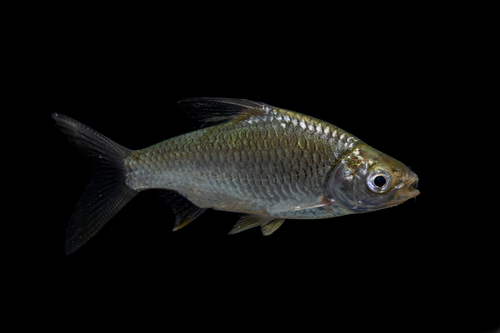
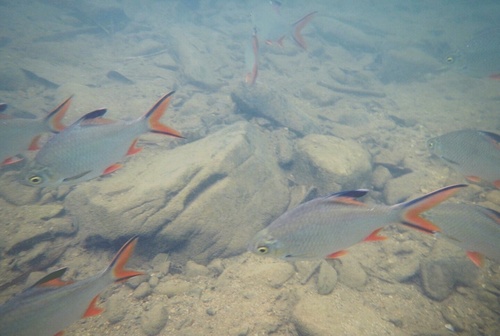
The tinfoil barb, with the accepted scientific name Barbonymus schwanenfeldii, is a tropical freshwater cyprinid fish native to Southeast Asia. This species was originally described as Barbus schwanenfeldii by Pieter Bleeker in 1853, and has also been previously classified in the genera Barbodes and Puntius. Its specific epithet is frequently misspelled as schwanefeldii. Today, the species is usually placed in the genus Barbonymus, which was only established in 1999. It is the type species of this genus, and appears to represent a quite distinct lineage of large "barbs". It is not very similar to the barbels that form the core of the genus Barbus. While it is closer to these Barbus barbels than to some African barbs, it is even more closely related to common carp (Cyprinus carpio) and Cyclocheilichthys than to either group. The tinfoil barb can be distinguished from other species in its genus by several physical traits: a red dorsal fin with a black blotch at the tip, red pectoral, pelvic and anal fins, and a red caudal fin with a white margin and a black submarginal stripe along each lobe. It also has 8 scale rows between the dorsal-fin origin and the lateral line. Large living individuals are silvery or golden yellow, with a red dorsal fin and an orange or blood-red caudal fin. It can grow up to 14 inches (36 cm) in length, and has a typical lifespan of 10 to 15 years. The tinfoil barb originates in the Mekong and Chao Phraya basins of Thailand, Cambodia, Laos, and Vietnam, as well as in Sumatra, Borneo, and the Malayan peninsula. It can be found in rivers, streams, canals, and ditches, and also enters flooded fields. Its native habitat has water with a pH between 6.5 and 7.0, water hardness up to 10 dGH, and a typical temperature range of 72–77 °F (22–25 °C). In Indonesia, this species has been recorded in waters with temperatures ranging from 20.4 °C to 33.7 °C. The tinfoil barb is largely herbivorous. It feeds on aquatic macrophytes, submerged land plants, and filamentous algae, and will occasionally eat insects. It also consumes small fishes, worms, and crustaceans. This species is commercially important for the aquarium hobby trade, commercial aquaculture, and subsistence farming, and is occasionally used as bait. It is usually marketed fresh. There are no obvious external characteristics that can be used to determine the sex of tinfoil barbs. They reproduce by egg scattering, and lay several thousand eggs per spawning event. They are not often bred in captivity for the aquarium trade, due to their large adult size.