About Barbonymus gonionotus (Bleeker, 1849)
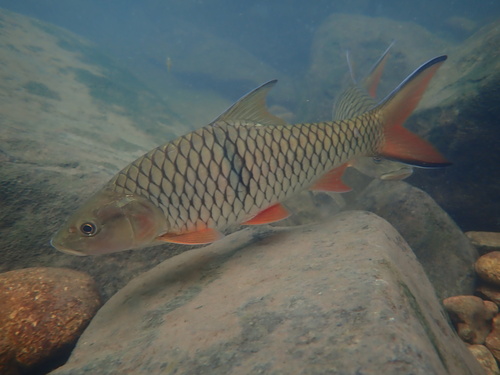
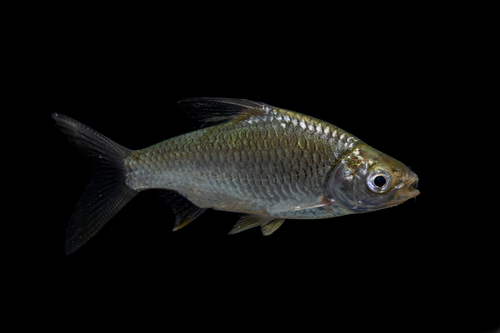
Barbonymus gonionotus, commonly called the Java barb or silver barb, has a strongly compressed body with an elevated back formed by an arched dorsal profile. It has a small head with a short, pointed snout and a terminal mouth, and the length of the snout is less than the diameter of the eye. It has very small barbels, and the upper barbels are minute, even disappearing entirely in some individuals. Fresh specimens are silvery white in colour, occasionally tinted with gold. The dorsal and caudal fins are grey to grey-yellow; the anal and pelvic fins are pale orange with reddish tips; and the pectoral fins are pale yellow. It has very few tubercles on the snout, which are only visible when viewed under magnification. The dorsal fin has four spines and eight soft rays, while the anal fin has 3 spines and 6-7 branched rays. Males of this species can grow to 40.5 cm (15.9 in) in total length. The Java barb's natural distribution ranges from Vietnam, where it has been recorded in the Mekong Delta and Dong Nai River, through the Mekong basin to the Chao Phraya basin in Thailand. It is also found on Sumatra and Java, and has been recorded from the Rajang River basin in Sarawak, Borneo. An introduced population of Java barb has been found in Peninsular Malaysia. The Java barb occurs in the middle to bottom of the water column in rivers, streams, floodplains, and sometimes in reservoirs. It shows an apparent preference for still water habitats rather than flowing waters. During periods of raised water levels, it moves into flooded forest. Its diet consists of plant matter including leaves, weeds, Ipomoea reptans and Hydrilla, as well as some invertebrates. It is not a long distance migrant, but it is a local migrant in the Mekong: it moves during the rainy season from the main river channel into small streams and canals, then into flooded areas, and returns as the water recedes. Upstream migration of the Java barb seems to be triggered by the first rains and rising water levels. The silver barb is one of the five most important aquacultured freshwater species in Thailand. It is a short-cycle species that, like tilapia, can be farmed with low technology and relatively less effort than other species, so it is popular as a farmed fish in Bangladesh, where it is known as Thai sharputi. The pituitary gland of the Java barb is frequently used to enable artificial propagation of other fish species in aquaculture. Escaped farmed Java barb have established populations that support fisheries on several Southeast Asian islands. This species is also considered useful in controlling excessive vegetation in reservoirs. It can be infrequently found in the aquarium trade. In fish farms, silver barbs rarely exceed 40 cm (16 in) in length and 1.5 kg (3 lb 5 oz) in weight. However, a 2.8 kg (6 lb 3 oz) specimen was caught in the Teak Tree Lake in Thailand, and a rod and reel record specimen with a weight of 13 kg (28 lb 11 oz) and a length of 90 cm (35 in) was caught in Malaysia. It is an important food fish in Thai, Lao and Cambodian cuisine. In Laos it is commonly used as an ingredient for larb. In Thailand it is usually either pickled as pla som (ปลาส้ม) or boiled in tom yam.