About Barbatula barbatula (Linnaeus, 1758)
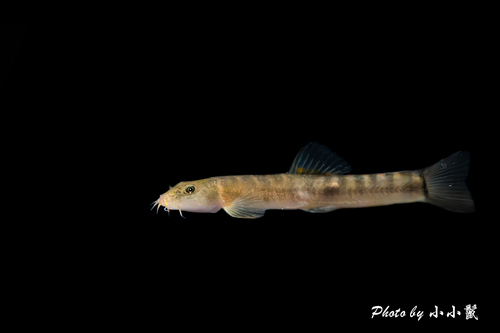
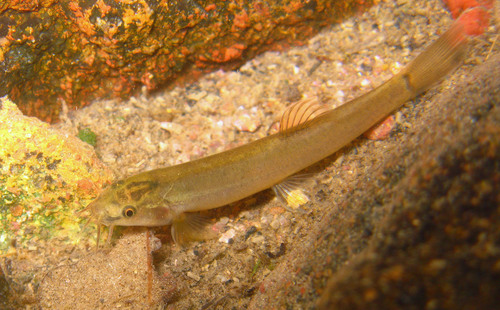
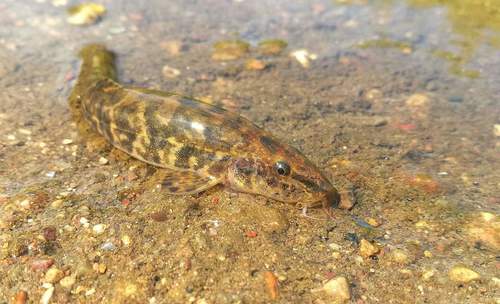
Barbatula barbatula, commonly known as the stone loach, is a small, slender bottom-dwelling fish. It can reach a maximum length of 21 cm (8.3 in), but most individuals grow to around 12 cm (5 in). Its eyes sit high on the head, and it has three pairs of short barbels on the lower jaw below the mouth. It has a rounded body that is only slightly flattened laterally, and is slightly less deep-bodied than the spined loach (Cobitis taenia). Unlike the spined loach, the stone loach has no spines beneath the eye. Both its dorsal and caudal fins are rounded with slightly notched tips; the spined loach’s fins are even more rounded than those of the stone loach. The stone loach’s base body color is yellowish-brown, marked with darker blotches and vertical bands. An indistinct dark stripe runs from the snout to the eye, and its brownish fins feature faint dark banding.
The stone loach is a common species found across most of Europe, in suitable clear rivers and streams with gravel and sandy bottoms. It also lives in well-oxygenated upland waters, chalk streams, lakes, and reservoirs. Individuals sometimes enter estuaries, but do not move into brackish water. Stone loach live on the river or lake bottom, often staying partly buried. They are most active at night, when they search through sand and gravel to feed on small invertebrates. Confirmed populations of this species are recorded in the Baltic states, Eastern Europe, Austria, Belgium, Bulgaria, Czech Republic, Denmark, Finland, France, Germany, Hungary, Ireland, Italy, Liechtenstein, Luxembourg, Moldova, the Netherlands, Poland, Romania, Serbia and Montenegro, Slovakia, Slovenia, Spain, Sweden, Switzerland, and the United Kingdom. The species has been extirpated from Greece.