About Baptisia bracteata Muhl. ex Elliott
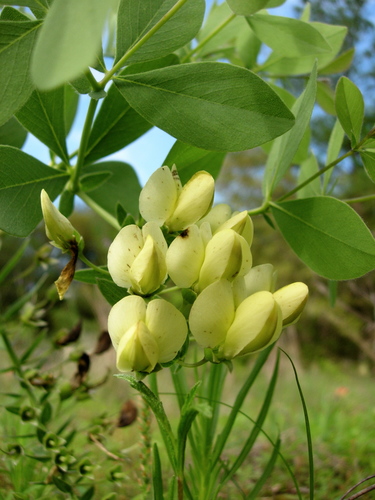
Baptisia bracteata Muhl. ex Elliott grows from its root system as one or more stems, reaching up to 46 cm (1.5 ft) in height. It forms a bushy plant with occasionally branching stems, and can grow up to 91 cm (3 ft) wide. Its stems are round, and range in color from light green to purple. Leaves are arranged alternately along the stem, and are split into 3 leaflets that measure 3–8 cm (1–3 in) long and 1–3 cm (0.5–1 in) across. The leaflets have smooth margins and are typically oblanceolate in shape. The inflorescence is a long raceme 10–30 cm (4–12 in) long, which droops below the plant's foliage under its own weight. Each raceme holds anywhere from a few to many pea-shaped flowers, plus leaflike, lanceolate bracts 10–30 cm (4–12 in) long. Flower colors range from white to creamy yellow. After flowering, the plant produces oval to cylindrical seed pods 3–5 cm (1–2 in) long. Extrafloral nectaries have been recorded on this species. Baptisia bracteata is native to the United States, ranging from Minnesota in the north, to Texas in the west and south, and to North Carolina in the east. It grows in prairies, rocky woods, fields, and alongside streams. Ecologically, its flowers bloom from April to June, and are pollinated by bumblebees that are actively nesting during this period. The caterpillars of multiple skipper species, including the wild indigo duskywing and the hoary edge, feed on its leaves. This plant is poisonous to mammalian herbivores.