About Baptisia australis (L.) R.Br.
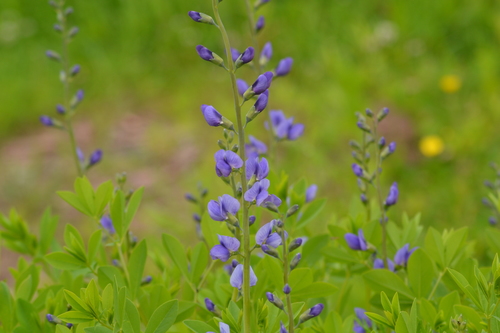
Baptisia australis (L.) R.Br. is an herbaceous perennial plant that reproduces both sexually and asexually via spreading rhizomes. This erect plant grows from an interconnected rhizome network, and has deep, branched roots that help it survive drought. When dug up, the roots are woody, black, and bear tubercles, which are wart-like projections on the root surface. The plant branches extensively starting about halfway up its height. Stems are stout and glabrous (hairless); when broken, stems release a sap that turns dark blue when exposed to air. Mature plants reach 1 to 1.5 metres (3 ft 3 in to 4 ft 11 in) tall, and 0.6 to 1 metre (2 ft 0 in to 3 ft 3 in) wide. It has grey-green, alternately arranged trifoliate leaves, divided into clover-like obovate leaflets (wider toward the leaf tip). Flower spikes develop in early summer: short, upright terminal racemes grow at the top of stems, holding pea-like flowers that range in color from light blue to deep violet. Flowering occurs from spring to summer depending on location; flowers are bisexual and roughly 2.5 cm (0.98 in) long. The fruit is a bluish black, inflated, hardened pod 2.5 to 7.5 cm (0.98 to 3.0 in) long and 1.25 to 2.5 cm (0.49 to 0.98 in) wide. Pods are oblong with a sharp tip at the apex, and hold multiple loose seeds when mature. Seeds are yellowish brown, kidney-shaped, and approximately 2 mm (0.079 in) in size. Leaves emerge around one month before flowering, and are shed roughly one month after pods form. Once seeds are fully mature, stems turn silverish grey and break away from the roots; pods stay attached to the broken stems, which are blown to new locations to spread the plant. Young shoots of Baptisia australis have been mistaken for asparagus, which has resulted in poisoning. The seeds may be toxic, especially to children. Baptisia australis is the most commonly cultivated species in its genus, and is grown outside its native continent, including in Great Britain where it has earned the Royal Horticultural Society's Award of Garden Merit. It is considered a desirable garden plant for its deep blue to violet spring flowers, attractive light green compound leaves, and unusual oblong fruits that develop in late summer. In garden settings, Baptisia australis can grow aggressively and requires regular pruning. It grows best in lime-free, well-drained stony soil in full sun to part shade. Cultivated garden plants reach around 90 to 120 cm (3.0 to 3.9 ft) tall with a similar spread. Like other species in the genus, it has a very deep taproot that makes it very difficult to transplant after planting. It grows well in full sun, and only needs additional watering during periods of low rainfall. A minor downside is that its leaves tend to drop early in autumn, but this can be avoided by cutting dead stems back as they die. It is hardy in USDA plant hardiness zones 3 through 8, and is often used as a border plant in gardens. While there are no widely available cultivars, several hybrids involving B. australis have been developed, such as 'Purple Smoke', a cross between B. australis and Baptisia alba. The variety B. australis var. minor is also sometimes used in gardens; it grows much shorter, reaching only 30 to 60 cm (1 to 2 ft) tall, but its flowers are the same size as those of the main species. Several Native American tribes have used this plant for a range of purposes. The Cherokee traditionally used it as a source of blue dye, a practice that European settlers later adopted. The Cherokee also used the roots in tea as a purgative, and to treat toothaches and nausea, while the Osage made an eyewash from the plant. Ripened seed pods have been used as children's rattles.