About Baptisia alba (L.) R.Br.
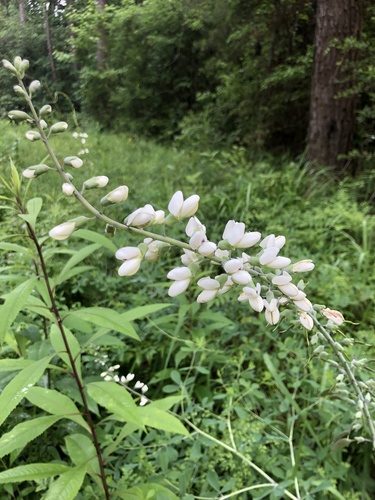
Baptisia alba (L.) R.Br. has alternately arranged leaves that are compound, trifoliate, narrow, oblong, and share a common stalk. Its white flowers grow from a long spike inflorescence. These flowers are papilionaceous, characterized by an irregular shape, five petals, and bilateral symmetry. Blooming takes place from April to July, with earlier blooming in the southern part of the species' range. The species is native to grasslands, but it is cultivated in some gardens. It can also grow in disturbed habitats including roadsides, hiking trails, and railways, and it prefers moist soils. There are two recognized varieties of Baptisia alba. Baptisia alba var. alba, which has the synonym B. pendula, can be distinguished from B. alba var. macrophylla, which has the synonyms B. lactea and B. leucantha, by two key traits: B. alba var. alba occurs only in the southeastern United States, and its ripe fruits hang downward. Across its entire range, Baptisia alba is classified as a facultative upland plant. In ecological interactions, B. alba acts as a host plant for caterpillars of the wild indigo duskywing butterfly and the indigo stem borer moth. Its flowers are pollinated by bumblebees. Regarding toxicity, ingesting Baptisia alba can be fatal to cows. For humans, it can cause skin irritation and is possibly poisonous.