About Baorangia bicolor (Kuntze) G.Wu, Halling & Zhu L.Yang
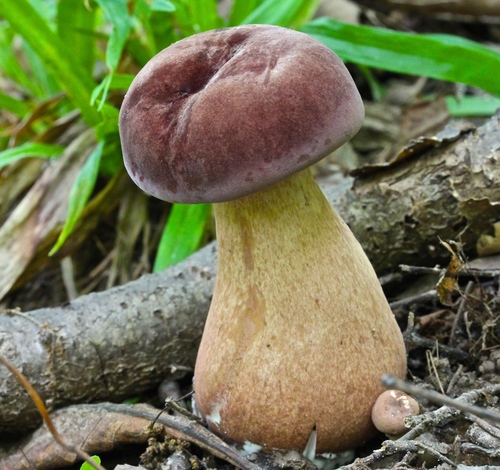
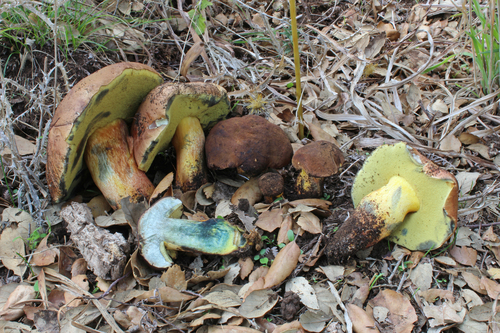
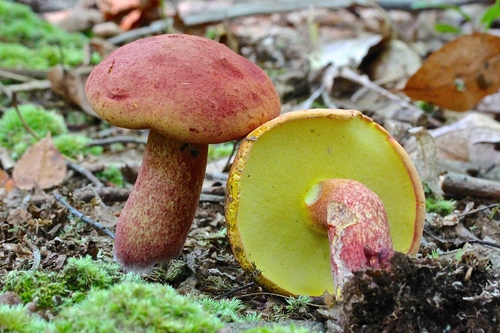
Baorangia bicolor (Kuntze) G.Wu, Halling & Zhu L.Yang, commonly called the two-colored bolete, has caps that are light red when young and turn brick red when mature. Mature caps are 4–15 cm (1+1⁄2–6 in) wide, with yellow pores on the underside. This is one of several bolete species with an unusual trait: the pore surface darkens to dark blue or indigo when injured, though this color change happens more slowly than it does in other bluing boletes. Exposed flesh also turns dark blue, but the change is less dramatic than what occurs on the pore surface. Its stem measures 5–10 cm (2–4 in) long and 1–3 cm (3⁄8–1+1⁄8 in) thick. The stem is yellow at the apex, and red or rosy red across its lower two-thirds. When injured, the stem bruises blue very slowly, and sometimes shows almost no color change at all. The stem has neither a ring nor a partial veil. Microscopically, this species produces an olive-brown spore deposit. Spores viewed in face view are slightly oblong to ventricose; in profile view, they are roughly inequilateral to oblong, with a shallow suprahilar depression. When mounted in potassium hydroxide solution (KOH), spores appear nearly hyaline (translucent) to pale dingy ochraceous, have a smooth surface, and measure 8–12 by 3.5–5 μm. The tube trama is divergent and gelatinous, originates from a single central strand, is not amyloid, and often stains yellow-brown when placed in dilute potassium hydroxide (KOH). The two-colored bolete is distributed across southeastern Canada, the Great Lakes Region, primarily east of the Rocky Mountains, south as far as the Florida peninsula, and west into the Midwest to Wisconsin. It is commonly found in deciduous woodland, usually growing under or near broad-leaved trees, especially oak. It can grow alone, in groups, or in clusters, and is mostly found between June and October. It also occurs in China and Nepal. This unusual wide, disconnected range is an example of Grayan disjunction, a phenomenon where a species lives on two opposite sides of the world with no populations in between the separate habitats, which is not uncommon among fungi.