About Banksia sessilis (Knight) A.R.Mast & K.R.Thiele
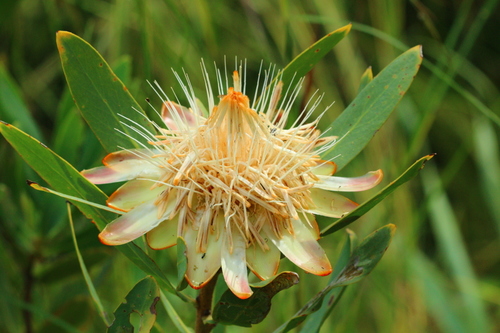
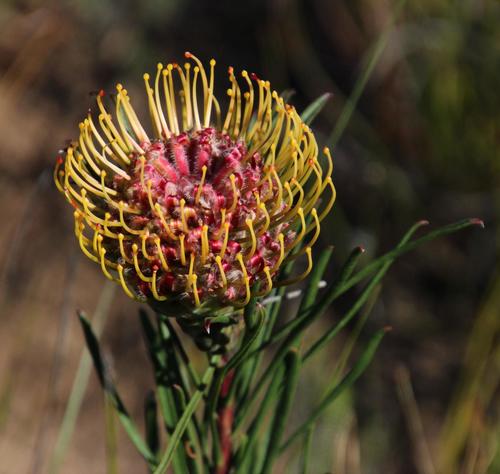
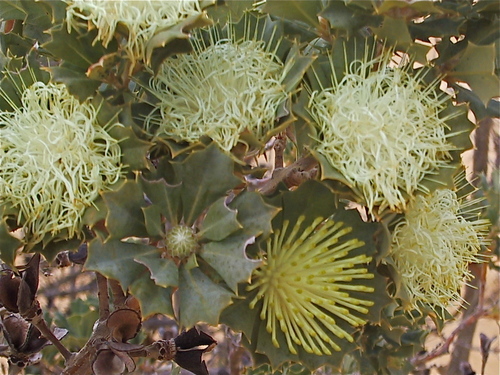
Banksia sessilis (Knight) A.R.Mast & K.R.Thiele grows as an upright shrub or small tree reaching up to 6 m (20 ft) high, and does not form a lignotuber. For most varieties, new stems are covered in soft, fine hairs that are shed as the plant matures; new stems of B. sessilis var. flabellifolia are usually hairless. Leaves are either blue-green or dark green, and their shape varies by variety: in var. cygnorum and var. flabellifolia, leaves are wedge-shaped with teeth only near the apex; in var. cordata, leaves are wedge-shaped with teeth along the entire margin; and in var. sessilis, leaves are somewhat broader at the base, sometimes taking an almost oblong shape. Leaf length ranges from 2 to 6 cm (1 to 2.5 in), and leaf width ranges from 0.8 to 4 cm (0.3 to 1.6 in). Leaves may be sessile, meaning they grow directly from the stem without a petiole, or they may sit on a petiole up to 0.5 cm (0.20 in) long. The inflorescences are cream or yellow, forming domed heads 4 to 5 cm (1.6 to 2.0 in) wide that grow at the end of stems. Each head holds 55 to 125 individual flowers, with a whorl of short involucral bracts surrounding the base of the head. Like most other Proteaceae, individual flowers of B. sessilis consist of a tubular perianth made of four united tepals, and one long wiry style. The end of the style is initially trapped inside the upper perianth parts, but breaks free when anthesis occurs. In this species, the perianth is straight, measures 20 to 32 mm (0.8 to 1.3 in) long, and is pale yellow. The style is slightly shorter, also straight, and cream-coloured. For this reason, unlike many other Banksia species, release of the style during anthesis does not produce a showy change in flower color. One field study found that anthesis occurs over four days, with outer flowers opening first and opening progressing inwards. Flowering occurs mostly from July to November; flowering for var. sessilis can begin as early as May. After flowering, the flower parts wither and fall away, and up to four follicles develop in the receptacle, the base of the flower head. Young follicles are covered in fine fur, but this covering is lost as the follicles mature. Mature follicles are ovoid in shape, and measure 1 to 1.5 cm (0.4 to 0.6 in) in length. Most follicles open as soon as they ripen, revealing their contents: a woody seed separator and up to two winged seeds.
Banksia sessilis is endemic to the Southwest Botanical Province, a floristic province recognised as a biodiversity hotspot located in the southwest corner of Western Australia. This region has a Mediterranean climate, with wet winters and hot, dry summers. B. sessilis occurs across most of the province, ranging from Kalbarri in the north, south to Cape Leeuwin, east along the south coast as far as Bremer Bay, and inland to Wongan Hills and Kulin. It spans a wide range of climates, occurring in all areas except semi-arid areas far inland. It is also absent from the Karri forest in the cool, wet, southwest corner of the province, but B. sessilis var. cordata occurs along the coast even within this region. The species tolerates a range of soils, only requiring that the soil is well-drained. Like most dryandras, it grows well in lateritic soils and gravels; this species is also found in deep sand, sand over laterite, and sand over limestone. It also occurs in a range of vegetation complexes, including coastal and kwongan heath, tall shrubland, woodland and open forest. It is a common understorey plant in drier areas of Jarrah forest, and forms thickets on limestone soils of the Swan Coastal Plain. Banksia sessilis produces a large amount of seed and is an aggressive coloniser of disturbed and open areas; for example, it has been recorded colonising gravel pits in the Darling Scarp. No research has been done into the conditions that affect its distribution, as its biogeography has not yet been studied. An assessment of the potential impact of climate change on this species found that its range is likely to contract by half under severe climate change, but is unlikely to change much under less severe scenarios.
Honeyeaters are clearly the most important pollination vector for B. sessilis, as inflorescences from which honeyeaters are excluded generally do not produce any fruit. Honeyeaters have been observed moving from tree to tree carrying significant loads of B. sessilis pollen on their foreheads, beaks and throats, which they pick up by brushing against pollen presenters while foraging for nectar; experiments have shown that some of this pollen may later be deposited on stigmas during subsequent foraging. The flowers of B. sessilis have adaptations that encourage outcrossing. First, they are protandrous: a flower's pollen is released around 72 hours before the flower itself becomes receptive to pollen, by which time around half of its pollen has lost its viability. Second, the period of maximum nectar production closely matches the period during which the flower is sexually active, so honeyeaters are attracted to visit at the most opportune time for pollination. This has proven an effective strategy: almost all pollen is removed within two to three hours of presentation. In addition, honeyeaters tend to move between inflorescences on different plants, rather than between inflorescences on the same plant, at least in high density sites. These factors combine to make it fairly unusual for a flower to be fertilised by its own pollen. When self-fertilisation does occur, whether autogamous or geitonogamous, the resulting seed is almost always aborted, and the species ultimately achieves an outcrossing rate of nearly 100%, at least in high density sites. Limited data for low-density sites, where honeyeaters move from plant to plant less frequently, suggests more of a mixed mating system.
This species is a prolific flower producer, and this, combined with very high outcrossing rates, results in massive seed output. In one study, the average number of seeds produced per B. sessilis plant was 622, compared with an average of two for B. dallanneyi. This exceptionally high fecundity can be understood as an adaptation to regular bushfire. Most Banksia species can be placed into one of two broad groups based on their response to fire: resprouters survive fire and resprout from a lignotuber or, more rarely, epicormic buds protected by thick bark; reseeders are killed by fire, but populations are rapidly re-established through seedling recruitment. B. sessilis is a reseeder, but it differs from many other reseeders in not being strongly serotinous: the vast majority of seeds are released spontaneously in autumn, even when no fire has occurred. The degree of serotiny is a matter of some contradiction in the scientific literature: it has been classified as 'serotinous', 'weakly serotinous' and 'non-serotinous'. Regardless of the terminology used, the massive spontaneous seed output of B. sessilis is its primary survival strategy, and is so effective that the species has a reputation as an excellent coloniser. However, this strategy, combined with its relatively long juvenile period, makes it vulnerable to overly frequent fire. Seeds of B. sessilis are short-lived, and must germinate in the winter following their release, or they die. They are also very sensitive to heating, and are killed by bushfire; in one study, just 30 seconds in boiling water reduced the germination rate from 85% to 22%, and not a single seed survived one minute of boiling. Like most other Proteaceae, B. sessilis has compound cluster roots: roots with dense clusters of short lateral rootlets that form a mat in the soil just below the leaf litter. These roots exude a range of carboxylates, including citrate, malonate and trans-aconitate, that act as acid phosphatase, allowing absorption of nutrients from nutrient-poor soils, such as the phosphorus-deficient native soils of Australia.
The nectar of B. sessilis is an important component of the diet of several species of honeyeater. In one study, B. sessilis was found to be the main source of nectar for all six species studied: the tawny-crowned honeyeater (Gliciphila melanops), white-cheeked honeyeater (Phylidonyris niger), western spinebill (Acanthorhynchus superciliosus), brown honeyeater (Lichmera indistincta), brown-headed honeyeater (Melithreptus brevirostris), and black honeyeater (Sugomel nigrum). Further, B. sessilis plays an important role in the distribution of these honeyeaters: nectar-feeding species only occur where B. sessilis occurs, and stay longest at sites where B. sessilis is most abundant. Other honeyeaters recorded feeding on B. sessilis include the red wattlebird (Anthochaera carunculata), western wattlebird (A. lunulata), and New Holland honeyeater (Phylidonyris novaehollandiae). A study of bird species diversity in wandoo woodland around Bakers Hill found that honeyeater species and numbers were greatly reduced in forest that lacked a Banksia sessilis understory; the plant is a key source of nectar and insects during the winter months. A field study in jarrah forest 9 km south of Jarrahdale, where B. sessilis grows in scattered clumps, found that western wattlebirds and New Holland honeyeaters sought out groups of plants with the greatest numbers of new inflorescences, particularly those one or two days after anthesis where nectar yield was highest. The birds likely recognise these groups through visual clues. Banksia sessilis is also a source of food for the Australian ringneck (Barnardius zonarius), and the long-billed black cockatoo (Zanda baudinii), which tear open the follicles and consume the seeds. The introduced European honey bee (Apis mellifera) has also been observed feeding on B. sessilis, as have seven species of native bee: four species of Hylaeus (including the banksia bee H. alcyoneus), two of Leioproctus, and one Lasioglossum.