About Banksia prionotes Lindl.
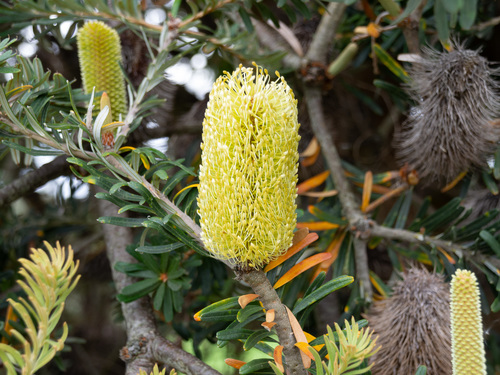
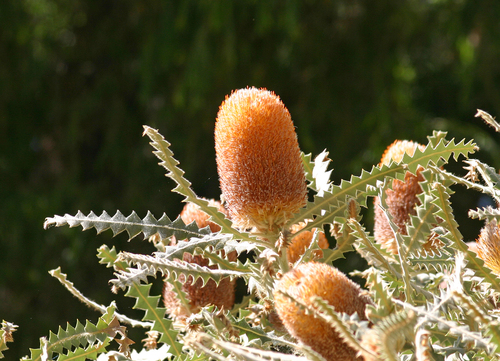
Banksia prionotes Lindl. varies in size depending on where it grows: in southern parts of its range, it grows as a tree up to 10 m (30 ft) high. In northern parts, it is usually a shorter tree or spreading shrub, reaching only around 4 m (13 ft) in height. Its height decreases further as the climate becomes warmer and drier moving further north. It has thin, mottled grey bark that is either smooth or grooved, and young stems are covered in fine, dense hairs. Its dull green alternate leaves are 15–27 cm (6–11 in) long and 1–2 cm (0.4–0.8 in) wide. Leaf margins are toothed with triangular lobes, and leaf surfaces are often wavy. Flowers form a characteristic Banksia flower spike: a cylindrical inflorescence made up of hundreds of small, densely packed individual flowers (called florets). B. prionotes has cream-colored flowers with a bright orange limb that is only visible once the flower opens fully. This opening process, called anthesis, progresses from the bottom to the top of the inflorescence over several days, giving the appearance of a cream inflorescence that gradually turns bright orange. After flowering finishes, old flower parts fall away to expose the central axis, which can hold up to 60 embedded woody fruit called follicles. These follicles are oval or oblong, initially covered in fine hairs, and measure 14 to 20 mm (0.6 to 0.8 in) long, 6–11 mm (0.24–0.43 in) wide, and protrude 3–6 mm (0.12–0.24 in) from the cone. Each follicle contains two seeds separated by a brownish woody seed separator. The matte blackish seeds are wedge-shaped (cuneate), measuring 8–10 mm (0.3–0.4 in) long by 5–6 mm (0.20–0.24 in) wide, and have a membranous 'wing'. The root system includes a main sinker root and up to ten lateral roots growing from a non-lignotuberous root crown. The main sinker root grows straight down to the water table, and may reach up to 15 m (49 ft) long if the water table is this deep. Immediately below the root crown, the sinker root is typically 3 to 5 cm (1.2 to 2.0 in) in diameter; it gradually becomes narrower with depth, and may be less than half a centimetre (0.2 in) wide just above the water table. When it reaches the water table, the sinker root branches out into a network of very fine roots. The lateral roots spread horizontally from the base of the plant, at a depth of 3–10 cm (1.2–3.9 in). They can extend over 5 m (16 ft) from the plant, and may grow secondary lateral roots; larger laterals often grow auxiliary sinker roots. Lateral roots seasonally produce secondary rootlets that grow dense surface mats of proteoid roots, which function throughout the wetter months before dying off when summer begins. Banksia prionotes occurs across most of the Southwest Botanical Province of Western Australia, found along both the west coast and inland. Its range extends from Shark Bay (25°30′S) in the north, to Kojonup (33°50'S) in the south and Jerramungup (34°24'S 118°55'E) in the south-east. It grows in tall shrubland or low woodland, mostly in dune swales and lower dune slopes, and strongly prefers deep white or yellow sand. It is most common in the kwongan heath of the Geraldton Sandplains north of Jurien, where it has a fairly continuous distribution, often grows as the dominant species, and extends inland to around the 350 mm isohyet. On the Swan Coastal Plain further south, its distribution is discontinuous. It is largely confined to patches of suitable sand in the narrow transition zone where tuart forest transitions to jarrah forest. With the exception of a population at Point Walter (32°00′S), it does not grow on the sandplain south of the Swan River. Soils east of the Darling Scarp are generally too heavy for this species, except for some isolated pockets of deep alluvial or aeolian yellow sand. B. prionotes therefore has a very patchy distribution east of the scarp. This area still makes up around half of its total geographic range, and the species extends well to the south and south-east of the scarp. In total, the species occurs over a north-south distance of about 815 km (500 mi), and an east-west distance of about 125 km (80 mi). The species is almost entirely restricted to dune swales and lower dune slopes. Two hypotheses have been proposed for this restriction: one argues that its dependence on groundwater means it can only grow where groundwater is relatively close to the surface; the other suggests it cannot survive on higher landscape parts because fires are too frequent there. The latter hypothesis is supported by the recent expansion of B. prionotes along road verges of the Brand Highway, where fires are relatively rare. Even though B. prionotes grows in lower landscape positions, it does not grow in flood-prone areas, because it is intolerant of heavy soils and extended flooding kills its seedlings. However, recent water table declines on the Swan Coastal Plain have allowed B. prionotes to replace the more water-tolerant Banksia littoralis in some areas that were previously flood-prone. The Australian Society for Growing Australian Plants (ASGAP) describes B. prionotes as "an outstanding ornamental species". Its brightly colored, conspicuous flower spikes make it a popular garden plant. It attracts honeyeaters to gardens, and sometimes flowers twice a year. A low-growing dwarf form that reaches 1 m (3.3 ft) high is available in Western Australia, sold under the name "Little Kalbarri Candles". It is fairly easy to grow in regions with a Mediterranean climate, but does not grow well in areas with high summer humidity. It requires a sunny position in well-drained soil, and tolerates at least moderate frost. It should be pruned lightly, and never pruned below the green foliage, because it tends to become straggly with age if not pruned correctly. Seeds do not require any treatment before sowing, and germinate in 21 to 35 days. The species is also considered ideal for cut flower production, since its flowers meet commercial requirements for terminal blooms and long stem length. It is therefore one of the most popular banksias for cut flower production, with commercial crops grown in Israel, Victoria, South Australia and Hawaii.