About Banksia paludosa R.Br.
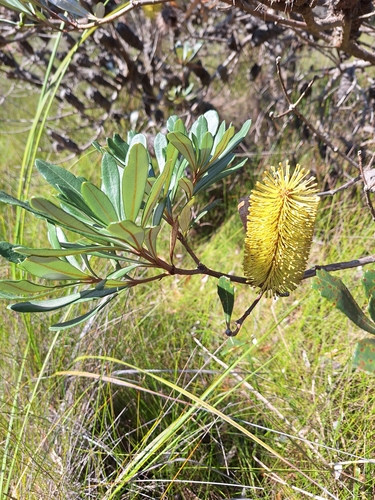
Banksia paludosa R.Br. has two subspecies, which have identical foliage and flowers, and differ only in size, growth habit, and response to bushfire. Banksia paludosa subspecies paludosa, the nominate subspecies, is most commonly a spreading multistemmed shrub generally under 1.5 m (4.9 ft) high, and rarely reaches 2 m (6.6 ft). In heathland habitats such as Nadgee or Barren Grounds Nature Reserves, it may not grow taller than 1 m (3.3 ft). In exposed areas such as Green Cape, it is further reduced to a 30 cm (12 in) prostrate shrub. This subspecies has a woody base called a lignotuber, which begins developing in the first year of life. Banksia paludosa subspecies astrolux is a more open non-lignotuberous shrub that reaches 5 m (16 ft) high. The bark and foliage of this species is rough; new growth is covered in fine hairs. Stems are generally less than 2 cm (0.79 in) in diameter, and may be red or yellow when young. Leaves grow alternate or whorled along the stems, and are lanceolate (spear-shaped) to obovate (egg-shaped). They measure 4–13 cm (1.6–5.1 in) long and 1–3 cm (0.39–1.18 in) wide. Leaf margins are entire or have occasional serrations. The leaf undersurface is white, with a visible midrib. Flowering occurs over autumn and winter, from April to July. Flower spikes called inflorescences grow from stems that are three or more years old. Cylindrical in shape, they consist of a central woody axis from which many compact floral units grow perpendicularly. Inflorescences are generally 3.2–4 cm (1.3–1.6 in) wide and 7–13 cm (2.8–5.1 in) high. Individual flowers are more openly spaced than those of other banksias, and this is particularly noticeable in the late bud stage. This open spacing, combined with the tall narrow shape of the flower spike, makes this species quite distinctive. Flower spikes are pale to golden brown in bud, and open to a more golden color after anthesis (the opening of the flower). Variations exist: one form has a grey bud limb, and plants with particularly tall flower spikes have been recorded near Huskisson at Jervis Bay. Like most banksias, individual buds open acropetally up the flower spike from base to top during anthesis. The full process from bud formation to the end of flowering takes six to eight weeks. As flower spikes age, they fade to grey, with old flowers remaining attached for years. Up to 60 woody follicles develop on each spike, which is called an infructescence at this stage. Narrow and elliptic, follicles measure 0.9–1.8 cm (0.4–0.7 in) long, 0.1–0.5 cm (0.0–0.2 in) high, and 0.3–0.7 cm (0.1–0.3 in) wide. Some follicles open spontaneously, but most remain closed until they are opened by bushfire. Each follicle holds one or two fertile seeds, with a woody dark brown separator of similar shape to the seeds positioned between them. Seeds are obovate and measure 1.3–1.8 cm (0.5–0.7 in) long. They are made up of a dark brown membranous "wing" 0.8–1.3 cm (0.3–0.5 in) wide, and a sickle-shaped (falcate) seed proper that measures 0.8–0.9 cm (0.3–0.4 in) long by 0.3–0.4 cm (0.1–0.2 in) wide. The seed surface may be smooth or covered in tiny ridges, and often glistens. Seedlings first grow two asymmetrical obovate cotyledon leaves measuring 0.9 cm (0.4 in) long by 0.7 cm (0.3 in) wide. These cotyledons may remain on the seedling for several months as additional leaves emerge. The first pairs of leaves are oppositely arranged on the stem, have 3–4 "teeth" along their margins, and are narrowly obovate. They measure around 1.2–1.4 cm (0.5–0.6 in), and each subsequent pair of leaves is slightly larger. The cotyledons of Banksia paludosa, B. marginata and B. integrifolia are very similar in appearance. The foliage of large shrubs from both B. paludosa subspecies resembles that of Banksia conferta subsp. penicillata, but B. conferta subsp. penicillata has wider inflorescences, and its buds are more crowded on the inflorescence before anthesis. Banksia paludosa also bears a superficial resemblance to B. oblongifolia; however, B. oblongifolia has a prominent midrib on its leaf undersurface, new growth covered in rusty fur, and bare old flower spikes with no remaining old flowers. B. oblongifolia also grows on drier rocky soils, while B. paludosa grows in wetter sandy soils. Both subspecies of Banksia paludosa are endemic to New South Wales. The nominate subspecies paludosa ranges from Glen Davis through the Sydney region and south to Ulladulla on the South Coast, with a separate population near Eden just north of the Victorian border. It occurs inland as far as Taralga on the Southern Tablelands. It was collected in 1966 from Hat Head on the Mid North Coast by Lawrie Johnson, but has not been found there since despite targeted field work. Aside from this single record, the northernmost historical coastal record is from what is now Centennial Park and La Perouse in Sydney's eastern suburbs, where the subspecies is now locally extinct. Subspecies astrolux is restricted to Nattai National Park in the Southern Highlands. Both subspecies grow in nutrient-poor, well-drained sandstone soils. They occur in open woodland alongside tree species including Sydney peppermint (Eucalyptus piperita), silvertop ash (Eucalyptus sieberi), grey gum (Eucalyptus punctata), narrow-leaved stringybark (Eucalyptus sparsifolia), red bloodwood (Corymbia gummifera) and smooth-barked apple (Angophora costata). They also grow in heathland alongside species including dwarf banksia (Banksia oblongifolia), coral heath (Epacris microphylla), and dagger hakea (Hakea teretifolia). Banksia paludosa subspecies paludosa is a slow-growing shrub that regenerates after bushfire by resprouting from its lignotuber. After fire, plants take around three years to produce substantial flower growth, and flower heavily by five years after fire. Flower head numbers decline by 14 years post-bushfire. Plants are estimated to live around 60 years. Seedlings also emerge from seed dispersed after bushfire. Like all banksias, B. paludosa develops proteoid, or cluster, roots adapted to the nutrient-poor conditions common to Australian soils, particularly those low in phosphorus. B. paludosa flower spikes cannot self-pollinate, and require pollinators to produce seed. A 1988 isozyme study found very high outcrossing rates; pollen from one individual mixes widely with other plants in the local area. Nonflying mammals are important pollinators in heathland habitat, with the brown antechinus (Antechinus stuartii) a frequent visitor to flower spikes. The sugar glider (Petaurus breviceps) is another recorded mammalian pollinator. Bird species observed foraging and feeding at the flowers include the red wattlebird (Anthochaera carunculata), yellow-faced honeyeater (Lichenostomus chrysops), white-eared honeyeater (Lichenostomus leucotis), crescent honeyeater (Phylidonyris pyrrhoptera), New Holland honeyeater (Phylidonyris novaehollandiae), and eastern spinebill (Acanthorhynchus tenuirostris). Insects recorded visiting flower spikes include the European honey bee and ants. Banksia paludosa was first introduced to cultivation in England in 1805. The species was grown at Kew Gardens, Cambridge Botanic Gardens, Woburn Abbey, Loddiges nursery in Hackney, John Miller's nursery in Bristol and George Hibbert's garden at Clapham Common. It was also grown in the Villa San Donato in Italy, in the collection of Anatoly Nikolaievich Demidov, 1st Prince of San Donato. Today, B. paludosa is cultivated in Australian gardens. It grows best in a sunny position with good drainage, in soils with a pH between 5.5 and 7.5. It is slow growing, and takes 6 to 10 years to flower from seed. It can be propagated by seed, which germinates in around two weeks, or by cuttings. Low-growing dwarf coastal forms reaching 60 cm (2.0 ft) tall are also commercially available, and must be propagated by cuttings to preserve their distinctive traits. Plant author John Wrigley noted the flower spikes are "rather dull" and described the species as "not a spectacular garden plant", though its foliage has been called "attractive". Amateur botanist and banksia enthusiast Alf Salkin deemed a Jervis Bay form with large orange flower spikes to have good horticultural potential.