About Banksia menziesii R.Br.
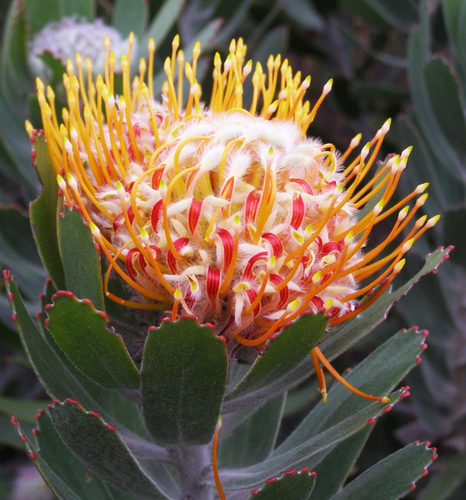
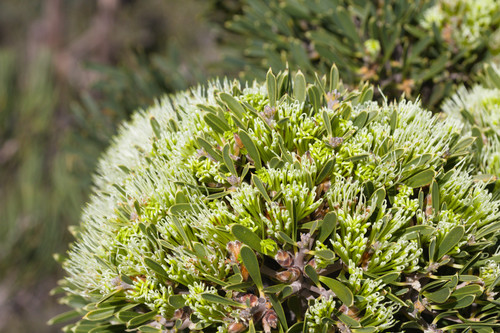
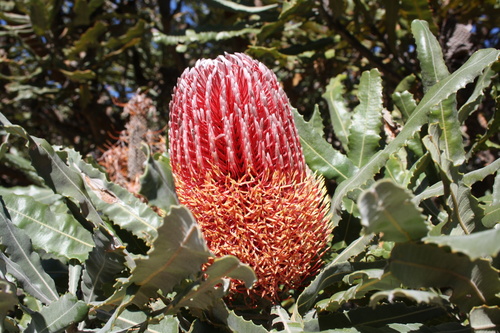
Banksia menziesii R.Br. grows as either a gnarled 10 metre (33 foot) tree, or a lower spreading 1–3 metre (3.3–9.8 foot) shrub. The shrub form is most common at the species' northern limits near Eneabba-Mount Adams, and the species steadily decreases in size as climate becomes warmer and drier further north. For the shrub form, multiple stems grow from a woody base called a lignotuber. Its trunk is greyish, sometimes with brown or pink tones, and its 2–3 cm (0.8–1.2 in) thick rough bark breaks away easily. New growth is covered in fine brownish hair, which wears away after two to three years to leave smooth stems and leaves. Stems that will produce flower spikes the next year are generally thicker and longer. Leaves are oblong, somewhat truncate at the tips, and grey-green; they are 8–25 cm (3.1–9.8 in) long and up to 4 cm (1.6 in) wide. New leaves are paler and covered in fine down. Leaf margins are serrated, with many small 1–2 mm long triangular teeth. The lower leaf surface has a midrib covered in fine pale brown hair. Flowering occurs in autumn and winter, peaking between May and July. Flower spikes (inflorescences) take around eight months to fully develop, starting from the first microscopic changes in late spring. The flower spikes are ovoid to cylindrical, reaching up to 7–8 cm (2.8–3.1 in) wide and 4–12 cm (1.6–4.7 in) tall. They are made up of many individual flowers: one field study south of Perth recorded an average of 1043 flowers per spike, while another study of cultivated plants in South Australia recorded an average of 720. B. menziesii has more flower colour variants than any other Banksia species. Its flower spikes appear in a wide range of pinks, plus chocolate, bronze, yellow, white, and greenish variants. They are particularly striking when viewed close up, but can look indistinct from a distance. They are most attractive in the late bud stage, when the styles contrast well with the body of the inflorescence, giving the whole structure the appearance of a red- or pink-and-white vertical candy striped bloom. Inflorescences are generally a deeper red after colder weather and later into the winter. Anthocyanin pigments are responsible for the red and pink flower shades. Old flowers usually fall off the spikes quickly, and up to 25 large beaked follicles develop. These are mottled dark brown and grey, and can be prominent with attractive patterning when newly developed. They are oval shaped, 2.5–3.5 cm (1.0–1.4 in) long by 1–1.5 cm (0.4–0.6 in) high and 1–1.5 cm (0.4–0.6 in) wide. Overall, only a small fraction of flowers develop into follicles; the proportion can be as low as one in a thousand. This plant depends on fire to reproduce, as follicles only open after being burnt. Each follicle produces one or two viable wedge-shaped (cuneate) seeds, located on either side of a woody separator. The colour and level of pigmentation in the seeds predicts the eventual colour of the plant's inflorescences. Kevin Collins of the Banksia Farm recalled that seed collectors discarded pale seeds for many years, assuming they were infertile. Later he learned that pale seeds produce yellow-coloured blooms, dark grey seeds produce the common red-coloured blooms, and black seeds produce a distinctive bronze-coloured bloom. Seedlings have obovate cotyledons 1–1.4 cm (0.4–0.6 in) long by 1–1.5 cm (0.4–0.6 in) wide. The leaves that develop right after germination are crowded and very hairy, with serrated margins. By five months of age, evidence of thickening to form a future lignotuber, as well as minute buds, can be detected at the base of seedlings. Banksia menziesii grows primarily in deep sandy soils of the Swan Coastal Plain and Geraldton Sandplains, extending from Waroona in the south to Kalbarri in the north. It is uncommon south of Mandurah. It is generally limited to the west by the Darling Scarp's heavy soils, but does grow on isolated patches of sand in the Jarrah Forest and Avon Wheatbelt regions, for example near Beverley, Toodyay and Wongan Hills. The easternmost known occurrence is a specimen collected by Roger Hnatiuk in 1979 from north-east of Brookton, around 125 km (78 mi) from the coast. Much of this species' range on the Swan Coastal Plain overlaps with Perth's expanding metropolitan area, and large amounts of habitat have been lost to clearing. Together with Banksia attenuata (candlestick banksia), B. menziesii is a dominant component of multiple widespread vegetation complexes on the Swan Coastal Plain, including Banksia low woodland and Jarrah-Banksia woodland. These complexes only grow on deep, well-draining sand. In shallower, seasonally wet soils, B. menziesii and B. attenuata are replaced by other Banksia species, such as B. littoralis (swamp banksia) or B. telmatiaea (swamp fox banksia). On the Geraldton Sandplains to the north, B. menziesii usually grows as a shrub or small tree that grows above low heath. Like many members of the family Proteaceae, Banksia menziesii is largely self-incompatible, meaning its inflorescences require pollinators to be fertilized and produce seed. The species promotes cross-pollination with other plants through protandry: male parts release pollen that becomes non-viable before the female parts on the same flower spike become receptive. Individual flowers are uniform, and it is unclear why so few go on to develop follicles. A 1988 published field study conducted in banksia woodland near Perth found that anthesis occurred on an inflorescence at an average rate of 40 to 60 florets opening per day, though this varied widely between different flowerheads. Foraging by honeyeaters caused florets to open, but bees did not. Banksia menziesii provides an important food source of flowers and seeds for the threatened short-billed black cockatoo (Zanda latirostris). Other bird species observed feeding on B. menziesii include the red-capped parrot (Purpureicephalus spurius), western rosella (Platycercus icterotis), red-tailed black cockatoo (Calyptorhynchus banksii), Australian ringneck (Barnardius zonarius), western gerygone (Gerygone fusca) and several honeyeater species: the New Holland honeyeater (Phylidonyris novaehollandiae), white-cheeked honeyeater (P. nigra), brown honeyeater (Lichmera indistincta), singing honeyeater (Gavicalis virescens), western spinebill (Acanthorhynchus superciliosus), red wattlebird (Anthochaera carunculata) and western wattlebird (A. lunulata). Recorded insects include ants, bees, and rove beetles (family Staphylinidae). A field study south of Perth found that, compared to other banksias, B. menziesii is particularly popular with the brown honeyeater and western spinebill. Twenty-one species from several orders of slime molds (myxomycetes) have been isolated from the bark of Banksia menziesii. Over half (13) belong to the order Stemonitales, and Echinosteliales and Liceales are also common. The abundance of the first two orders may be due to the acidity of the bark. The order Physarales is unusually rare here; other studies show this order is typically abundant on the bark of tree species around the world. Banksia menziesii regenerates after bushfire by resprouting from its woody lignotuber, or from epicormic buds on the trunk. It is generally only weakly serotinous in the southern part of its range, meaning it lacks a canopy seed bank because follicles on old flower spikes in the canopy release their seed after two years. Populations retain more seed as you move further north. Lower canopies and drier climates lead to hotter fires that are more likely to kill plants and trigger seed release, which facilitates seedling recruitment. All banksias develop proteoid (cluster) roots in response to the low-nutrient conditions of Australian soils, particularly soils lacking in phosphorus. The plant grows masses of fine lateral roots that form a mat-like structure just under the soil surface, which lets it extract nutrients as efficiently as possible from the soil. A study of three co-occurring species in southwestern Australian banksia woodland—Banksia menziesii, B. attenuata and B. ilicifolia—found that all three develop fresh roots in September after winter rainfall. The study also found that the bacterial populations associated with B. menziesii root systems differ from those of the other two species, and change depending on the age of the roots. Along with Banksia attenuata, Banksia menziesii is a facultative phreatophyte. The two species are less strictly tied to the water table, so they are able to grow in a wider range of locations within Perth-area banksia woodland habitat than co-occurring Banksia ilicifolia and Banksia littoralis. Recent falls of the water table on the Swan Coastal Plain, caused by use of the Gnangara Mound aquifer for Perth's water supply plus years of below average rainfall, have led to reduced population numbers and vigour of Banksia menziesii since the mid-1960s. A 2009 Spanish study found that Banksia menziesii seedlings are moderately sensitive to salinity. The species is also sensitive to sulfur dioxide. A 1994 study by Byron Lamont and colleagues from Curtin University found that Banksia menziesii plants within 50 metres (160 feet) of road verges had crowns two and a half times bigger, and produced three times as many seeds as plants growing further from the road. This difference is likely due to increased nutrient and water availability from road runoff. Banksia menziesii has several horticultural features of interest, including patterned buds and follicles, attractive pinkish new growth, and showy flowerheads. A dwarf form is commonly sold in nurseries. Byron Lamont observed that dwarf plants may grow into taller single-trunked plants when cultivated. The plant is fairly easy to grow in a Mediterranean climate with good drainage and light (sandy) soil. However, it has medium to high susceptibility to Phytophthora cinnamomi dieback, so it is unreliable in conditions that favour growth of this soil-borne water mould, such as summer humidity or poor drainage. The use of phosphite fungicides does reduce the spread of Phytophthora. It generally grows poorly in eastern Australia, but it is grown commercially as a cut flower crop in southeastern South Australia. It is also cultivated in California and Hawaii. Seeds do not require any treatment before planting, and take 26 to 40 days to germinate. Seeds that grow into yellow-flowered plants are pale and unpigmented, while future bronze-flowered plants are dark greyish and future red-flowered plants are black. It generally takes five to seven years to flower from seed. This plant favours sandy well-drained soils and a sunny position, and can be heavily pruned if needed because new growth can sprout from the lignotuber. Although it is readily propagated by seed, experiments with in vitro propagation found B. menziesii to be more difficult to propagate this way than other tested species.