About Banksia grandis Willd.
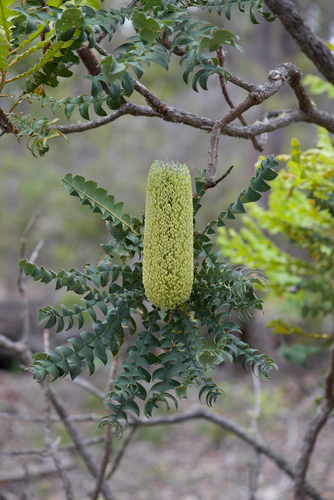
Banksia grandis Willd. usually grows as a tree, reaching a typical height of 5–10 m (16–33 ft), and sometimes growing up to 15 m (49 ft). It also occurs as a stunted, spreading shrub near the south coast, and whenever it grows among granite rocks. Its trunks are short, stout and often crooked, with the rough grey bark that is characteristic of the genus Banksia. Its leaves are pinnatisect, 100–450 mm (3.9–17.7 in) long and 30–110 mm (1.2–4.3 in) wide, borne on a 10–35 mm (0.4–1.4 in) long petiole. Each leaf has between eight and twelve large triangular lobes along each side. The upper surface of the leaf is shiny dark green, while the lower surface is covered in soft hairs. Flowers are borne in a spike that is 100–400 mm (3.9–15.7 in) long and 70–90 mm (2.8–3.5 in) wide when flowering. Hairy involucral bracts up to 25 mm (1.0 in) long sit at the base of the flower head. The flowers are pale yellow with cream-coloured styles; the perianth is 26–35 mm (1.0–1.4 in) long, and the pistil is 35–40 mm (1.4–1.6 in) long. Flowering occurs from October to January. After flowering, elliptical follicles develop on a massive cone; the follicles are 17–25 mm (0.7–1.0 in) long, 3–10 mm (0.12–0.39 in) high and 6–12 mm (0.24–0.47 in) wide. Old flowers fall off early, and follicles usually open as they mature. A seed collected from the south coast and grown in Kings Park had retained its spreading shrub habit as of 1981. Bull banksia, the common name of this species, grows in woodland and heath on the coastal plain between Mount Lesueur and Cape Leeuwin, east to Cape Riche and inland to Woodanilling. It is common in the jarrah forest on the Darling Range. Nectarivorous bird species observed feeding on B. grandis include red wattlebird (Anthochaera carunculata). Red-capped parrot (Purpureicephalus spurius) has been recorded feeding on its seeds, as have black cockatoos. It is not clear whether the observed black cockatoos were Baudin's black cockatoo (Zanda baudinii) or Carnaby's black cockatoo (Z. latirostris). Bull banksia is not often cultivated, and is slow-growing, taking ten years or more to flower from seed. It is very sensitive to dieback and difficult to grow in regions with summer humidity. It requires well-drained sandy soil. Its seeds do not require any treatment before sowing, and take 22 to 42 days to germinate. Indigenous peoples living within this species' range call the flowers of Banksia grandis mangyt, pulgarla or Bool gal la. The flowers were steeped in water or sucked to obtain nectar.