About Banksia ericifolia L.fil.
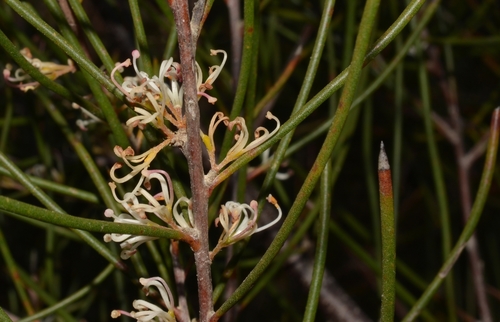
Banksia ericifolia L.fil. typically grows as a large shrub reaching up to 6 metres (20 feet) tall, though plants in exposed sites like coastal or mountain heathlands are often smaller, between 1–2 metres (3.5–6.5 ft) high. Its grey bark is smooth and fairly thin with visible lenticels, but thickens substantially as the plant ages. The leaves are small, narrow, linear, and dark green, measuring 9–20 mm (1⁄4–3⁄4 in) long and up to 1 mm wide. Most leaves have two small teeth at their tips, and they grow crowded and alternately arranged along branches. New growth, which usually emerges in summer, has a distinctive attractive lime green colour. Flowering occurs in autumn, or in winter in cooler regions. The inflorescences are upright flower spikes 7–22 cm (2.8–8.7 in) tall and roughly 5 cm (2.0 in) wide. Each individual flower is made of a tubular perianth of four fused tepals, plus one long wiry style. As is characteristic for the taxonomic section this species belongs to, the styles are hooked rather than straight. When flowers are young, the end of each style is trapped inside the upper parts of the perianth, and breaks free at anthesis as the flower opens. Overall, flower spikes are red or gold, with styles in shades of golden, orange, orange-red, or burgundy. Unusual forms can have striking red styles on a whitish perianth, and all-yellow inflorescences are seen very rarely. Though the flower spikes do not grow at the tips of branches, they are prominently displayed above the foliage, growing from two- to three-year-old stem nodes. As old flower spikes age, they fade first to brown, then to grey. Old flower parts fall away quickly, revealing numerous small, dark grey to dull black, finely furred follicles. The oblong follicles are 15–20 mm (9⁄16–13⁄16 in) across, ridged on each valve, and stay closed until opened by fire. Banksia ericifolia is a seeder that relies on fire for regeneration: the parent plant is killed by fire, and new plants grow from stored seed. Because wild plants take several years to reach flowering age, the species is very sensitive to overly frequent fires, and has been eliminated from some areas where too-frequent burning occurs. By eight years of age, established plants can store up to 16,500 seeds in their seed-containing follicles across multiple cones. Some plants produce multiple flower spikes, sometimes varying in size, from a single origin point. In terms of distribution and habitat, the nominate variety B. ericifolia var. ericifolia grows on acidic sandstone-based soils. It occurs in elevated heathland within 2 kilometres (1.2 mi) of the coast around the Sydney basin, from Collaroy south to Jervis Bay, and also on elevated sandstone soils in mountainous areas such as the Blue Mountains and the Budawangs. These heathlands are often moist, with access to groundwater, and can be quite swampy. It can grow to form dense thickets alongside Dagger Hakea (Hakea teretifolia) and Scrub She-oak (Allocasuarina distyla). Other common associated plant species include Coast Tea-tree (Leptospermum laevigatum) and the smaller species Woollsia pungens. Its inflorescences are a well-known feature of autumn bushwalking in sandstone areas, including the Kings Tableland walk in the Blue Mountains, Jennifer Street Boardwalk in Little Bay, and Royal National Park. The northern subspecies macrantha is found in two separate areas on the far north coast of New South Wales: one population stretches from Crowdy Bay on the Mid North Coast north to Hat Head National Park, north of Port Macquarie, and the other runs from Yuraygir National Park north to Kingscliff just south of the Queensland border. This variety is more strictly coastal, with most populations found within two kilometres of the coast or in swampy areas, and it may grow associated with Banksia oblongifolia. Like other banksias, B. ericifolia hosts a wide range of pollinators and provides an important source of nectar in autumn, when few other plants are flowering. Multiple studies of its pollination have been conducted. A 1998 study in Bundjalung National Park, Northern New South Wales, recorded a variety of small mammals foraging on B. ericifolia inflorescences, including marsupials such as the yellow-footed antechinus (Antechinus flavipes), and rodents such as the pale field rat (Rattus tunneyi) and grassland mosaic-tailed rat (Melomys burtoni). These animals carry pollen loads comparable to those of nectar-feeding birds, making them effective pollinators for the species. A 1978 study found the bush rat (Rattus fuscipes) carries large amounts of B. ericifolia pollen, and suggested the hooked styles may play a role in mammal pollination. Other recorded flower visitors include the Western honey bee (Apis mellifera). A great many bird species have been observed visiting this banksia. A 1985 study of B. ericifolia var. ericifolia in the Sydney region recorded numerous birds visiting inflorescences, including honeyeaters: the eastern spinebill (Acanthorhynchus tenuirostris), white-cheeked honeyeater (Phylidonyris nigra), New Holland honeyeater (Phylidonyris novaehollandiae), white-naped honeyeater (Melithreptus lunatus), yellow-faced honeyeater (Lichenostomus chrysops), red wattlebird (Anthochaera carunculata) and little wattlebird (Anthochaera chrysoptera), as well as the Silvereye (Zosterops lateralis). The beautiful firetail (Stagonopleura bella) is also associated with this species. While the study recorded some mammals visiting flowers, they were found to carry no pollen. Pollinator exclusion experiments confirmed that birds and insects are important for successful fertilisation. Additional species recorded for B. ericifolia var. ericifolia in The Banksia Atlas survey include the white-eared honeyeater (Lichenostomus leucotis), white-plumed honeyeater (Lichenostomus penicillatus), crescent honeyeater (Phylidonyris pyrrhoptera), noisy miner (Manorina melanocephala), and friarbird species. Recorded visitors for B. ericifolia var. macrantha include the brown honeyeater (Lichmera indistincta), tawny-crowned honeyeater (Gliciphila melanops) and black-faced cuckoo-shrike (Coracina novaehollandiae). Insects collected from B. ericifolia inflorescences include the banksia boring moth (Arotrophora canthelias): young instars eat flower and bract tissue, before tunneling into the flower spike rachis as they mature, then boring into follicles to eat seeds. This tunneling damages the structure of the spike and stops seeds from developing. Other seed predators include unidentified moth species of the genus Cryptophasa, plus Scieropepla rimata, Chalarotona intabescens, Chalarotona melipnoa, Brachmia trinervis, Carposina hyperlopha, and an unidentified weevil species. Like most other Proteaceae, B. ericifolia produces proteoid roots: roots with dense clusters of short lateral rootlets that form a mat in the soil just below the leaf litter. These roots improve nutrient solubilisation, allowing the plant to take up nutrients in low-nutrient soils such as the phosphorus-deficient native soils of Australia. The species does not have a lignotuber, so it is killed by fire and regenerates entirely from seed. Banksia ericifolia requires fire to regenerate: if fires are too infrequent, populations age and eventually die out. But too-frequent fires also threaten the species, as it takes around six years to reach maturity and flower. One study estimates the optimum fire interval for this species is 15–30 years. Across much of its range, Banksia ericifolia grows near human settlements along Australia’s eastern coastline. Bushland near urban areas is often subject to arson and prescribed burns, which drastically shorten fire intervals and have led to the species disappearing from some areas. Hotter fires trigger faster seed release, and the timing of rainfall after fire is also critical for seedling survival. In New South Wales, Banksia ericifolia is listed in Part 1 Group 1 of Schedule 13 of the National Parks and Wildlife Act 1974. As a common and secure species, this means it is exempt from any licensing or tagging requirements under the 2002–2005 management plan that regulates and minimises use of protected and threatened plants in the New South Wales cut-flower industry. Banksia ericifolia was one of the first Banksia species brought into cultivation, and was introduced to gardeners in England in 1788. It had already flowered in multiple private and botanical collections by 1804. That same year, a painting of the species by Sydenham Edwards was published in Curtis's Botanical Magazine, where the species was described as "a handsome shrub [that] thrives freely". In cultivation, B. ericifolia's inflorescences attract a variety of birds to gardens. It is hardy enough to be used as a street planting in parts of Sydney, and is fairly easy to grow when given its preferred conditions: sandy, well-drained soil and a full sunny position. It needs extra water during dry periods until it is established, a process that can take up to two years, as it naturally comes from a region with most rainfall falling in warmer months. Like most eastern Australian banksias, it is resistant to Phytophthora cinnamomi dieback. Because it naturally grows on acidic soils, Banksia ericifolia is particularly sensitive to iron deficiency, a condition called chlorosis. Chlorosis appears as yellowing of new leaves while the leaf veins remain green, and typically occurs when plants are grown in high pH soils. This problem often develops where soil contains cement residue from landfill or building foundations, and can be treated by adding iron chelate or iron sulfate. When grown from seed, plants take several years to start flowering, with a minimum of four years being average. Buying a more mature plant, or planting a cutting-grown specimen, will result in earlier flowering. Banksia ericifolia can be propagated easily from seed, and it is one of the easier banksias to propagate from cuttings. Named cultivars must be propagated from cuttings to ensure the resulting plants retain the original cultivar's characteristics. Regular pruning is recommended to maintain an attractive growth habit and prevent the plant from becoming open and spindly. Hard pruning below the level of green growth is not recommended for this banksia. Since it lacks a lignotuber, it does not have dormant buds under the bark that resprout after pruning or fire, so it cannot resprout from old wood as easily as commonly cultivated lignotuberous banksia species like B. spinulosa and B. robur.