About Banksia coccinea R.Br.
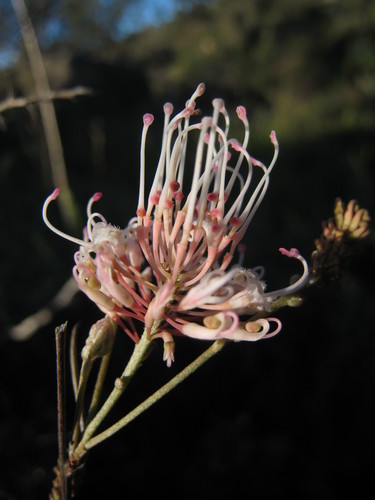
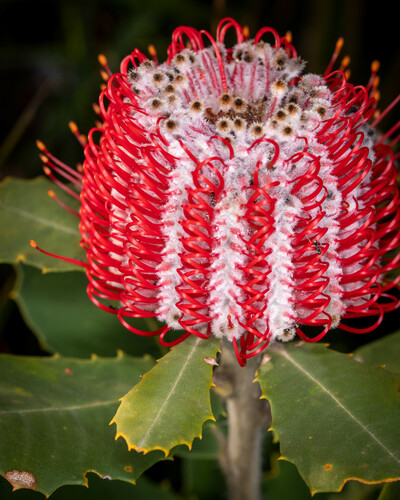
Banksia coccinea R.Br., commonly called scarlet banksia, grows as an erect shrub or small tree. It typically reaches 2–4 m (6.6–13.1 ft) in height with little lateral spread, though it can grow as tall as 8 metres (26 ft), especially in areas near Albany, Western Australia. It usually has a single trunk at the base before branching; the trunk is covered in 2–5 mm (0.08–0.20 in) thick smooth grey bark with no lenticels. New growth is pinkish-brown, densely hairy, and reaches peak growth in the summer months. Leaves are oblong, cordate, or obcordate, measuring 3–9 cm (1.2–3.5 in) long, 2–7 cm (0.8–2.8 in) wide, and sit on 3–5 mm (0.12–0.20 in) long petioles. Leaves are truncate at the apex, with dentate margins holding small 1–3 mm long teeth spaced 3–18 mm (0.12–0.71 in) apart, separated by shallow U- or V-shaped sinuses. The upper leaf surface is covered in fine fur when young and becomes smooth as it ages, while the lower leaf surface is covered in white fur, particularly along the midrib. The flowering process of Banksia coccinea takes 9–12 months total: microscopic development of stems begins in spring, with no visible flower spike development for roughly five months before buds emerge. Flower spikes bloom from May to December or January, with peak blooming occurring between July and October. The plant’s distinctive inflorescences grow from the ends of one-year-old branchlets. They are squat and roughly cylindrical, 3–6 cm (1.2–2.4 in) high and 8–10 cm (3.1–3.9 in) wide. A field study on southern sandplains found an average of around 286 individual flowers per spike. The white flower is covered in grey or pale brown fur, with very little color variation. The style is generally scarlet, but can also be dark red, orange, or pink. The perianth measures 3–3.2 cm (1.2–1.3 in) long, while the 4–4.8 cm (1.6–1.9 in) long style is strongly recurved or looped until it is released at anthesis. Anthesis is acropetal, meaning flowers open from the base of the spike upward to the apex. Like all banksias, the flowers of Banksia coccinea grow in a spiral pattern around the flower spike axis, but in this species they develop into distinctive vertical columns with large gaps between them that strongly accentuate the structure. With red styles paired in columns and contrasting against the grey-white perianth, the resulting flower spike is very striking. The infructescence is small, holding up to 20 small follicles concentrated at the lower end of the spike. Each follicle is 6–8 mm (0.2–0.3 in) long, 1–2 mm (0.04–0.08 in) high, and 2–3 mm (0.08–0.12 in) wide, and it usually opens in response to fire. Seeds are 1.1–1.4 cm (0.43–0.55 in) long, consisting of a wedge-shaped (cuneate) seed body proper that is 0.5–0.7 cm (0.2–0.3 in) long and 0.4–0.7 cm (0.2–0.3 in) wide, plus a papery wing. One side, the outer surface, is grey-black and wrinkled, while the other (inner) surface protrudes and is black and glistening. Seeds are separated by a dark brown seed separator that is roughly the same shape as the seeds, with a depression where the seed body sits adjacent to it within the follicle. The seed separator measures 1.1–1.4 cm (0.4–0.6 in) long and 0.7–0.8 cm (0.28–0.31 in) wide. The dull green cotyledons of seedlings are 0.8–0.9 cm (0.3–0.4 in) long and 0.5–0.6 cm (0.20–0.24 in) wide, described by Alex George as "cuneate to obovate". Each cotyledon has a 1 mm (0.04 in) auricle at its base. The thick, smooth hypocotyl is 1 cm (0.5 in) high and 1.5 mm thick. Seedling leaves grow crowded above the cotyledons and are linear to spathulate in shape, with recurved, deeply serrated margins that have V-shaped sinuses, almost dividing leaves into triangular lobes. The first pair of seedling leaves are 0.8–1.2 cm (0.3–0.5 in) long, while the next 2–4 leaves grow up to 1.7 cm (0.7 in) long. Later successive leaves are more obovate in shape, growing up to 4 cm (1.6 in) long and 1.4 cm (0.6 in) wide. Seedling stems are covered in white hair. Banksia coccinea is found close to the south coast of Western Australia, ranging from the Hay River northeast of Denmark and Albany in the west, east to Stokes National Park southeast of Munglinup, and inland to the Stirling Range and the northern border of Fitzgerald River National Park. Around 47% of all Banksia coccinea plants are located within protected conservation areas, while 13% grow on road verges. It prefers deep white or grey sand, growing in tall shrubland, heath, or mallee-heath alongside species such as B. baxteri, B. speciosa, B. attenuata, and Lambertia inermis. It also grows in low open woodland in the Stirling Range and near Albany, where it is found growing with Eucalyptus marginata, Banksia attenuata, and B. ilicifolia. Most of its range has gently undulating topography, but it also grows on a steep rocky slope at Ellen Peak in the Stirling Ranges. Annual rainfall across its range is 400–800 mm (16–31 in). A field study conducted near Albany found that the honey possum (Tarsipes rostratus) sometimes visits Banksia coccinea, along with the New Holland honeyeater (Phylidonyris novaehollandiae), white-cheeked honeyeater (P. nigra), and western spinebill (Acanthorhynchus superciliosus). Two species of colletid bees, Hylaeus alcyoneus and H. sanguinipictus, also visit the plant’s flowers. The short-billed black cockatoo breaks off old cones holding follicles to eat the seed, often doing so before the seed is ripe. Banksia coccinea is killed by fire and regenerates from seed released from burnt follicles. It exhibits some degree of serotiny, meaning it maintains an aerial seed bank in its canopy within the follicles of old flower spikes. However, it holds fewer seeds than other co-occurring banksia species on the southern plains, and seed counts peak several years after a fire. Unusually for banksias, Banksia coccinea can release seeds that produce seedlings even without a bushfire trigger. Plants begin flowering and producing fruit three years after germination, and are shorter-lived than other banksias, typically declining in health or dying before reaching 20 years of age. They appear adapted to fire intervals shorter than 20 years. Manipulating growing conditions for cultivated plants showed that longer daylight (16 hours compared to 8 hours) led to development of more flower spikes, indicating that flower initiation in this species is related to day length. Banksia coccinea is extremely sensitive to dieback caused by Phytophthora cinnamomi, and acts as an indicator species for the presence of the disease. There is no known way to eradicate dieback. Much of Stirling Range National Park is infested with the pathogen, though Fitzgerald River National Park has remained largely unaffected. Applying phosphite to infested areas reduces mortality rates to around 50%. Banksia coccinea can show some toxicity symptoms from phosphite application, including patchy leaf necrosis, but the plant takes up less of the compound compared to other shrub species. Unusually, symptoms do not appear proportional to the level of exposure. Dying stands of Banksia coccinea were first observed in 1989, and the fungus Cryptodiaporthe melanocraspedia was isolated as the cause in 1995. This disease, a form of aerial canker, first appears as dead, dry, brown leaves and dead new growth tips. Plants die from the top downward, with larger branches becoming affected over time. Under the outer bark, orange and brown patches of necrosis spread out from leaf nodes until they encircle the stem, which then dies. Flower spikes may also be affected during the flowering season. During humid periods in warm weather, white or pink spore tendrils grow on dead wood. One affected stand monitored over three years from October 1989 to June 1992 saw 97% mortality of plants, compared to a baseline 40% mortality. Investigators Bryan Shearer and colleagues isolated another virulent pathogen they identified as a Zythiostroma species; however, it appeared to trigger an immune response in the plant. This immune response, paired with the fact that the pathogen had not been observed affecting the species in the wild, led researchers to conclude it was not a major pathogen of Banksia coccinea. This species has since been reclassified and named Luteocirrhus shearii. Banksia coccinea is a host for the gall midge Dasineura banksiae, a fly species that attacks and lays eggs on leaves between late October and early December. The resulting round white hairy galls are 5–7 mm in diameter, generally holding one larva, though severely infested plants may have up to five larvae per gall. Larvae moult and feed from January to March, then reduce activity until early October. Although the galls do not harm the plant, they disfigure cut foliage and reduce its commercial value. Widely regarded as one of the most attractive Banksia species, B. coccinea is a popular garden plant and one of the most important Banksia species for the cut flower industry. It is grown commercially in Australia, South Africa, Canada, the United States, New Zealand, and Israel, and has been trialled in France, Spain, and South America. Its striking terminal inflorescences and furry new growth are its main valued horticultural features. However, it is highly sensitive to dieback and dies readily when exposed to the pathogen. It is difficult to keep alive in areas with heavy soils, summer rainfall, or humidity, such as Australia’s east coast. Additionally, flowering may be sparse or fail entirely when cultivated in warmer climates such as Perth. Pruning promotes branching, which in turn leads to production of more flower spikes. Propagation is done by seed, though seeds can be difficult to extract from follicles. Seeds do not require any treatment before sowing, and germination takes 12 to 48 days. Cultivars require propagation by cutting to produce true-to-type progeny, and cuttings are slow to strike root. Attempts to graft B. coccinea have had little success. In a breeding program run by Margaret Sedgley of the Department of Horticulture, Viticulture and Oenology at Waite Agricultural Research Institute, University of Adelaide in Adelaide, South Australia, two cultivated forms of Banksia coccinea were bred, registered under plant breeders' rights, and commercially propagated mainly for the cut flower industry: Banksia 'Waite Flame' is an early-flowering, somewhat orange-hued form, and B. 'Waite Crimson' is a red-flowering form that peaks in mid-season.