About Bambusa vulgaris Schrad. ex J.C.Wendl.
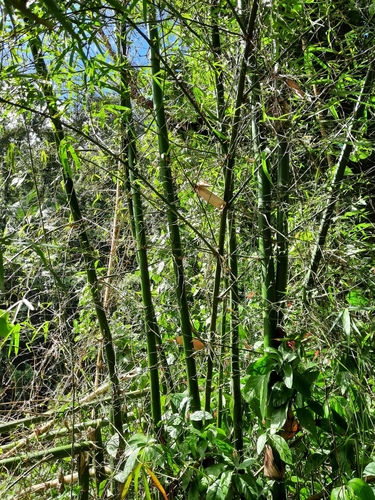
Bambusa vulgaris Schrad. ex J.C.Wendl., also called common bamboo or golden bamboo, forms moderately loose, thornless clumps. Its culms (stems) are lemon-yellow with green stripes, and it has dark green leaves. Stems are not straight, difficult to split, inflexible, thick-walled, and strong when new. Densely tufted culms reach 10–20 m (30–70 ft) in height and 4–10 cm (2–4 in) in thickness. Culms are either straight or flexuose (bent alternately in different directions) at the base, with drooping tips, slightly thick walls, slightly inflated nodes, and internodes that measure 20–45 cm (7.9–17.7 in). Multiple branches grow from mid-culm nodes and nodes higher up. Culm leaves are deciduous with dense pubescence, and leaf blades are narrowly lanceolate. Flowering is uncommon in this species, and seeds are not produced. Fruits are rare due to low pollen viability caused by irregular meiosis. Entire local populations flower synchronously at intervals of several decades, and individual stems produce a large number of flowers during these events. This bamboo reproduces vegetatively via clump division, rhizome division, stem and branch cuttings, layering, and marcotting. The easiest and most commonly used cultivation method is culm or branch cutting. In the Philippines, the best results come from one-node cuttings taken from the lower portions of six-month-old culms. When an individual stem dies, the clump usually survives, and new clumps can even grow from stems repurposed as poles, fences, props, stakes, or posts. Its rhizomes extend up to 80 cm before turning upward, creating open, fast-spreading clumps. The ease of propagating B. vulgaris explains its apparent occurrence in seemingly wild populations. The average chemical composition of B. vulgaris is: cellulose 41–44%, pentosans 21–23%, lignin 26–28%, ash 1.7–1.9%, and silica 0.6–0.7%. Common bamboo is the most widely cultivated bamboo across the tropics and subtropics. While it is mostly known from cultivation, spontaneous, escaped, and naturalized populations exist throughout tropical and subtropical regions both inside and outside Asia. It is widely cultivated in East, Southeast, and South Asia, as well as tropical Africa including Madagascar, and is highly concentrated in Indomalayan rainforests. It is one of the most successful bamboo species in Pakistan, Tanzania, and Brazil. It was already popular as a hothouse plant by the 1700s, and was one of the earliest bamboo species introduced to Europe. It is thought to have been introduced to Hawaii by Captain James Cook in the late 18th century, and it is the most popular ornamental plant there. It has been widely cultivated in the United States and Puerto Rico apparently since it was introduced by the Spanish in 1840, and it may have been the first non-native bamboo species introduced to the United States by Europeans. B. vulgaris grows mostly on river banks, roadsides, wastelands, and open ground, generally at low altitudes. It is a preferred species for erosion control. It grows best in humid conditions, but can tolerate unfavorable conditions including low temperatures and drought. While it can adapt to a wide range of soils, it grows more vigorously in moist soils. It can tolerate frost down to −3 °C (27 °F), and can grow at elevations up to 1,500 m (4,900 ft) above sea level, though stems grow shorter and thinner at higher altitudes. During extreme droughts, it may lose all its leaves. Among all bamboos, only the shoots of B. vulgaris contain taxiphyllin, a cyanogenic glycoside that acts as an enzyme inhibitor in the human body when released, but taxiphyllin breaks down readily in boiling water. The compound is highly toxic, with a human lethal dose of approximately 50–60 mg. A 25 mg dose of cyanogenic glycoside fed to rats of 100–120 g body weight caused clinical signs of toxicity including apnoea, ataxia, and paresis. Horses in Pará, Brazil, have been diagnosed with clinical signs of somnolence and severe ataxia after ingesting B. vulgaris. Some African farmers prefer to buy B. vulgaris rather than grow it, because they believe it harms soil. Common bamboo has a wide variety of uses: its stems are used as fuel, and its leaves are used as fodder, though large amounts of leaf ingestion are known to cause neurological disorders in horses. Global production and trade of B. vulgaris is considerable, but no statistics are available for it. It does have some drawbacks: its stems have poor working and machining properties because they are not straight, hard to split, and inflexible, even though they are thick-walled and initially strong. Due to its high carbohydrate content, stems are susceptible to attacks from fungi and insects such as powderpost beetles, so protection from these biological threats is required for long-term use. The variety B. vulgaris var. striata is used as an ornamental solitary plant or as a border hedge. Its shoots, boiled in water, are sometimes used for their claimed medicinal qualities. It is cultivated worldwide and generally found in East, Southeast, and South Asia. B. vulgaris f. waminii is cultivated in the United States and Europe in addition to Asia. B. vulgaris f. vittata is the most popular ornamental variety and is considered very attractive. The 'Kimmei' cultivar is mostly cultivated in Japan. Young shoots of this plant, either cooked or pickled, are edible and eaten across Asia. Yellow shoots keep their buttercup yellow color after cooking. In Mauritius, a decoction of the growing tips is mixed with Job's tears (Coix lacryma-jobi) to make a refreshing drink. The shoots are tender and whitish pink, and have good canning quality. A 100-gram serving of young shoots from green-stem cultivars contains 90 g of water, 2.6 g of protein, 4.1 g of fat, 0.4 g of digestible carbohydrates, 1.1 g of insoluble dietary fiber, 22.8 mg of calcium, 37 mg of phosphorus, 1.1 mg of iron, and 3.1 mg of ascorbic acid. A 100-gram serving of young shoots from yellow-stem cultivars contains 88 g of water, 1.8 g of protein, 7.2 g of fat, 0.0 g of digestible carbohydrates, 1.2 g of insoluble fiber, 28.6 mg of calcium, 27.5 mg of phosphorus, and 1.4 mg of iron. Golden bamboo is considered to have medicinal value in many Asian traditions, and has many uses in herbal medicine, though these effects have not been clinically proven. In Java, water stored in golden bamboo tubes is used as a treatment for various diseases. In the Congo, its leaves are used as part of a treatment for measles; in Nigeria, an infusion of macerated leaves is taken against sexually transmitted diseases and as an abortifacient — the abortifacient effect has been shown to work in rabbits. While it is not suited for small yards because it grows large clumps, young golden bamboo plants can be grown in large containers. Golden bamboo grows well in full sunlight or partial shade. Protection is important, because animals often graze on young shoots. In Tanzania, B. vulgaris cultivation management involves clearing the ground around clumps.