About Balsamorhiza hookeri (Hook.) Nutt.
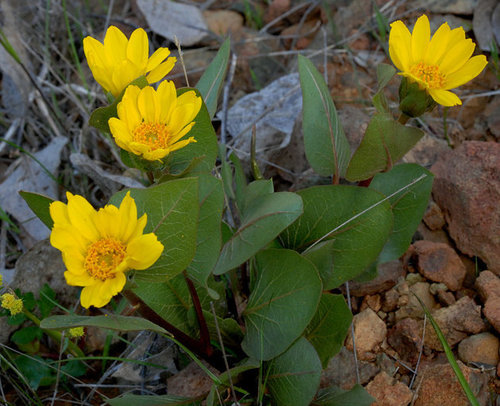
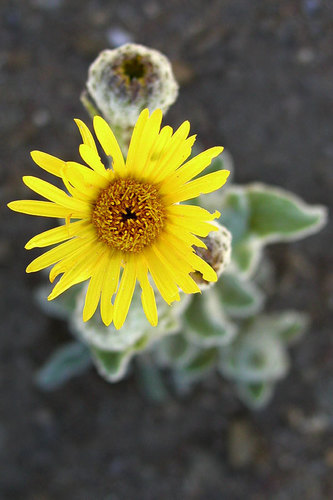
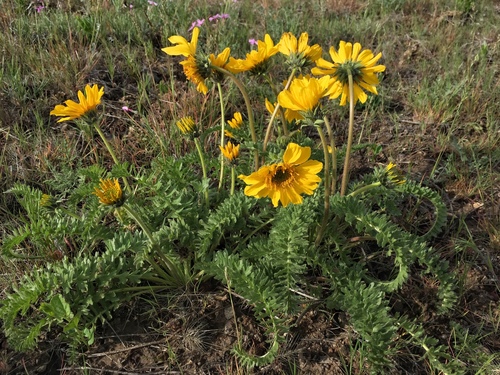
Balsamorhiza hookeri (Hook.) Nutt. has compound pinnate leaves, where the leaflet divisions are further divided or deeply lobed. Its hairy basal leaves can reach up to 16 inches (41 cm) in length. This plant may produce one to several leafless, hairy stems, each topped by a single flower. It blooms between April and July. Its flower heads are 1 to 3 inches (2.5 to 7.6 cm) wide, sunflower-like, with 10–21 fringe-tipped ray flowers and numerous disc flowers. Its flower bracts are covered in long hairs.
This species grows up to 9,000 feet (2,700 m) in elevation, inhabiting dry, grassy meadows within sagebrush steppe and montane plant communities of the Great Basin. It is common at much lower elevations in the scablands of central Washington State.
Compared to its close relative arrow-leaf balsamroot (Balsamorhiza sagittata), Balsamorhiza hookeri tends to grow in rockier habitats. It can hybridize with arrow-leaf balsamroot, which produces hybrid plants that have the arrow-shaped leaf form of Balsamorhiza sagittata paired with the deep leaf division of Balsamorhiza hookeri.
Balsamroots, including this species, have been used as food and medicine by Indigenous peoples for many years.