About Balsamorhiza deltoidea Nutt.
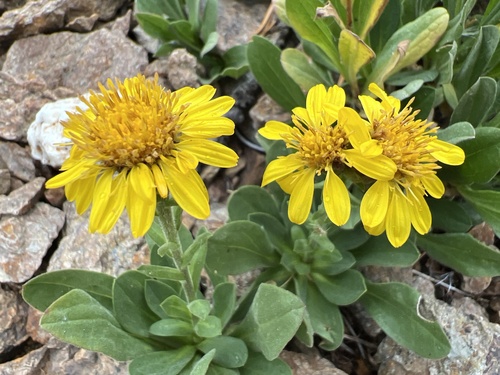
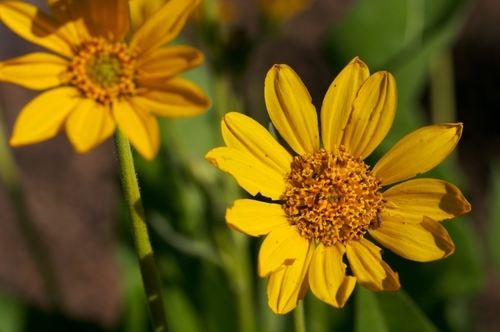
Balsamorhiza deltoidea Nutt. is a taprooted perennial herb that grows upright, reaching a maximum height of around 90 centimeters (35 inches). Its stems are covered in hairs and glandular. The species produces large leaves that grow up to 25 centimeters (9.8 inches) long and 20 centimeters (7.9 inches) wide. These leaves are roughly triangular in shape, hairy and glandular, and usually have toothed edges. The inflorescence typically holds one, or sometimes a small number of, large flower heads. Each flower head is lined with hairy, pointed phyllaries that can reach up to 4 centimeters (1.6 inches) long. The flower head has a center of yellowish disc florets, surrounded by a fringe of pointed yellow ray florets. Each ray floret can grow up to 4 or 5 centimeters (1.6 or 2.0 inches) long. The fruit of this species is an achene that measures 7 to 8 millimeters (0.28 to 0.31 inches) in length. Deltoid balsamroot, the common name of this species, has been used as a food and medicinal plant by Native Americans. Native Americans ate the seeds raw or cooked, and sometimes ground the seeds to make breads or cakes. The roots were also eaten raw or cooked, and roasted roots were used to make a coffee substitute. Young shoots of the plant were consumed as a fresh green vegetable. Roots were additionally used to treat colds.