About Balistoides conspicillum (Bloch & Schneider, 1801)
The clown triggerfish, scientific name Balistoides conspicillum (Bloch & Schneider, 1801), can grow up to 50 cm (19.7 inches) in the wild, but it does not usually reach this full length when kept in captivity. It has a stocky, oval body that is laterally compressed. Its large head makes up approximately one third of its total body length. The mouth is small, located at the end of the head, and holds strong teeth that grow continuously, an adaptation that helps it feed on crustaceans.
The first dorsal fin is made up of three spines, one of which is longer and stronger than the others. This fin is erectile and can be hidden in a dorsal furrow; the set of dorsal spines forms the characteristic trigger system that defines the family Balistidae. The second dorsal fin matches the shape and size of the symmetrically opposed anal fin. The pelvic fin is reduced to a small ventral protrusion.
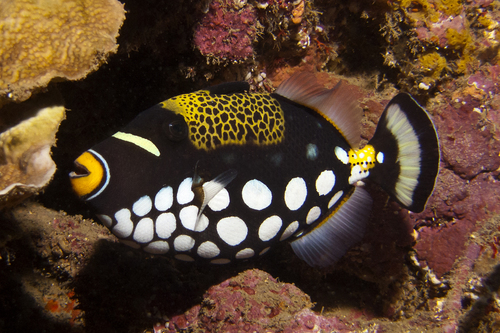
The fish has thick, rhomboid scales that overlap weakly. Each scale has two layers: the topmost layer is bone, and the lower layer is collagenous. Its base body color is black. The lower half of the body is marked with large, more or less round white spots. Yellowish winding lines form a net-like leopard pattern across the area around the first dorsal fin. There is a yellowish ring around the mouth, which is in turn surrounded by an outer white ring. A white stripe runs across the snout just below eye level. The second dorsal fin and anal fin are white, with a yellow line running along their base. The top of the caudal peduncle has a yellowish blotch and three horizontal rows of spiny scales. The caudal fin is yellowish in its center and has a black margin.
Juvenile clown triggerfish have a black base color covered in small scattered white spots. The tip of the snout and the base of the first dorsal fin are yellowish.
Clown triggerfish are widely distributed across tropical and subtropical waters of the Indian Ocean and the western Pacific Ocean, and have also been documented in the Red Sea, where their presence is most likely the result of aquarium release. A single record of the species from Mediterranean Sea waters off Spain was reported in 2012, which is also thought to be from an aquarium release. The species is most commonly found on clear-water external reef slopes at depths between 1 and 75 meters. Juveniles typically stay at depths greater than 20 meters, and live inside caves or under overhangs.