About Balistes capriscus Gmelin, 1789
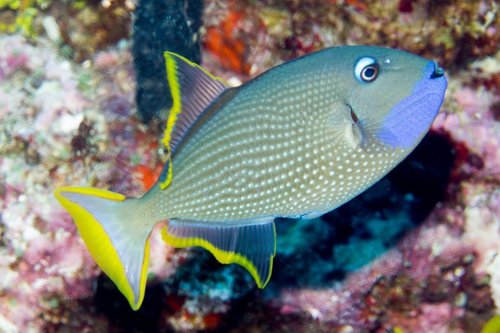
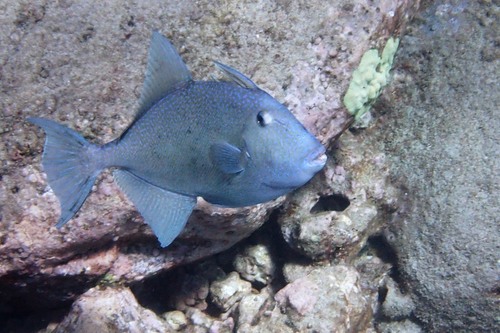
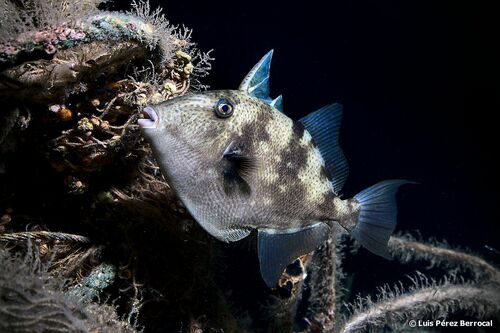
The grey triggerfish (Balistes capriscus Gmelin, 1789) is a medium-sized fish that can reach a maximum length of 60 cm (24 in), though a more typical adult length is 44 cm (17 in). It has a small, beak-like mouth tipped at the end of its snout, which features fleshy lips. Its eyes are set far back, positioned near the top of the head. The species has a laterally compressed, deep-bodied form covered in tough, leathery skin. Its front dorsal fin holds three spines, where the first spine is very strong and much longer than the other two. The second dorsal fin has 26 to 29 soft rays, and matches the size and shape of the anal fin located directly below it; the anal fin has no spines and contains 23 to 26 soft rays. Pectoral fins are small and rounded, and the outer rays of the caudal fin become elongated in larger individuals. Scales are large on the head and front half of the body, while scales on the hind half of the body are smaller and smoother. The grey triggerfish is most often pale grey, greenish-grey, or yellowish-brown. Its body has three unclear, broad dark bars, and there is a pale streak along the chin. The upper edge of the eye socket is blue, with small blue spots and lines present on the dorsal fins and upper sections of the body. Lower body sections sometimes have white dots and irregular lines. Both the second dorsal fin and the anal fin have a somewhat marbled color pattern. Body color fades slightly as the fish ages, with juvenile individuals being more colourful. The grey triggerfish is primarily a shallow-water fish native to the western Atlantic Ocean. Its native range stretches from Nova Scotia south to Argentina, and includes the Caribbean Sea, the Gulf of Mexico, and Bermuda. It typically lives over hard bottoms at reefs, rocky areas, lagoons, and bays, at depths down to approximately 55 m (180 ft). This species is also found across the Atlantic in the eastern basin: around the British Isles, in the Mediterranean Sea, and off the coast of Angola. It likely crossed the Atlantic via Gulf Stream water movement, and it is known to breed in the Mediterranean. It was once considered an uncommon visitor to northern European seas, but growing numbers of records along the Cornish coast suggest it may now be breeding there. In recent years, it has also been recorded in other areas along the coast of Great Britain, indicating its range is continuing to expand northward. One individual has even been caught as far north as the island of Tiree in the Inner Hebrides, Scotland.