About Balearica regulorum (E.T.Bennett, 1834)
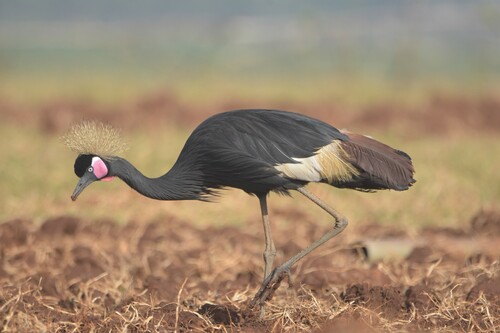
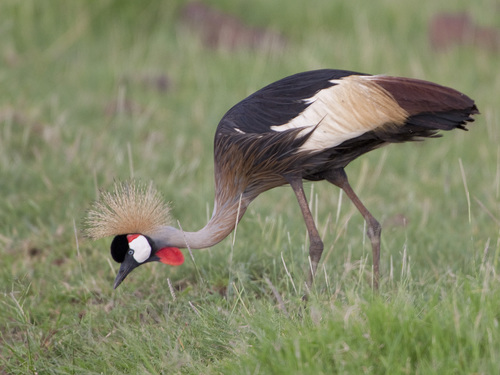
The grey crowned crane (scientific name Balearica regulorum (E.T.Bennett, 1834)) is approximately 1 m (3 ft 3 in) tall, weighs 3.5 kg (7.7 lb), and has a wingspan of 2 m (6 ft 7 in). Its body plumage is mainly grey. The wings are predominantly white, with sections of dark grey and dark red, plus a golden yellow patch. The head bears a crown of stiff golden feathers. The sides of the face are white, and it has a bright red inflatable throat pouch. Its bill is relatively short and grey, and its legs are black. It has long legs suited for wading through grasses. Its feet are large but slender, adapted for balance rather than defense or grasping. The sexes have similar appearance, though males tend to be slightly larger. Juvenile grey crowned cranes are greyer than adults, and have a feathered buff-colored face. This species and the black crowned crane are the only cranes able to roost in trees, because they have a long hind toe that can grasp branches. This trait is assumed to be an ancestral trait among cranes, which has been lost in the other crane subfamily. Compared to other cranes, crowned cranes also lack a coiled trachea and have looser plumage. The grey crowned crane lives in dry savannah across Sub-Saharan Africa, though it nests in somewhat wetter habitats. It can also be found in marshes, cultivated lands, and grassy flatlands near rivers and lakes from Uganda and Kenya as far south as South Africa. This species does not have fixed migration patterns. Birds living closer to the tropics are typically sedentary. Birds in more arid areas, particularly in Namibia, make localized seasonal movements during drier periods.